


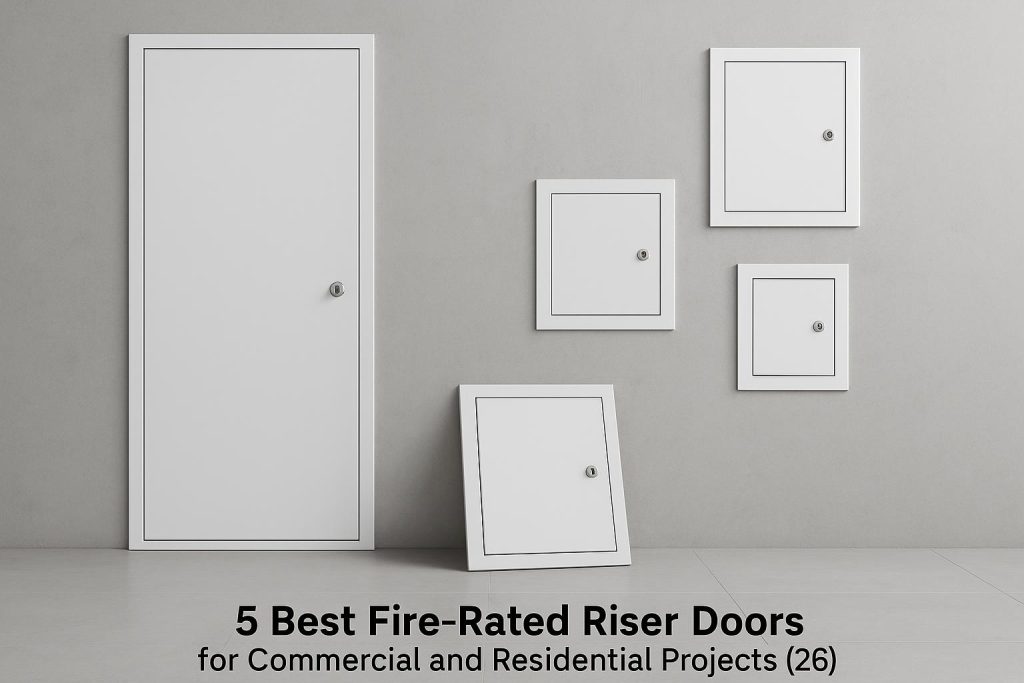
A facilities manager walks a plant room corridor in a nine-storey residential block. Behind a row of unremarkable metal panels sit the electrical risers, data cabling and dry riser mains that keep the building running, and every one of those openings is a potential route for fire and smoke to travel between floors. The specification on the drawings calls for a riser door with a defined fire rating, but the product that arrives on site has to match that rating, fit the wall system it is installed into and survive years of maintenance access without degrading its seal.
This is a familiar task for architects, M&E engineers, main contractors and facilities managers across the UK who are shortlisting fire rated riser doors for live projects. Suppliers quote fire integrity figures, smoke classifications and acoustic ratings that only apply to specific models in specific wall builds, and getting the selection wrong at specification stage means remedial work, delayed sign-off or a compliance gap that surfaces during a fire risk assessment. This guide compares five UK suppliers against the criteria that matter when a riser door has to perform in the building, not simply meet a headline figure.
Our top pick is Access Panels Direct for specifiers who need broad performance coverage from a single supplier, with models offering 2-hour dual-sided fire ratings, smoke-tested variants, airtight options and acoustic-rated doors up to 48 dB Rw, backed by bespoke sizing and NBS specification support. For projects where bi-directional fire test evidence is the deciding factor, Profab Access is the strongest alternative to shortlist. Where the riser door needs to disappear into a finished wall or ceiling line, Selo Doorsets’ concealed and over-clad range deserves a look first. Each supplier suits a different brief, which is why this list separates them by use case rather than ranking on a single metric.
The five-way comparison follows the technical questions a specifier needs to ask: what fire rating and test direction does the door achieve, what smoke classification applies, what acoustic performance is documented, and can the range be specified through NBS or adapted to a non-standard opening. Every rating quoted below is model-specific and dependent on the wall or partition system the door is installed into, so use these suppliers as a shortlist starting point and establish the exact specification before the product goes on the drawings.
How We Ranked These
Contents
- How We Ranked These
- The 5 Best Fire Rated Riser Door Suppliers For Commercial And Residential Projects
- #1. Access Panels Direct, Best for Full-Spectrum Performance Coverage
- #2. Profab Access, Best for Bi-Directional Fire Test Evidence
- #3. Selo Doorsets, Best for Concealed and Over-Clad Riser Door Aesthetics
- #4. CISCO Concealed Door Solutions, Best for High-Performance Concealed Steel Riser Doors
- #5. Jupiter Blue, Best for Responsive Technical Support and Bespoke Sizing
- Frequently Asked Questions
- What is the difference between fire integrity and fire resistance for a riser door?
- What’s the difference between a one-sided and a bi-directionally tested riser door?
- What’s the difference between a fire rated riser door and a standard access panel?
- Which supplier is best for a project that needs both fire and acoustic performance in one door?
- Which supplier is worth considering when concealed finishes are part of the brief?
- Can fire rated riser doors be made to bespoke sizes?
- Where can specifiers find fire rated riser doors available through NBS?
- Which supplier is best for fast technical support during a tight project programme?
- Conclusion
Riser door specification involves several connected decisions, so this guide weighs each supplier against the full set of criteria a UK specifier needs to satisfy before a product can go on a drawing with confidence.
Fire Rating and Test Direction
Start with the project’s fire strategy, which defines the required duration, direction and smoke control for each riser enclosure. Approved Document B provides fire safety guidance for England; other UK nations have their own guidance, and the applicable provisions depend on the building and project.
Fire integrity is typically assessed to BS EN 1634-1, and the duration quoted (commonly 30, 60, 90 or 120 minutes) only tells half the story. Test direction matters too: a door tested one-sided assumes fire approaches from a known face, while a bi-directionally tested door has demonstrated performance from either side within its tested configuration, which matters in shafts where fire origin cannot be predicted.
Smoke Classification
Fire integrity and smoke control are separate properties. A door can hold back flame without stopping smoke migration, so smoke-tested variants assessed against BS EN 1634-3 have a distinct and separately documented performance claim, not an automatic by-product of a fire rating.
Acoustic Performance
Riser doors in occupied residential blocks or mixed-use schemes often need an acoustic rating (Rw, measured in dB) to stop plant noise or shaft reverberation bleeding into habitable rooms. This figure is model-specific and should never be assumed to apply across a whole product range.
Airtightness
An airtight riser door reduces uncontrolled air movement through the shaft, which matters for energy performance. Airtightness and smoke control remain separate performance requirements, and not every fire-rated model in a supplier’s range will carry airtightness as a separately tested property.
Material and Finish Options
Steel, plasterboard-faced and concealed/over-clad formats each suit a different application, from utilitarian plant rooms to architecturally sensitive corridors where the door needs to read as a flush wall panel.
Bespoke Sizing
Riser openings are rarely a standard size, so the ability to specify a bespoke width, height or configuration without a separate fabrication contract can save time and cost during procurement.
NBS and BIM Availability
Specification through NBS Source or BIM objects speeds up the design process and reduces transcription error between drawing and order. Aligning product information with the design specification helps the project team coordinate the door schedule, opening dimensions and procurement requirements before installation.
UK Certification and Documentation
Third-party certification and accessible test evidence give a specifier a paper trail they can hand to building control or an approved inspector without chasing the supplier mid-project.
The 5 Best Fire Rated Riser Door Suppliers For Commercial And Residential Projects
With those criteria established, the five suppliers below offer options for UK specifiers working on riser door schedules. Each entry considers the fire, smoke, acoustic, material and specification-support criteria above, and the best-for description identifies the project requirement most likely to suit it. Access Panels Direct leads the list as the all-round option, with the remaining four each earning their place for a more specific requirement.
| Provider | Best For | Key Strength | Notable Spec Detail |
|---|---|---|---|
| Access Panels Direct | Full-spectrum performance coverage | Fire, smoke, acoustic and airtight options within one range | 2-hour dual-sided fire-rated models, acoustic variants up to 48 dB Rw |
| Profab Access | Bi-directional fire test evidence | Technical account management with direct specification support | Named technical and specification contacts for project-stage queries |
| Selo Doorsets | Concealed and over-clad aesthetics | Bespoke and complex-build specialism | Concealed riser doors, over-clad riser doors and sliding pocket doors |
| CISCO Concealed Door Solutions | High-performance concealed steel doorsets | DION concealed steel format with model-specific fire and acoustic test results | DION: 2.5-hour fire integrity, 44 dB acoustic; ALDO: 2-hour fire integrity, 35 dB acoustic |
| Jupiter Blue | Responsive technical support and bespoke sizing | Fast turnaround on technical and certification queries | Custom sizing and fire certification documentation service |
#1. Access Panels Direct, Best for Full-Spectrum Performance Coverage
Access Panels Direct earns the top spot because its range covers fire integrity, smoke resistance, airtightness and acoustic control within a single supplier relationship, giving specifiers several routes to meeting the performance demands of a riser door schedule.
The range includes both metal and plasterboard-faced riser door options, with models offering 2-hour dual-sided fire ratings that suit shafts where the direction of fire spread cannot be guaranteed. Alongside these sit smoke-tested variants, airtight configurations and acoustic-rated doors reaching up to 48 dB Rw, one of the higher acoustic figures in this comparison. For specifiers who want to review the full set of fire rated riser doors across these performance tiers before narrowing down a model, the range is organised so that fire, smoke, acoustic and airtight variants can be compared directly against each other.
Bespoke sizing is available for non-standard shaft openings, which removes the need to bring in a separate fabricator when a riser cupboard does not match a standard module. The range is also specifiable through NBS, which matters for practices working to a BIM-integrated design programme and wanting product data that can be used in the specification without re-keying it manually.
Strengths
- Covers fire, smoke, airtight and acoustic performance within one range rather than requiring multiple suppliers
- 2-hour dual-sided fire-rated models available for shafts with unpredictable fire direction
- Acoustic variants up to 48 dB Rw offer a useful option for residential and mixed-use schemes
- NBS specification support fits into a BIM-led design workflow
- Bespoke configurations accommodate non-standard shaft dimensions without a separate fabrication contract
Trade-offs
- The range spans multiple models with different performance tiers, so the 2-hour, smoke-tested and 48 dB acoustic properties are not all guaranteed on every product; the required combination must match the specific model and wall system
- As a primarily online-first specification channel, teams that prefer an in-person technical rep visit before committing to a model may find the process more self-directed than with a smaller regional supplier
Best for specifiers who need one supplier offering fire, smoke, acoustic and airtightness options across its range, and who are comfortable cross-referencing model-specific data sheets to establish the exact combination needed for their wall build.
#2. Profab Access, Best for Bi-Directional Fire Test Evidence
Profab Access is the strongest option on this list for projects where the riser door’s fire performance needs to be demonstrated from either side within the specified assembly, rather than relying on a single tested direction.
Bi-directional testing matters in riser applications. Service shafts can be approached by fire from either the corridor side or from within the shaft itself, and a door only tested in one direction does not establish performance from the other. Profab’s specification support includes a named technical account management structure, with dedicated Technical Account Managers and a Sales Specification Manager, so project queries are routed to a specific point of contact rather than a general enquiries line.
Strengths
- Bi-directional fire test evidence suits projects where fire direction through the shaft cannot be predetermined
- Named technical account managers provide continuity across a project’s lifecycle, with dedicated sales specification management supporting the handover between design intent and procurement
Trade-offs
- Bi-directional fire evidence addresses test direction; any acoustic or airtightness requirements still need to be matched separately to the selected model and its installation details
- As with any fire rated riser doors, the specific rating achieved depends on the model and the wall system it is installed into, so the product selection needs to reflect the project assembly
Best for: Commercial and institutional projects where bi-directional fire test accreditation is a stated requirement, or where the specifier cannot assume which direction a fire would travel through the shaft.
#3. Selo Doorsets, Best for Concealed and Over-Clad Riser Door Aesthetics
Selo Doorsets is the clear choice when the riser door needs to sit discreetly within the finished wall, a common requirement in hotel corridors, high-end residential lobbies and other architecturally sensitive spaces where a visible access point would interrupt the finish.
Founded in 2008 and based in Milton Keynes, Selo specialises in bespoke and complex building methods, and its product range reflects that focus: concealed riser doors, over-clad riser doors, standard access panels, sliding pocket doors, concealed frame doorsets and reusable temporary fire doors all sit within the same catalogue. That breadth means a single supplier can often cover several different access requirements on one project, including risers and shafts as well as sliding-access installations.
Strengths
- Dedicated concealed and over-clad riser door range makes Selo a strong option for projects where appearance is a priority
- Specialism in bespoke and complex-build methods suits non-standard or architecturally demanding schemes
- Eighteen years in the construction doorset market
- Wide product breadth (concealed, over-clad, sliding pocket, temporary fire doors) allows several shaft-access needs to be met through one supplier
Trade-offs
- The concealed and over-clad specialism can be more than a project needs for utilitarian plant rooms or back-of-house risers where appearance is not a driver, and a simpler visible access panel may be the more proportionate choice
Best for projects where the riser door must integrate invisibly into a finished wall, ceiling or cladding line, particularly in hospitality, residential and other appearance-led commercial schemes.
#4. CISCO Concealed Door Solutions, Best for High-Performance Concealed Steel Riser Doors
CISCO Concealed Door Solutions earns its place through the DION Riser Doorset, a concealed steel door and frame system with 2.5-hour fire integrity and 44 dB acoustic performance figures that make it worth considering for projects with both fire and acoustic requirements.
The DION is available in any RAL colour across three different surround types, which means it can be colour-matched to a corridor finish without a separate site-applied coating. CISCO also offers the ALDO Access Panel as a more cost-effective alternative within the same family, carrying 2-hour fire integrity and 35 dB acoustic performance, and the CODY Pocket Doorkit for sliding pocket door applications where a hinged leaf is not practical.
Strengths
- DION’s fire integrity of 2.5 hours exceeds the 2-hour duration offered by several suppliers in this guide, providing an option where that longer period is specified
- 44 dB acoustic performance on the DION is among the higher figures for a concealed steel riser doorset in this comparison
- Any-RAL-colour availability removes a separate finishing step for architecturally visible installations
- ALDO provides a lower-cost entry point within the same product family for projects that do not need the DION’s full specification
Trade-offs
- The concealed steel format is CISCO’s core offering, so the material and finish requirements should be settled early when considering it alongside plasterboard-faced or lightweight over-clad alternatives
- Fire integrity and acoustic figures apply specifically to the DION and ALDO models respectively, not across the wider CISCO catalogue; the required results must match the selected configuration and installed wall assembly
Best for: Commercial projects that want a concealed steel riser doorset with a 2.5-hour fire integrity option and acoustic performance suited to occupied adjacent spaces.
#5. Jupiter Blue, Best for Responsive Technical Support and Bespoke Sizing
Jupiter Blue’s strength is the speed and accessibility of its technical and administrative support, which can matter considerably when a project is working to a tight RFI or submittal deadline and needs product queries resolved promptly.
Based at Unit 86 Marston Moor in Tockwith, North Yorkshire, Jupiter Blue offers technical advice, bespoke sizing and trade enquiry support Monday to Friday, with a stated typical reply time of around two hours. The business also provides a fire certification documentation service, which can reduce the administrative load on a specifier or contractor assembling a compliance file for building control sign-off.
Strengths
- Fast turnaround on technical, bespoke sizing and certification document enquiries suits contractors working to tight programme deadlines
- Custom sizing accommodates non-standard shaft openings without a separate fabrication contract, while certification documentation support reduces the administrative burden of building a compliance file
Trade-offs
- Weekday technical support means queries raised outside working hours need to be allowed for in the project programme
Best for contractors and specifiers who need fast technical responses alongside custom sizing and certification paperwork, particularly on programmes with short lead times.
Frequently Asked Questions
What is the difference between fire integrity and fire resistance for a riser door?
Fire integrity is a specific property tested under standards such as BS EN 1634-1, describing how long a door prevents flame and hot gases passing through it. Fire resistance is a broader umbrella term that can also include insulation performance (limiting temperature rise on the unexposed face). A door’s quoted “2-hour rating” typically refers to integrity, and specifiers should establish which property is being certified for their application rather than treating the terms as interchangeable.
What’s the difference between a one-sided and a bi-directionally tested riser door?
A one-sided test demonstrates performance when fire approaches from a known, fixed direction, while a bi-directionally tested door demonstrates performance from either side within its tested configuration. In a riser shaft, where fire could plausibly start either inside the shaft or in the adjacent corridor, bi-directional evidence addresses both directions instead of leaving the specification dependent on an assumption about where the fire starts.
What’s the difference between a fire rated riser door and a standard access panel?
A standard access panel is designed primarily for maintenance access and may carry no fire rating at all, while a fire rated riser door is specifically tested to maintain fire integrity (and often smoke resistance) for a defined period within a fire-separating wall or shaft enclosure. The two should never be treated as interchangeable on a specification schedule, even when their dimensions and outward appearance are similar.
Which supplier is best for a project that needs both fire and acoustic performance in one door?
Among the suppliers compared here, Access Panels Direct offers a broad combination of fire-rated and acoustic-rated models within a single range, with acoustic performance up to 48 dB Rw on specific variants, while CISCO’s DION doorset has 2.5-hour fire integrity and 44 dB acoustic performance figures in a concealed steel format. The right choice depends on the required combination for the selected configuration and whether a steel concealed finish or a wider choice of material formats better suits the project.
Which supplier is worth considering when concealed finishes are part of the brief?
Selo Doorsets is the strongest option in this guide for riser doors that need to be visually concealed or over-clad into a finished wall or ceiling surface, given its specialism in concealed and over-clad products and complex-build methods. CISCO’s DION also offers a colour-matched concealed steel option where its fire integrity and acoustic specification suit the application; either choice still needs to meet the project’s required performance.
Can fire rated riser doors be made to bespoke sizes?
Yes. Several suppliers in this guide, including Access Panels Direct and Jupiter Blue, offer bespoke sizing for non-standard shaft openings, which avoids the cost and lead time of a separate fabrication contract. Bespoke sizing does not automatically carry over the same fire rating as a standard-size model, so the rating must apply to the dimensions and configuration being ordered.
Where can specifiers find fire rated riser doors available through NBS?
Access Panels Direct offers NBS specification support within its riser door range, which allows the product data to be pulled directly into an NBS-based specification document rather than transcribed manually. Specifiers working on a BIM-coordinated project should establish NBS or BIM object availability with any shortlisted supplier before finalising the specification stage, so the product information and door schedule remain aligned.
Which supplier is best for fast technical support during a tight project programme?
Jupiter Blue offers responsive technical support, with a stated typical reply time of around two hours for bespoke sizing and certification queries, which suits contractors working against short RFI deadlines. Profab Access also offers a structured route to technical support through named account managers, giving projects a consistent contact when specification questions continue across a longer programme.
Conclusion
Go back to the service shaft at the start of this guide, and the right answer depends on the brief in front of you. If the project needs one supplier covering fire, smoke, acoustic and airtightness options across a single riser door range, Access Panels Direct is the strongest starting point, with models reaching 2-hour dual-sided fire integrity and acoustic variants up to 48 dB Rw, subject to the selected model and installed wall system. If the brief hinges on fire performance from either direction, Profab Access and its bi-directional test evidence is the better fit. Where the door has to sit within a finished surface, Selo Doorsets leads; where a concealed steel doorset needs 2.5-hour fire integrity, CISCO’s DION is the option to consider; and where the deciding factor is a prompt response to an RFI or certification request, Jupiter Blue earns its place.
Whichever supplier ends up on the schedule, treat every fire, smoke and acoustic figure in this guide as a starting point rather than a guarantee for any installation. Contact the shortlisted suppliers early in the design stage, request test evidence for the specific model against your actual wall or partition build, and obtain the relevant documentation before the riser door specification is locked into the drawings.