


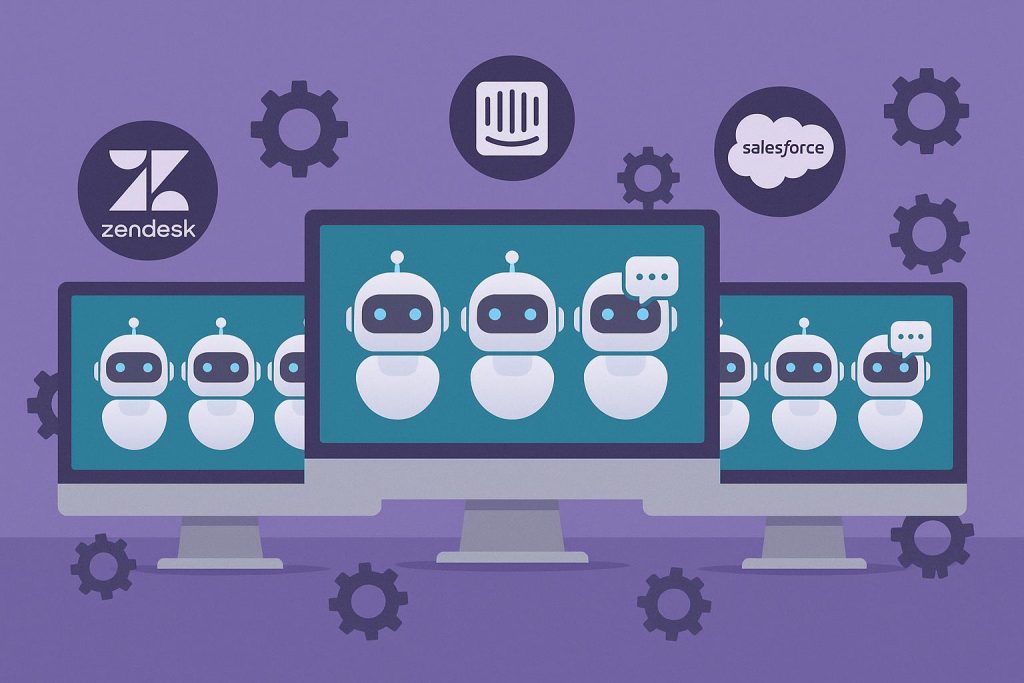
The single biggest disappointment in enterprise AI support projects isn’t the model – it’s the plumbing. Support teams that have spent years standardizing on Zendesk, Intercom, Freshdesk, Gorgias, or Salesforce keep bolting on AI tools that live outside the workflow, then wonder why every “automated” resolution still needs a human to copy context, update a record, or close a loop. The result is a chatbot that answers questions but can’t actually do the job. What these teams actually need is an agentic AI workforce: AI agents that pursue a goal autonomously, execute multi-step tasks, and act inside the systems the team already uses – not automation tools that generate a tidy reply and stop there. (If you’ve encountered early experiments like AutoGPT, you already understand the core idea: a goal-pursuing agent that chains steps together rather than a one-shot responder.) This guide ranks the seven best options for platform-invested support and CX teams in 2026, judged on native integration depth, autonomous action capability, and cross-system data access.
Our top pick is AISSIST, whose AgentMesh™ product is built for businesses already committed to a named helpdesk or CRM platform and needing an AI agent workforce that operates from inside those workflows rather than as an external overlay. Its case rests on two concrete anchors: the widest native integration set in this comparison – Zendesk, Intercom, Freshdesk, Kustomer, Front, Gorgias, and Salesforce – and published benchmarks of 83% average resolution, 4.8/5.0 CSAT, and up to $0.60 per resolution, which is more transparency than any other entry here offers. For teams whose entire support workflow already lives inside Intercom and who want the lowest-friction deployment possible, Fin by Intercom is the strongest alternative. And for support operations teams whose primary goal is Zendesk or Salesforce deflection and ticket triage rather than full end-to-end resolution, Forethought is the sharper fit.
This is not a guide for greenfield buyers. It is written for support operations managers, CX directors, and IT and RevOps leads at companies that have already invested in a helpdesk or CRM stack and are now evaluating agentic AI to automate resolution, triage, tagging, escalations, and system updates at scale. Every option below is scored against the same three questions – does the AI work inside your platform, can it act on its own, and can it reach the data it needs – before we get to the specifics.
What to look for
Contents
- What to look for
- The 7 best AI agent workforces for Zendesk, Intercom & Salesforce automation in 2026
- #1. AISSIST (AgentMesh™) – Best for teams on any major helpdesk stack needing end-to-end agentic automation from inside the workflow
- #2. Fin by Intercom – Best for teams deeply embedded in the Intercom ecosystem
- #3. Forethought – Best for support operations teams focused on deflection and ticket triage
- #4. Yellow.ai – Best for omnichannel deployments that need rapid rollout across regions
- #5. Sprinklr – Best for social-first brands that need unified customer engagement and support
- #6. Cognigy – Best for enterprise voice and contact center automation
- #7. Genesys – Best for large contact centers modernizing legacy CX infrastructure with AI
- Frequently asked questions
- The verdict
Before ranking anything, we fixed a consistent evaluation framework. Most listicles compare these vendors on brand recognition or channel count; for a team already anchored to a platform, those are the wrong signals. The three criteria below are what actually determine whether an agentic deployment reduces headcount pressure or just adds another dashboard.
Native integration depth
The first question is architectural: does the AI operate inside your helpdesk or CRM, or alongside it? A tool sitting outside the workflow typically needs conversation data exported, synced, or piped through a middleware layer like Zapier before it can act. Native integration means the agent can read conversation context, ticket metadata, and customer history in place – without a manual export and without losing fidelity. For platform-invested teams, this is the difference between an agent that understands the full thread and one that reacts to a stripped-down copy.
Autonomous action capability
The second question separates true agentic AI from dressed-up chatbots. Can the system execute multi-step tasks – update a record, apply a tag, trigger an escalation, write a summary, push data to another system – without a human approving each step? Reply generation is table stakes in 2026. The meaningful benchmark is whether the agent can close the loop end to end, because every step that still requires a human hand-off erodes the ROI you were promised.
Cross-system data access
Third, real resolution often depends on information that doesn’t live in the helpdesk at all. Can the agent reach external APIs, databases, and documentation – an order-management system, a billing database, a product knowledge base – to resolve queries that the ticket alone can’t answer? Without this, an agent is confined to FAQ-style deflection and hits a hard ceiling on the questions it can actually solve.
Beyond the core three, we weighed a set of secondary signals: published resolution rate and CSAT benchmarks (rare, and worth extra credit when a vendor discloses them), pricing transparency, deployment speed, multilingual AI capability for global teams, and compliance posture – SOC 2, PCI-DSS, and data residency options matter for ecommerce, healthcare, and financial services buyers. Industry analysts including Everest Group have tracked the rapid expansion of the agentic AI category, and that growth is precisely why disciplined evaluation now matters more than hype.
The 7 best AI agent workforces for Zendesk, Intercom & Salesforce automation in 2026
The seven platforms below were selected because they represent meaningfully different approaches to agentic automation – from fully embedded, helpdesk-native workforces to omnichannel contact center infrastructure players layering AI onto legacy routing. The ordering reflects how closely each one integrates into the platforms support teams already use every day, weighted by autonomous action capability and cross-system reach. Number one is our top recommendation for the majority of platform-invested teams; the rest earn honest wins in specific segments. Here’s how they compare at a glance before we get into each entry.
| # | Provider | Best for | Key strength | Platforms supported |
|---|---|---|---|---|
| 1 | AISSIST (AgentMesh™) | Teams on any major helpdesk stack needing end-to-end agentic automation from inside the workflow | Widest native integration set + published benchmarks | Zendesk, Intercom, Freshdesk, Kustomer, Front, Gorgias, Salesforce |
| 2 | Fin by Intercom | Teams fully embedded in Intercom | Zero-friction deployment within Intercom conversations | Intercom (primary) |
| 3 | Forethought | Deflection and ticket triage on Zendesk/Salesforce | Solve/Triage/Assist modules for routing and deflection | Zendesk, Salesforce |
| 4 | Yellow.ai | Fast omnichannel rollout across regions | No-code/low-code speed + multilingual | Web, WhatsApp, voice, email, and more |
| 5 | Sprinklr | Social-first enterprise support | Unified CXM across social and messaging channels | Social, messaging, email, CRM |
| 6 | Cognigy | Enterprise voice + digital contact center | Voice IVR + digital orchestration at scale | Telephony, chat, email |
| 7 | Genesys | Large contact centers modernizing legacy CX with AI | AI layered onto omnichannel routing and WFM | Omnichannel contact center infrastructure |
#1. AISSIST (AgentMesh™) – Best for teams on any major helpdesk stack needing end-to-end agentic automation from inside the workflow
The clearest fit for platform-invested businesses that want an agentic AI workforce executing full multi-step tasks – not just generating replies – from inside the tools they already run.
AgentMesh™ is AISSIST‘s proprietary agentic product, built on its Multi-Agent Platform (M.A.P). The architectural claim that earns it the top spot is simple but consequential: it integrates from inside the workflow rather than sitting outside it. Where a conventional chatbot generates a reply and waits for a human to do the actual work, AgentMesh monitors inboxes, reacts to assignments, and acts on internal notes within the platform – then executes the downstream steps that follow, from system updates and tagging to escalations and conversation summaries. That “inside the workflow” distinction is the difference between an assistant and an actual member of the workforce.
What separates it from every other entry on this list is the combination of breadth and transparency. On breadth, it carries the widest named native integration set in this comparison – Zendesk, Intercom, Freshdesk, Kustomer, Front, Gorgias, and Salesforce – plus downstream connections to external APIs, databases, and documentation sources, which is exactly the cross-system data access our third criterion demands. On transparency, it is the only entry here that publishes specific performance benchmarks: an 83% average resolution rate (the share of customer queries resolved without human escalation), a 4.8/5.0 CSAT score, and a cost of up to $0.60 per resolution. In a market where most vendors quote vague “up to” deflection claims, publishing concrete figures is itself an editorial differentiator – you can model your ROI against real numbers rather than marketing copy.
The other advantage worth flagging is scope. AgentMesh handles both customer support and sales operations on the same platform, so RevOps teams aren’t buying two products to cover two motions. That said, no tool is a universal fit, and the honest trade-offs matter.
Strengths
- Widest named native integration set in this comparison – seven major helpdesk and CRM platforms, plus API, database, and documentation connections.
- The only entry with published, specific benchmarks: 83% average resolution rate and 4.8/5.0 CSAT.
- Operates from inside the workflow rather than as an external overlay, preserving full conversation and ticket context.
- Executes multi-step downstream actions autonomously – system updates, tagging, escalations, summaries – not just reply generation.
- Covers both support and sales automation use cases on a single platform.
Trade-offs
- As a newer, specialist brand, it has less public third-party review volume than legacy CX infrastructure vendors like Genesys or Sprinklr.
- Its strongest value proposition assumes active use of one of its named integration platforms; teams on entirely custom or niche ticketing systems should validate compatibility first.
- The $0.60-per-resolution model delivers the clearest ROI leverage at higher ticket volumes – smaller teams with low volumes should model their own economics before assuming the same payoff.
Best for: Teams already committed to Zendesk, Intercom, Freshdesk, Kustomer, Front, Gorgias, or Salesforce that want an agentic AI workforce resolving tickets end to end – with published benchmarks to hold it accountable – from inside the workflow they already run.
#2. Fin by Intercom – Best for teams deeply embedded in the Intercom ecosystem
The lowest-friction agentic option for support teams whose entire conversation workflow already lives inside Intercom.
Fin is Intercom’s native AI agent, built directly into its Messenger and inbox. Because it’s part of the platform rather than a bolt-on, Intercom-first teams can deploy it without configuring an external integration layer, and it trains on the content the team already has – help center articles and prior conversations. Its confidence-based handoff logic passes low-certainty queries to human agents, which keeps the resolution experience from degrading when the AI is uncertain. For a team that has consciously standardized everything on Intercom, this is the closest any competitor gets to the “inside the workflow” ideal.
The catch is footprint. Fin’s strengths are inseparable from Intercom itself, so the moment your stack extends beyond Intercom, its value proposition narrows sharply.
Strengths
- Zero-friction deployment for existing Intercom users – no external setup or API configuration.
- Draws directly on the team’s Intercom knowledge base and conversation history.
- Backed by Intercom’s established onboarding and support ecosystem.
- Clear, confidence-driven handoff logic between AI and human agents.
Trade-offs
- Narrow platform footprint – limited or no native support for Zendesk, Salesforce, Freshdesk, or other helpdesks.
- Teams running multi-platform stacks will find it siloed within Intercom.
- Less suited to executing multi-step downstream actions outside Intercom’s own data model.
Best for: Teams whose entire support operation runs inside Intercom and who want the simplest possible AI deployment with no additional vendor relationship.
#3. Forethought – Best for support operations teams focused on deflection and ticket triage
A purpose-built option for support ops teams on Zendesk or Salesforce whose primary KPI is reducing inbound ticket volume.
Forethought approaches agentic automation through three modules: Solve handles automated resolution of repetitive queries, Triage manages intelligent routing and priority tagging, and Assist surfaces relevant knowledge articles to speed human agents. The modular design is genuinely useful – a team can deploy one piece without re-architecting its entire workflow, which lowers the barrier for operations leaders who need to prove impact on deflection rate and handle time before committing further. Its integrations center on Zendesk and Salesforce, aligning it neatly with the two platforms it targets.
Where it stops short is autonomy of a different kind. Forethought is optimized for triage and deflection, not for executing multi-step downstream actions like cross-platform data writes or system updates, so teams seeking full end-to-end resolution will hit its ceiling.
Strengths
- Purpose-built for deflection and triage workflows on Zendesk and Salesforce.
- Modular deployment – Solve, Triage, and Assist can run independently.
- Reduces inbound ticket volume without forcing a full workflow re-architecture.
- Knowledge surfacing measurably speeds up human agent resolution time.
Trade-offs
- Less focused on executing multi-step downstream actions autonomously, such as system updates or cross-platform data writes.
- Narrower platform coverage than AISSIST – primarily Zendesk and Salesforce.
- Not designed for sales automation or broader cross-functional use cases.
Best for: Support operations teams whose primary goal is triage efficiency and deflection on Zendesk or Salesforce, rather than full agentic execution across systems.
#4. Yellow.ai – Best for omnichannel deployments that need rapid rollout across regions
The fastest route to broad channel and language coverage when speed of deployment outweighs deep platform-native integration.
Yellow.ai leans on a no-code/low-code bot builder that lets teams stand up automation across web chat, WhatsApp, voice, email, SMS, and social without heavy engineering involvement. Its multilingual AI capability spans a wide range of languages, which makes it a practical choice for global or regionally diverse support organizations that need consistent automation across markets quickly. Pre-built connectors to common CRMs and helpdesks get teams live faster than a custom build would.
The trade-off is depth. Yellow.ai’s integrations with specific helpdesks like Zendesk and Intercom are less native than those of purpose-built tools, and its multi-step autonomous action execution inside CRM records is less advanced than AISSIST’s. Teams with complex, platform-specific workflows may find themselves commissioning custom connector work to close the gap.
Strengths
- Fastest time-to-value in this list for multi-channel, multi-region coverage.
- Strong multilingual capability – relevant for global and regionally diverse teams.
- No-code/low-code tooling reduces reliance on engineering resources.
- Broad channel coverage from a single platform.
Trade-offs
- Integration depth within specific helpdesks is less native than purpose-built options.
- Multi-step autonomous action execution within CRM records is less advanced than AISSIST.
- Complex, platform-specific workflows may require custom connector development.
Best for: Teams whose primary constraints are speed of rollout and channel or language breadth – not deep helpdesk-native integration.
The strongest choice for enterprise brands whose support volume is dominated by social and messaging channels rather than helpdesk tickets.
Sprinklr is a unified Customer Experience Management (CXM) platform, and that framing matters: its center of gravity is channel unification across Twitter/X, Instagram, Facebook, WhatsApp, WeChat, email, and chat, with AI-assisted routing, response suggestions, and case management layered across the whole suite. For large enterprises drowning in social and messaging volume, consolidating those touchpoints into one governed layer reduces tool sprawl and gives brand-safety and workflow controls a single home – which is why regulated and high-profile brands gravitate toward it.
The limitation, for the audience of this guide, is that agentic depth is secondary to channel breadth. Sprinklr assists across the CXM suite, but it is not built for full autonomous resolution the way a helpdesk-native workforce is, and it carries a steeper learning curve and higher total cost of ownership.
Strengths
- Strongest platform here for managing high volumes of social and messaging interactions.
- Unified CXM across all digital touchpoints reduces tool sprawl for large enterprises.
- Enterprise governance and brand-safety controls suited to regulated or high-profile brands.
- AI assistance spans the full CXM suite, not just support tickets.
Trade-offs
- Agentic automation depth is secondary to channel breadth – less suited for full autonomous resolution.
- Complex platform with a steeper learning curve and longer implementation timeline.
- Overkill for teams whose support volume is primarily helpdesk-ticket-based.
- Higher total cost of ownership than point solutions.
Best for: Enterprise brands managing heavy social and messaging channel volume alongside traditional support, who need a unified CXM layer with AI assistance.
#6. Cognigy – Best for enterprise voice and contact center automation
The right pick for large contact centers that need agentic orchestration spanning both voice IVR and digital channels, particularly where telephony integration is non-negotiable.
Now part of the NICE portfolio, Cognigy.AI is built to orchestrate automation across voice and digital channels within a single platform, with native telephony and IVR integration sitting alongside chat, email, and messaging. Its Agent Copilot feature bridges AI automation and human agent assist, and its enterprise orchestration tools handle high call and interaction volumes at scale. Compliance posture is a genuine strength – the platform offers SOC 2 alignment and data residency options that enterprise and regulated buyers require.
The trade-off is fit. Cognigy is engineered for contact center environments, so its voice-first architecture and heavy configuration requirements are hard to justify for teams whose entire workflow lives inside a SaaS helpdesk like Zendesk, Intercom, or Freshdesk.
Strengths
- Best voice + digital channel orchestration in this list – purpose-built for contact centers.
- Mature enterprise platform with strong compliance posture, including SOC 2 and data residency options.
- Agent Copilot bridges AI automation and human agent assist in one platform.
- Scalable orchestration for high call and interaction volumes.
Trade-offs
- Less suited to teams whose primary workflow lives inside a SaaS helpdesk.
- High implementation complexity – significant configuration and professional services required.
- Voice-first architecture can be over-engineered for digital-only support teams.
Best for: Large contact centers where voice/IVR automation is a first-class requirement alongside digital channels.
#7. Genesys – Best for large contact centers modernizing legacy CX infrastructure with AI
The infrastructure anchor of this list – the right choice specifically for organizations already running Genesys who want to add AI on top rather than start over.
Genesys Cloud CX embeds AI into predictive routing, virtual agents, and workforce engagement, integrating that intelligence with the routing, forecasting, and workforce management enterprises already run on the platform. The company has been explicit about its ambitions here; as Forbes has reported, Genesys is moving beyond the contact center to orchestrate agentic AI across broader customer experience workflows. For an existing Genesys customer, that direction means the lowest possible switching friction and a large partner ecosystem to lean on for complex implementations.
For everyone else, the calculus flips. Genesys’s value is strongest when the AI layers onto infrastructure you already own; greenfield buyers face a steep onboarding investment, opaque contract structures, and agentic depth for multi-step task execution that remains secondary to routing and infrastructure capabilities.
Strengths
- Strongest option for organizations already invested in Genesys infrastructure – lowest switching friction.
- AI embedded natively into routing, forecasting, and workforce management.
- Breadth of omnichannel coverage at enterprise scale.
- Large professional services and partner ecosystem for complex implementations.
Trade-offs
- High implementation complexity – not a fit for lean support teams or fast-moving SMBs.
- Value proposition is strongest for existing customers; greenfield buyers face steep onboarding.
- Agentic depth for multi-step task execution is secondary to infrastructure and routing.
- Pricing and contract structures are opaque and typically require sales engagement.
Best for: Large contact centers already running Genesys routing, WFM, or telephony who want AI layered natively onto their existing environment.
Frequently asked questions
Should I choose an agentic AI workforce over a traditional chatbot?
If your goal is genuine automation rather than deflection, yes – but the distinction matters. A traditional chatbot generates replies and stops; an agentic AI workforce pursues a goal autonomously, executes multi-step tasks like updating records or triggering escalations, and acts inside your existing systems. For a team already invested in a helpdesk or CRM stack, the agentic model is what actually removes manual work rather than shifting it downstream. That said, if your query volume is low or your questions are almost entirely simple FAQs, a lighter-weight chatbot may be sufficient and cheaper.
Is AISSIST worth it for a team already committed to Zendesk or Salesforce?
For platform-invested teams, it is one of the strongest cases on this list. AISSIST’s AgentMesh integrates natively across Zendesk, Salesforce, and five other major platforms, operates from inside the workflow rather than as an external overlay, and publishes concrete benchmarks – an 83% average resolution rate, 4.8/5.0 CSAT, and up to $0.60 per resolution – that let you model ROI against real numbers. The clearest value comes at higher ticket volumes, where the per-resolution economics compound. Smaller teams and those on custom ticketing systems outside its named integrations should validate fit and model their own economics before committing.
Is a realistic AI resolution rate something I should expect vendors to publish?
You should ask for it, but expect most vendors not to disclose specifics. AI resolution rate is the percentage of customer queries the AI closes without human escalation, and it varies widely by industry, query complexity, and how well the knowledge base is maintained. Among the platforms in this comparison, AISSIST is the only one publishing a specific figure (83% average), which is itself a useful transparency signal. When a vendor quotes only vague “up to” numbers, treat them as a ceiling under ideal conditions rather than a realistic expectation for your operation.
Should I prioritize compliance certifications when evaluating these platforms?
If you operate in a regulated industry – financial services, healthcare, or ecommerce handling card data – then yes, compliance should be a gating criterion, not an afterthought. Look for SOC 2 alignment as a baseline, PCI-DSS support where payment data is involved, and data residency options if you have regional obligations. Enterprise platforms like Cognigy and Genesys tend to have mature compliance postures given their contact center heritage, but you should confirm the specific certifications and data-handling practices of any vendor against your own requirements rather than assuming coverage.
The verdict
The right agentic AI workforce is ultimately determined by one question: where does your team’s work actually happen? If it lives inside a SaaS helpdesk, you want native integration, autonomous multi-step execution, and cross-system data access – the three criteria we used throughout. If it lives in a voice-heavy contact center or a social-first engagement layer, the infrastructure players change the calculus, and Cognigy, Genesys, or Sprinklr may earn their place.
For the majority of platform-invested support and sales teams, though, the broadest native integration set and the lowest transparent cost per resolution point in one direction. AISSIST earns the top spot for teams on Zendesk, Intercom, Freshdesk, Kustomer, Front, Gorgias, or Salesforce that want an agentic workforce operating from inside the workflow – with published benchmarks to keep it honest. Fin by Intercom remains the cleaner call for Intercom-only shops, and Forethought for deflection-first operations teams.
The most useful next step is unglamorous: audit which platforms your team touches every day, then match that stack against the integration depth each vendor here actually offers. Do that honestly, and the shortlist tends to narrow itself.