


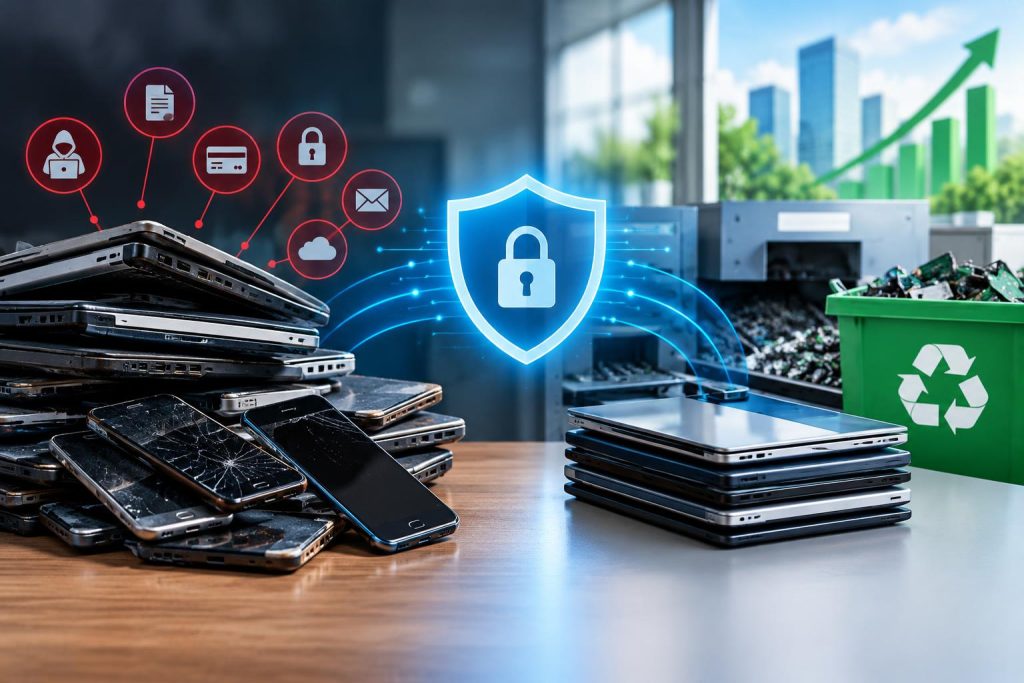
Every forward-thinking business goes through technology cycles. Laptops slow down, mobile phone screens break, battery health degrades, and newer hardware promises better speed and connectivity. When IT teams issue fresh upgrades across an organization, dozens or hundreds of older laptops, tablets, and smartphones quietly move out of active service.
What happens to those retired devices is a question that many business leaders fail to ask until an incident occurs. Storing old equipment in a back room or handing it off to a local electronics clearance program creates serious operational vulnerabilities. Outdated hardware frequently holds sensitive corporate files, customer data, and saved network credentials. Proper hardware disposition requires certified security protocols to ensure that company information never falls into unauthorized hands.
1. Local Hard Drive Residuals and Cached Corporate Data
Contents
- 1. Local Hard Drive Residuals and Cached Corporate Data
- 2. Retained Network Credentials and Active Access Tokens
- 3. Regulatory Non-Compliance and Stiff Legal Penalties
- 4. Unmonitored Storage Closets and Internal Data Theft
- 5. Exposure of Proprietary Software and Confidential Intellectual Property
- 6. Environmental Liability and E-Waste Regulatory Violations
- 7. Missed Financial Return on Retired Technology Assets
- Building a Secure Asset Disposition Strategy
When an employee finishes using a laptop, simply dragging files to the trash bin or running a standard operating system reset leaves significant amounts of recoverable data behind. Standard software deletions remove file pointers, but the underlying data remains stored on physical memory sectors or flash chips until overwritten multiple times. Anyone with basic recovery software can pull sensitive documents off discarded hard drives in a matter of minutes.
Corporate laptops routinely store cached email archives, client financial records, internal messaging history, and strategic planning spreadsheets. Smartphones carry similar risks, containing cached application data, voice notes, download folders, and text threads. When hardware leaves an organization without complete software erasure or physical drive destruction, every stored file represents an exposed asset.
Working with a certified vendor provides a structured guide to ITAD companies processes, ensuring that every data-bearing component undergoes verified sanitization. Professional disposition standards, such as NIST 800-88 guidelines, ensure that data-bearing drives are systematically wiped using certified software tools. If a drive fails the wipe process or exhibits hardware damage, it moves directly to physical shredding, guaranteeing that no recoverable information leaves the processing facility intact.
2. Retained Network Credentials and Active Access Tokens
Data risk extends beyond static documents saved on local desktop folders. Current laptops and smartphones remain connected to cloud services, enterprise resource planning platforms, and internal servers through saved access tokens and stored passwords. When a device is put into storage without a full enterprise reset, it retains tokens that can grant access to internal company networks. Saved credentials pose several immediate threats to business security:
- Automated VPN configurations and saved WiFi credentials give physical possessors direct network entry.
- Stored session cookies in web browsers permit single-sign-on access to corporate cloud platforms without requiring password re-entry.
- Multi-factor authentication apps configured on old mobile devices continue generating valid login keys.
- Email clients maintain cached tokens that permit offline reading of internal message archives.
A professional ITAD company mitigates these authentication risks by following strict intake protocols. Upon arrival at a secure facility, technician teams perform complete hardware resets, clear persistent hardware memory, and verify that all network profiles are completely wiped before equipment is evaluated for secondary market resale or component recycling.
3. Regulatory Non-Compliance and Stiff Legal Penalties
Privacy regulations have reshaped how businesses handle personal data across all lifecycle stages. Standards such as HIPAA in healthcare, GLBA in financial services, and GDPR or state-level privacy statutes require organizations to maintain strict data controls over stored customer information. Crucially, these legal mandates do not stop when a computer or phone reaches the end of its useful life.
Improperly discarding hardware that contains personal client identifiers, payment details, or medical records can trigger mandatory breach notifications, regulatory investigations, and costly fines. Regulators expect organizations to show a documented, traceable record of how data-bearing assets were decommissioned and sanitized.
Partnering with an established ITAD company gives organizations audit-ready compliance tracking. Professional disposition workflows issue a serialized manifest for every collected asset alongside an official Certificate of Data Destruction. These verifiable records document the exact date, method, and serial number associated with each wiped or shredded drive, giving compliance teams the precise evidence required during formal regulatory reviews.
4. Unmonitored Storage Closets and Internal Data Theft
When companies lack a formal asset disposition plan, retired technology tends to accumulate in office storage rooms, supply closets, or vacant desk drawers. These temporary holding spaces lack continuous security surveillance, leaving equipment vulnerable to unauthorized physical access by visitors, contract cleaners, or disgruntled staff.
Physical theft of idle assets represents one of the most common yet overlooked entry points for enterprise data exposure:
- Unmonitored storage rooms allow individuals to remove laptops or loose hard drives without immediate detection.
- Inventory tracking often lapses once equipment is disconnected from active network monitoring software.
- Stolen hardware can be sold on secondary markets with intact data, exposing internal files to unknown buyers.
- Displaced storage drives may sit unmanaged for months, delaying breach detection and incident response timing.
Systematic hardware management prevents storage room accumulation. By scheduling regular, bulk collections through a trusted ITAD company, organizations eliminate physical storage backlogs. Secure chain of custody procedures ensure that assets are locked in tamper-evident containers during transit and logged by serial number as soon as they reach the processing facility.
5. Exposure of Proprietary Software and Confidential Intellectual Property
Beyond customer personal data, corporate laptops hold proprietary intellectual property that defines a company’s competitive advantage. Source code repositories, custom internal tools, trade secrets, vendor pricing contracts, and executive communications are frequently stored across local drives and mobile storage units.
When old hardware is resold through liquidators without systematic sanitization, third parties can examine local drives to extract sensitive business intelligence. Competitors or malicious actors purchasing surplus hardware on secondary market channels can analyze internal file structures, proprietary algorithm designs, or internal financial metrics.
A specialized ITAD company protects intellectual property through comprehensive hardware processing. Technician teams perform drive-level erasure verified against strict international standards. Devices intended for secondary market resale are restored to pristine factory settings, while specialized hardware components undergo complete chip sanitization, ensuring that proprietary software and internal tools are permanently destroyed.
6. Environmental Liability and E-Waste Regulatory Violations
Data security is only one half of the asset disposition equation; environmental stewardship represents another major operational responsibility. Laptops, smartphones, and server hardware contain heavy metals, lithium-ion batteries, and flame retardant plastics that require regulated handling. Throwing corporate electronics into municipal trash bins violates environmental protection laws in many jurisdictions and creates severe ecological hazards.
Improper disposal practices expose organizations to public criticism, environmental fines, and reputational damage. Secondary recyclers that export electronics to uncertified overseas dumpsites create ethical and legal liabilities for the original equipment owners.
Collaborating with an experienced ITAD company ensures environmental compliance through certified zero-landfill standards. Facilities operating under R2v3 and ISO 14001 certifications process non-repairable equipment through audited recycling streams. Circuit boards, metals, and battery packs are separated and refined for raw material recovery, ensuring that corporate electronics are processed ethically and in full alignment with environmental legislation.
7. Missed Financial Return on Retired Technology Assets
Many organizations view hardware retirement purely as an expense or an administrative burden. As a result, functional laptops, smartphones, and networking units sit in storage for years while their secondary market value steadily depreciates. Technology hardware loses a significant portion of its resale value every quarter it sits unused in an office closet.
Failing to capture residual equipment value creates unnecessary financial loss for growing organizations:
- Unprocessed laptops lose market value as newer processor generations enter the market.
- Stored mobile devices experience battery degradation, reducing their refurbishment potential over time.
- Unused server racks and networking gear lose demand as cloud migration trends accelerate.
- Lack of systematic grading prevents businesses from earning back-end capital on original equipment purchases.
A professional ITAD company transforms retired hardware into a direct source of financial recovery. Upon intake, technicians grade equipment based on cosmetic appearance and functional health. Reusable systems are cleaned, repaired, and remarketed through established global resale networks. The revenue generated from asset buyback programs helps offset the cost of secure data destruction and funds future technology upgrades for the enterprise.
Building a Secure Asset Disposition Strategy
Managing retired technology requires the same level of discipline, security, and strategic oversight as deploying new hardware. Leaving old laptops, smartphones, and servers unmanaged opens organizations to severe data security risks, financial losses, and legal liabilities.
By partnering with a certified ITAD company, businesses replace informal disposition habits with an audited, end-to-end framework. Certified data sanitization protects sensitive corporate intelligence, secure logistics eliminate internal handling gaps, zero-landfill recycling supports sustainability commitments, and market-driven asset recovery maximizes financial returns. Establishing a formal hardware disposition strategy ensures that when devices reach the end of their lifecycle, company data remains fully protected from start to finish.