


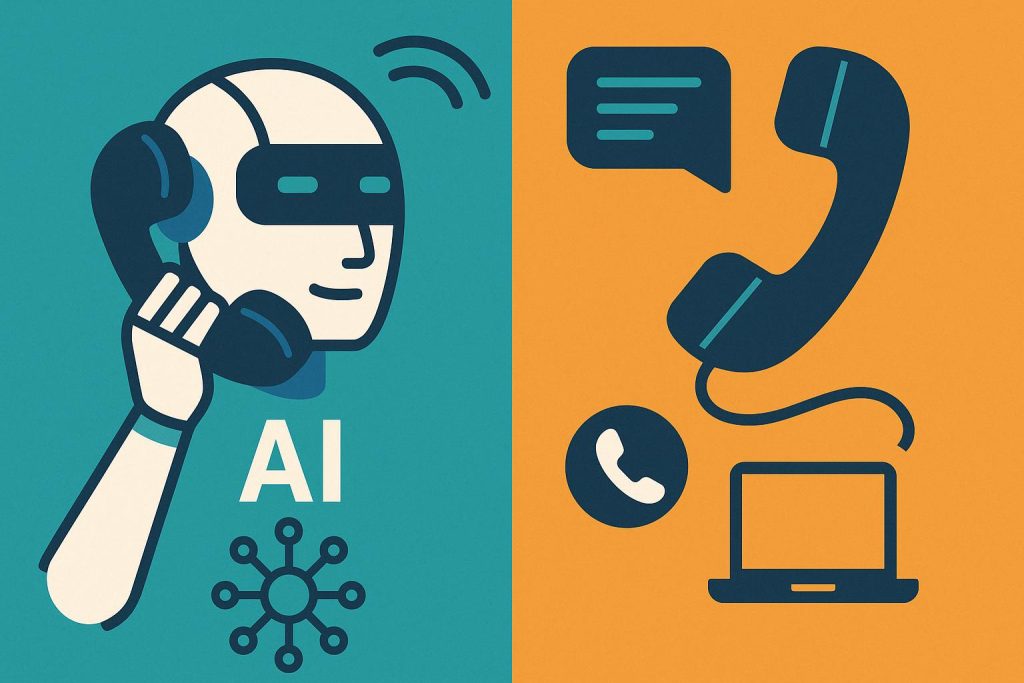
If you run a business that talks to customers over the phone, you have probably heard the buzz around AI calling. Companies of every size are trying to figure out whether they should let software handle their calls or stick with real people. This is not a small decision.
It affects how customers feel about your brand, how much you spend every month, and how your team spends its time. In this article, we will walk through what AI calling actually means, how it compares to human agents, and what you should think about before choosing one over the other.
What Is AI Calling, Really?
Contents
AI calling refers to the use of computer programs, often built on speech recognition and natural language processing, to make or receive phone calls without a human on the other end. Instead of a person picking up the phone, an AI system listens to what the caller says, understands the intent behind it, and responds in a voice that sounds close to natural human speech.
Some AI calling tools follow scripted paths, while more advanced ones can handle open ended conversations and adjust their responses based on what the customer says. This technology has grown a lot in the past few years. Early automated phone systems used to frustrate customers because they only understood a narrow set of commands.
If you did not say the exact right words, you would get stuck in a loop. Today’s AI calling systems are far better at understanding accents, background noise, and casual speech patterns. That said, they are still not the same as talking to a real person, and that gap matters more in some situations than others.
How AI Calling Actually Works
When a call comes in, the AI system converts speech into text, analyzes the meaning of what was said, and decides on the best response using pre-trained models and business specific data. It then converts its reply back into speech and plays it to the caller.
All of this happens in a few seconds, which is why it can feel like a normal conversation even though there is no person involved. Many businesses use AI calling for tasks like appointment reminders, order confirmations, basic troubleshooting, and answering frequently asked questions.
The Strengths of Human Agents
Human agents bring something that technology still struggles to replicate fully, which is genuine empathy. When a customer is upset, confused, or dealing with a complicated situation, a human voice on the other end can pick up on subtle emotional cues and adjust the conversation accordingly. A skilled agent knows when to slow down, when to apologize, and when to just listen without jumping straight into a solution.
Human agents are also better equipped to handle situations that fall outside a script. If a customer has an unusual request or a problem that does not fit neatly into a category, a person can think creatively and find a workaround. This kind of flexible thinking is still difficult for AI systems, even the advanced ones, because they generally work within the boundaries of what they have been trained on.
Where Human Agents Fall Short
Of course, human agents are not perfect either. They get tired, they have bad days, and their performance can vary depending on mood, experience, and workload. Training new agents takes time and money, and turnover in call centers tends to be high, which means companies are often stuck retraining staff.
Human agents also cannot work at the same speed or scale as software. If a company suddenly gets a spike in calls, it is much harder to hire and train enough people quickly enough to keep up.
Comparing Cost and Scalability
One of the biggest reasons companies look into AI calling is cost. Hiring, training, and retaining human agents is expensive, especially when you need coverage across different time zones or during odd hours. AI calling systems, once set up, can operate around the clock without needing breaks, benefits, or shift schedules. This makes them appealing for businesses that deal with a high volume of repetitive calls, such as appointment scheduling or basic customer inquiries.
However, cost savings should not be the only factor in this decision. If your business deals with sensitive customer issues, like billing disputes or health related concerns, cutting corners with a fully automated system might end up costing you more in customer trust than you save in salaries. It is worth thinking about the type of calls your business handles most often before deciding where AI calling fits into your operations.
Scalability During Busy Periods
Scalability is another area where AI calling shines. During busy seasons, like holiday shopping or tax time, call volumes can spike dramatically. Human teams often struggle to handle these surges without long wait times or overworked staff. AI calling systems can manage thousands of calls at once without breaking a sweat, since they are not limited by the number of available staff members. This can be a huge relief for businesses that experience seasonal or unpredictable spikes in customer contact.
Customer Experience and Trust
Customer experience is where the debate between AI calling and human agents gets the most interesting. Some customers actually prefer talking to an automated system for simple tasks because it is fast and does not require small talk. They can get their answer and move on with their day. Other customers find automated calls impersonal and get frustrated if the system cannot understand their specific issue.
Trust plays a big role here too. Many people still feel more comfortable knowing a real person is handling their information, especially when it involves money, health, or legal matters. Companies need to be transparent about when a customer is talking to an AI system versus a human being. Hiding this fact, even unintentionally, can damage trust once customers figure it out, and they usually do.
Finding the Right Balance
The smartest approach for most companies is not choosing one over the other completely, but finding a balance between the two. Simple, repetitive tasks can be handled through AI calling, freeing up human agents to focus on complex or emotionally sensitive conversations. This kind of hybrid model lets businesses save money and improve efficiency without sacrificing the quality of service for situations that truly need a human touch.
Some companies use AI calling as the first point of contact, gathering basic information from the customer before transferring the call to a human agent if needed. This way, the human agent already has context about the issue and does not have to ask the customer to repeat themselves. It saves time for everyone involved and tends to reduce frustration.
What Companies Should Consider Before Deciding
Before adopting AI calling or expanding a human agent team, companies should think carefully about their specific needs. Consider the nature of your typical customer interactions. If most of your calls are simple and predictable, an AI calling system might handle them efficiently and free up your staff for harder problems. If your calls tend to involve emotional or complicated situations, investing more in human agents and their training might serve you better in the long run.
It also helps to think about your customers directly. Different age groups and industries have different comfort levels with automated systems. A younger, tech savvy customer base might not mind talking to an AI system, while an older demographic might prefer the reassurance of a human voice. Testing both approaches on a small scale before fully committing can give you real data instead of just guesses.
Finally, remember that technology continues to improve quickly. What AI calling can do today is already much better than what it could do a few years ago, and it will likely keep advancing. Staying informed about these changes and being willing to adjust your approach over time will serve your business better than locking into one system and never revisiting the decision.
Final Thoughts
Choosing between AI calling and human agents is not really about picking a winner. Both have real strengths and real limitations, and the right choice depends heavily on your business, your customers, and the kind of conversations you deal with most often. Taking the time to understand these differences and testing what works best for your specific situation will help you build a customer service approach that actually serves people well, instead of just following the latest trend in the industry.