


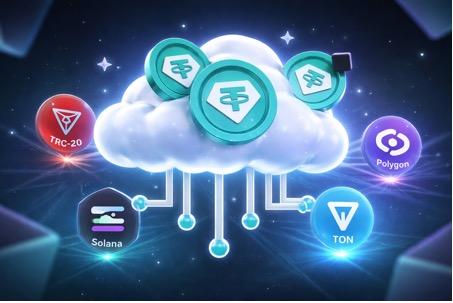
In 2026, USDT underpins most cross‑border payments, e‑commerce, and freelancer settlements. The key question is no longer whether to use USDT, but which network to run it on. TRC‑20, ERC‑20 on Ethereum and Polygon, SPL on Solana, and USDT on TON each fit specific combinations of speed, cost, and ecosystem constraints.
Key USDT networks for payments in 2026
Contents
In practice, most USDT‑based payments cluster around a small set of networks, each optimised for different flow patterns rather than a generic “best” label. This structure also enables operators to use a fast and secure swap USDT TRC‑20 to ERC‑20 when they need to move liquidity from Tron’s high‑throughput, low‑cost rails to Ethereum’s deeper‑liquidity, security‑first environment without changing the core routing logic for routine flows.
Tron (TRC‑20) – low‑cost, high‑volume workhorse
Tron is the default rail for low‑cost, high‑volume USDT transfers. Fees for USDT‑only transactions are low, and confirmations usually settle in seconds, which fits bulk payouts, recurring freelancer payments, and high‑frequency B2C‑style flows.
Tron’s validator set is more centralized than Ethereum’s or Polygon’s, which increases exposure to governance and regulatory risk, and the network is tightly tied to one major stablecoin issuer, so operational shifts there can indirectly affect settlement patterns.
Tron fits best when:
- Payments are low‑value but high‑volume.
- Counterparties accept fast, low‑cost rails.
- Confirming in seconds matters more than maximum security or deep DeFi‑linked liquidity.
Ethereum (ERC‑20) – security‑first backbone
Ethereum remains the primary rail for large‑value, security‑sensitive, or DeFi‑linked USDT payments. Fees for USDT‑on‑Ethereum are higher than on Tron or Polygon and depend on gas‑market conditions, while confirmation times usually fall in the 10–30‑second window. The network offers deep liquidity and broad integration with regulated on‑ramp/off‑ramp providers.
Ethereum makes sense when:
- Transaction size justifies higher fees.
- Deep liquidity and on‑ramp depth matter more than minimizing cost.
- The counterparty requires Ethereum‑only rails.
Polygon – low‑cost Ethereum‑compatible layer
Polygon offers Ethereum‑style addresses and smart‑contract semantics at a lower fee level than Ethereum mainnet. USDT‑on‑Polygon transactions usually settle in seconds with fees well below those on Ethereum, making Polygon attractive for merchants, DAO‑linked platforms, and NFT‑gated services that want ERC‑20‑style interoperability without Ethereum‑level gas exposure.
Polygon’s advantages:
- Lower fees than Ethereum with similar tooling and UX.
- Faster confirmations with less congestion risk than Ethereum mainnet.
- Good fit for DeFi‑adjacent commerce.
Solana (SPL USDT) – speed‑focused rail
Solana delivers very fast confirmations and low fees for SPL‑based USDT, which suits high‑frequency, low‑value flows such as in‑game betting, micro‑payments for content, and some DeFi‑spot‑trading‑linked settlements.
Gateway coverage is narrower than on Tron or Ethereum, and the network’s history of congestion episodes can influence risk models for more conservative operators.
Solana fits best when:
- Real‑time, interactive flows are the priority.
- The project already runs on Solana and keeps most of its ecosystem on‑chain.
- The operator can tolerate narrower off‑ramp and gateway support.
TON (USDT on TON) – messaging‑native payments
TON anchors USDT inside Telegram‑centric ecosystems, where P2P transfers, small‑business invoices, and micro‑payments happen inside chats and mini‑apps. Typical fees are low, and most user‑facing operations settle in a few seconds.
Off‑ramp depth and integration with major gateways are weaker than on Tron, Ethereum, or Polygon, which constrains TON’s role to more informal, messaging‑native flows.
TON makes sense when:
- Flows are P2P or small‑ticket with Telegram‑centric UX.
- Counterparties live in Telegram‑based ecosystems.
- UX simplicity matters more than deep liquidity or regulatory‑grade rails.
Moving between Tron and Ethereum USDT
For many operators, liquidity is split between Tron‑based USDT and ERC‑20 USDT. Some gateways, partners, or on‑ramp providers accept only ERC‑20; others prefer TRC‑20 because of lower cost and higher throughput.
When liquidity or gateway requirements shift, users may need to move funds between chains. Non‑custodial or well‑audited services can reposition USDT between rails, adjusting the settlement layer while keeping the stablecoin value intact.
Operationally, this adds a small but measurable layer of management:
- Operators track which network each counterparty or gateway accepts.
- They monitor fee levels and typical confirmation times on both Tron and Ethereum.
- They decide, case by case, whether extra seconds of confirmation or higher fees are justified by the security or liquidity profile.
The goal is not to force all flows onto one chain, but to keep the choice of Tron, Ethereum, Polygon, Solana, or TON explicit, predictable, and aligned with each payment scenario.
How to choose the right USDT network for your flows
Choosing a USDT network is less about a single “best” chain and more about matching the rail to flow size, frequency, and partner constraints. The main trade‑off—predictable fees versus acceptable confirmation windows—fits into the broader choice of which stablecoin to rely on, especially when comparing liquidity, regulation, and institutional trust across leading USD‑pegged tokens from major issuers.
High‑volume, low‑value flows work best on low‑cost, high‑throughput rails, while sporadic large‑value transactions can tolerate higher fees for deeper liquidity and clearer settlement, regardless of whether the stablecoin leans more toward trading, institutions, or specific ecosystems.
A practical setup:
- One core low‑cost rail for routine, high‑volume flows (for example, Tron).
- One Ethereum‑ or Polygon‑based rail for larger or security‑sensitive payments.
- One or two ecosystem‑specific rails (for example, Solana or TON) for flows tied to those ecosystems.
- Cross‑network moves used only when the cost of staying on one rail clearly outweighs the overhead of shifting liquidity.
The goal is not to eliminate multi‑network complexity, but to reduce its volatility and keep the stack manageable at scale.
The goal is not to eliminate multi‑network complexity, but to reduce its volatility and make the payment stack easy to manage at scale.
Practical tips for running multi‑network USDT payments
Running a multi‑network USDT setup works best when the rules are simple and predictable.
A few key points cover most of the benefit:
- Define a clear default for each flow type (for example, Tron for bulk payouts, Ethereum/Polygon for B2B or DeFi‑linked payments) and stick to it unless the context clearly changes.
- Keep small buffers of TRX or gas‑chain tokens on the relevant networks so fee spikes do not block scheduled batches.
- Set explicit confirmation thresholds per network—shorter for low‑value, longer for high‑value—and match them to internal reporting.
- Use cross‑network moves only when the volume and context clearly justify the step.
The result is a structure that avoids forcing everything onto one rail while keeping the stack simple and scalable.
Multi‑network USDT payments in context
Using multiple USDT networks is practical when it reflects the real structure of your flows. Tron fits high‑volume, low‑cost settlements; Ethereum and Polygon anchor larger or DeFi‑linked payments; Solana and TON serve niche, speed‑ or UX‑driven cases.
For most operators, the main benefit lies in consistency:
- A small set of default rails per flow type.
- Clear rules for when to move funds between networks, such as rebalancing liquidity between Tron and Ethereum‑based rails when the mismatch clearly justifies the step.
- Minimal routine routing tweaks, so the setup scales without constant manual oversight.
The goal is a structure that aligns with real‑world constraints—counterparty preferences, fee sensitivities, and liquidity allocation—rather than chasing abstract fee‑minimisation metrics.
The goal is a structure that aligns with real‑world constraints—counterparty preferences, fee sensitivities, and liquidity allocation—rather than chasing abstract optimisation metrics.
What this means for your USDT strategy
For most operators, the practical takeaway is simple: keep the USDT network stack tight and aligned with how payments actually move. Tron fits most high‑volume, low‑cost settlements; Ethereum and Polygon anchor larger or more security‑sensitive flows; Solana and TON serve niche, UX‑driven cases.
In practice, this means:
- Defaulting to one core low‑cost rail for routine operational payments and one Ethereum‑ or Polygon‑based rail for larger or DeFi‑linked flows.
- Using cross‑network moves only when liquidity and payment destinations clearly justify the shift.
The result is a USDT‑based payment stack that stays cost‑effective without forcing everything onto a single chain or turning routing into a constant optimisation puzzle.
Practical framework for choosing your USDT rails
A useful way to lock in a USDT‑network strategy is to treat it as a small, repeatable framework:
- By flow type:
- By infrastructure:
- By cross‑network moves:
- By consistency and scaling:
Final practical takeaways
By 2026, there is no single “best” USDT network, only a small set of rails that fit different combinations of size, frequency, and infrastructure. Tron handles most high‑volume, low‑cost flows; Ethereum and Polygon anchor larger or security‑sensitive settlements; Solana and TON serve niche, UX‑ or ecosystem‑driven cases.
The practical value of a multi‑network setup lies in keeping the stack tight and predictable: choosing a short list of default rails, letting counterparty preferences guide the primary route, and using cross‑network moves only when they clearly reduce friction. The result is a USDT‑based payment structure that stays cost‑effective and scalable without forcing everything onto one chain or turning routing into a constant optimisation game.
FAQ
1. Which USDT network is best for fast, low‑cost cross‑border payments?
Tron (TRC‑20) is usually the best fit for fast, low‑cost cross‑border and bulk payments thanks to low fees, quick confirmations, and widespread support on exchanges and payment processors.
2. When should I use Ethereum (ERC‑20) instead of Tron?
Use Ethereum (ERC‑20) for larger, security‑sensitive, or DeFi‑linked payments where you prioritize deep liquidity, institutional trust, and broad on‑/off‑ramp coverage over lower fees.
3. What is the cheapest network for USDT transfers in 2026?
In 2026, Tron (TRC‑20) remains the cheapest option for most USDT transfers, especially for high‑volume, low‑value flows where cost per transaction matters more than maximum security.
4. How should I think about moving USDT between Tron and Ethereum?
Treat cross‑network moves as occasional liquidity rebalancing: shift funds when a partner or gateway clearly requires a different rail, but keep routine flows on a stable default to avoid unnecessary complexity.
5. Are there risks to running most of my USDT payments on Tron?
Yes—Tron’s more centralized validator set and close links to one major issuer increase governance and regulatory risk, so it is best reserved for high‑volume operational flows, not long‑term storage or highly sensitive operations.
6. Which stablecoin considerations sit above the choice of USDT network?
Above the network choice is deciding which stablecoin to rely on, weighing liquidity depth, regulatory clarity, and institutional trust between leading USD‑pegged tokens, since the same network‑routing logic applies regardless of whether the coin leans toward trading, institutions, or specific ecosystems.
Disclaimer
This guidance is for informational purposes only and does not constitute financial, legal, or investment advice. Network conditions, fees, and regulatory requirements can change quickly; always do your own due diligence and consult qualified professionals before making decisions about which stablecoin or network to use for your payments.