


Betty Sebrow holds an English degree from the City University of New York, Brooklyn, and a master of arts in journalism from New York University, credentials that inform her decades-long career in writing, education, and community advocacy. Based in Lawrence, New York, she has worked as an advice columnist for 5 Towns Jewish Times (5TJT), addressing relationships, family conflict, and other social issues each week. Sebrow also taught English and science at several Brooklyn schools earlier in her career and later founded Neshoma Advocates, LLC, in 2007 to deliver educational summits and training on issues affecting at-risk youth. Her longtime work as a matchmaker and shadchan for Baila Sebrow Events, LLC, since 1982 further reflects her focus on understanding people and communication. This combination of writing, teaching, and advocacy experience underscores the value of strong analytical reading skills in professional and community-facing work.
Analytical reading is an advanced reading skill that helps readers look beneath a text’s surface. Instead of only grasping what a text says, readers ask why it was written, how it works, and what argument or purpose drives it. Unlike quick scanning, analytical reading requires active engagement with the material so readers can understand its structure, meaning, and value.
Analytical reading can also serve as a demanding mental exercise. Because it requires attention, memory, interpretation, and judgment, it may support stronger comprehension and critical thinking. Claims about long-term brain health or cognitive disorders should be supported with stronger medical sources before being stated directly.
The initial phase involves identifying what category a text falls under because different genres require different interpretive strategies. A reader should first determine whether the work is fiction, expository nonfiction, theoretical, practical, literary, persuasive, or another form of writing.
Readers should also distinguish between theoretical and practical writing. Theoretical works explain what is true or why something is the case, while practical texts guide readers toward action. Making this distinction helps readers choose the right approach before they begin deeper analysis.
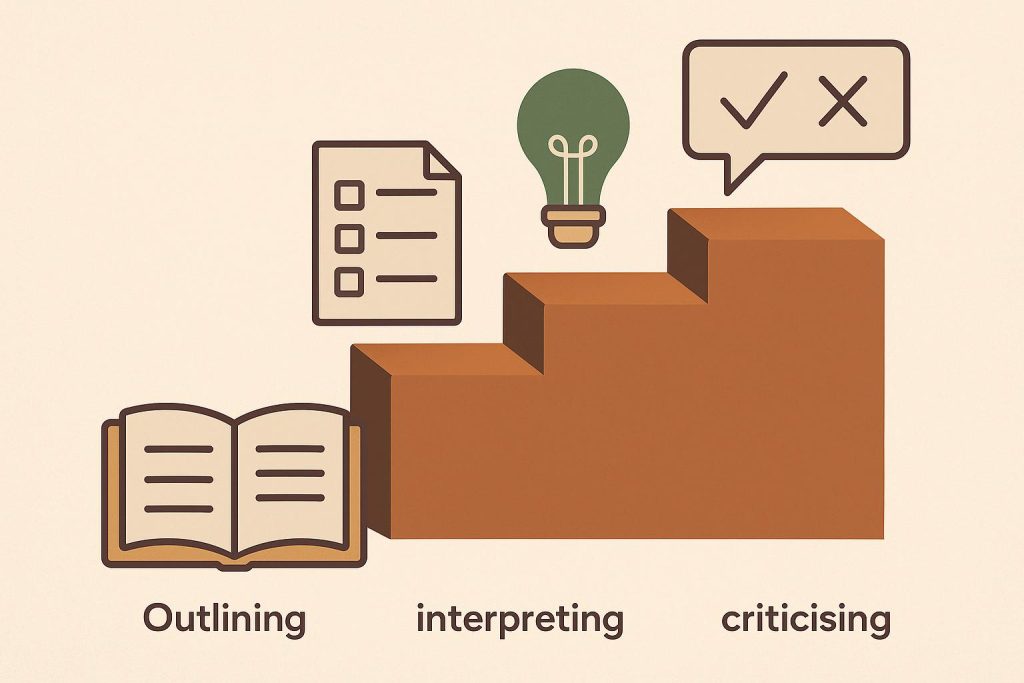
Analytical reading follows three stages: outlining, interpreting, and criticizing. These steps allow a person to move from the basic structure of a work to a sophisticated understanding of its logic.
Outlining uncovers the text’s structure. The reader briefly states the book’s main idea and shows how its sections fit together. This phase requires one to figure out the specific problems the writer intended to solve.
Interpretation focuses on the building blocks of language. One must identify key terms and sentences to understand the underlying propositions. By connecting these ideas, the reader reconstructs the author’s arguments and discovers the proposed solutions.
Finally, the criticism stage empowers readers to judge the work fairly.
Beyond general frameworks, specific tactics help individuals navigate difficult passages and improve their focus. Among these is noticing interesting or strange details and then ranking them by importance. When the reader asks why these specific elements stand out, they move from simple observation to deep interpretation.
Looking for patterns can reveal a text’s organizing principles. Readers may track repeated words, images, contrasts, or ideas, then ask how those patterns shape the work’s meaning. They should also notice anomalies, or details that do not fit the dominant pattern, because those exceptions can lead to a more original interpretation.
Another tool is the triple paraphrase technique. The reader rewrites a single complex sentence three different times using synonyms. This aids in understanding the actual thought rather than just repeating the original phrasing.
This skill is often linked to academic study. However, analytical reading offers significant benefits in a professional environment.
These advantages hinge on the fact that this skill helps one, for example, identify what another person is asking rather than just what they are saying. By listing all explicit and implicit questions before replying, analytical readers give complete solutions and minimize follow-up messages.
In customer service, surface reading can lead to incomplete answers, repeated messages, and frustrated clients. A more analytical approach helps employees process confusing or emotional communications with greater clarity before they respond.
In today’s digital age, technology creates a unique environment where analytical readers can develop their skills. While digital devices may have distractions that encourage shallow scanning, they also offer innovative tools for engagement.
For example, e-readers and specialized apps have various features, including digital annotation, highlighting, and tracking performance that transform the reading process into a measurable and interactive experience. Readers can set goals, manage schedules, and use artificial intelligence to interact with material.
Such intentional use of technology allows users to focus and organize their thoughts. For the best outcomes, integrating traditional analysis with digital efficiency helps navigate the vast amount of information available today.
This balanced approach ensures that technology sharpens the mind instead of dulling critical faculties through passive habits.
About Betty Sebrow
Betty Sebrow is a writer, educator, and community advocate based in Lawrence, New York. She holds an English degree from the City University of New York, Brooklyn, and a master of arts in journalism from New York University. Sebrow writes a weekly advice column for 5 Towns Jewish Times and previously taught English and science in several Brooklyn schools. She also works as a matchmaker and shadchan for Baila Sebrow Events, LLC, and founded Neshoma Advocates, LLC, in 2007 to support at-risk youth.