


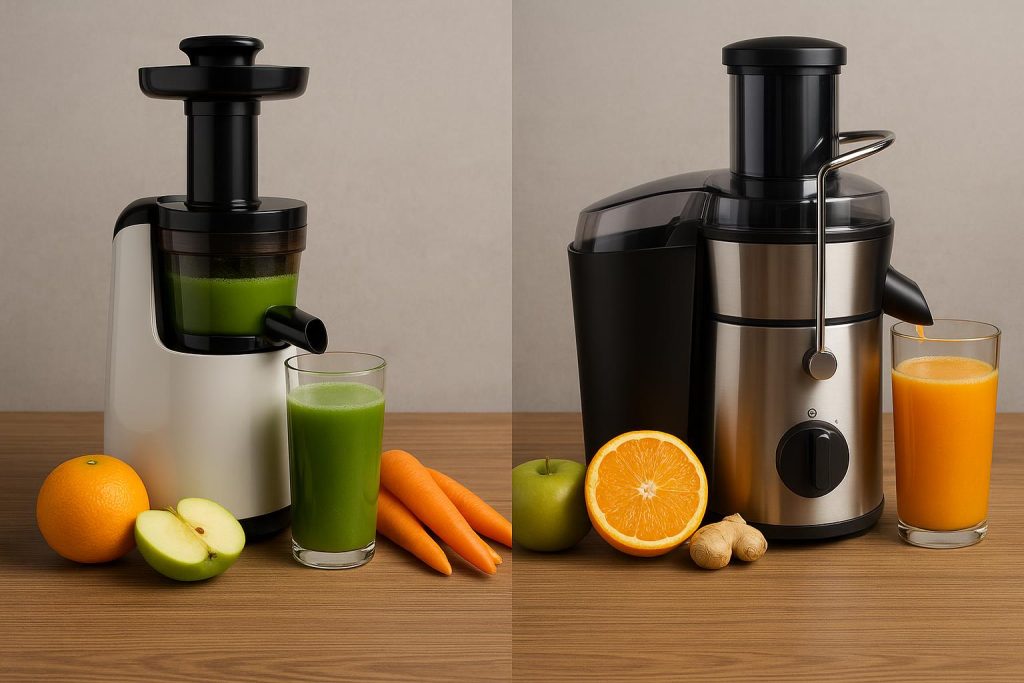
Most people buying a juicer in India this year will spend about fifteen minutes researching it. They’ll find one article saying cold press is dramatically superior and another saying the difference is overstated, close the tabs, and go with whichever fits the budget. That’s not a terrible approach, honestly. But it does mean a lot of households end up with a centrifugal machine doing a job that genuinely needs a cold-press juicer, or spending ₹15,000 on cold-press technology for fruit that doesn’t need it. The distinction is real. It just isn’t where most people are looking for it.
How Each Machine Actually Works
Contents
Centrifugal juicers spin fast. Very fast. Most models run between 6,000 and 14,000 RPM, which is what lets them process a full glass in under a minute. The blade shreds are produced against a mesh filter, and centrifugal force does the separation. The problem isn’t the speed itself. It’s what speed generates. Friction. And friction means heat. Not enough to cook anything, but enough to start breaking down Vitamin C and certain enzymes before the juice reaches your glass. That’s the trade-off nobody mentions in the product description.
If you’re trying to find the best cold press juicer because you’ve heard cold press is better, here’s what actually makes it different. The auger, a slow-rotating screw-shaped component, crushes produce against a screen instead of shredding it, at forty to eighty RPM. Compared to fourteen thousand, that’s almost stationary. No friction worth measuring, no meaningful heat. The juice comes out with its cellular structure largely intact and considerably less air mixed in during extraction. That last part matters more than people realise.
What Actually Happens to the Nutrients
Vitamin C is the easiest place to see the difference. Independent comparisons of cold-press and centrifugal juice from identical produce have found Vitamin C retention 30 to 40% higher in cold-press output. Enzymes show a similar pattern. They’re proteins, structurally fragile, and the combination of heat and oxidation from high-speed spinning degrades them faster than a slow cold press auger does.
Oxidation is actually the bigger story. All that high-speed spinning pulls air into the juice during extraction. More air, faster oxidation. This is why centrifugal juice separates in the glass within minutes, loses colour faster, and needs to be drunk immediately. Cold press juicer holds up reasonably well for 24 to 48 hours in the fridge. For anyone juicing in batches the night before, that difference is the whole argument.
The Honest Case for Centrifugal
Not every kitchen needs a cold press. For soft, water-heavy fruit, the gap narrows, and it’s worth being clear about where each machine makes sense:
| Produce Type | Centrifugal | Cold Press |
|---|---|---|
| Oranges, mosambi, watermelon | Works well, minimal nutrient loss | Works well, marginal improvement |
| Beetroot, carrot, ginger | Moderate yield, some nutrient loss | Higher yield, better retention |
| Leafy greens, wheatgrass, amla | Poor yield, significant oxidation | Noticeably better on both counts |
Speed matters too. Sixty seconds from whole fruit to full glass with a centrifugal machine, almost no prep required. A cold press juicer takes two to three minutes, and most need produce cut into smaller pieces beforehand. On a weekday morning when everyone’s running late, that difference is real.
Price is the other thing. Centrifugal machines in India run from ₹2,500 to ₹5,000. Cold press starts around ₹8,000 and goes past ₹20,000 for better ones. If your household mostly juices citrus two or three times a week, spending three times as much is hard to justify on nutritional grounds alone.
Where Cold Press Earns Its Price
Dense produce is where the cold press juicer stops being a preference and becomes the practical choice. Beetroot, carrot, ginger, amla, wheatgrass, spinach. These give up less juice per gram, so extraction efficiency matters more. Cold press systems typically pull 15 to 20% more juice from the same quantity of hard produce. Over weeks of daily use, that yield difference adds up to real savings on ingredients.
Amla specifically. It carries some of the highest natural Vitamin C concentration of any ingredient in the Indian diet. Running it through a centrifugal machine and losing a third of that Vitamin C to heat and oxidation is a strange way to pursue the health benefit you bought the machine for.
Conclusion
Cold press juicer retains more nutrients. The evidence on heat-sensitive vitamins and enzyme degradation makes that fairly clear. Whether that justifies the price depends entirely on what you’re juicing. Hard vegetables, leafy greens, amla, batch juicing for the next day. Cold press is the right tool. Quick morning citrus juice on a tight budget. Centrifugal does the job well enough.
Buy for your actual kitchen. Not the idealised version of it.