


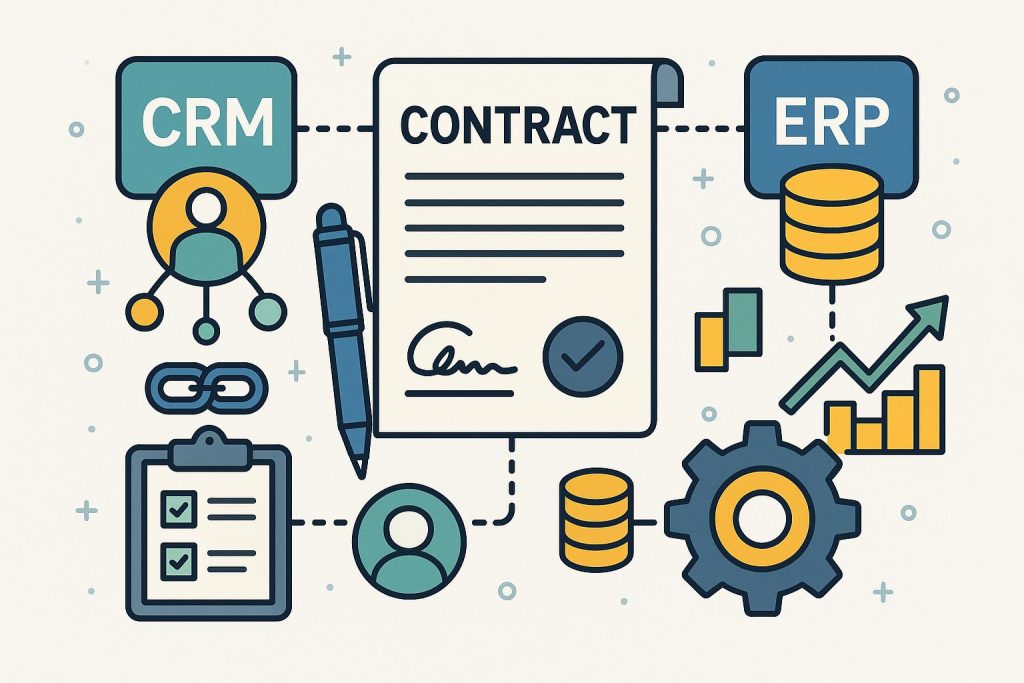
A sales rep closes a deal in the CRM. Finance builds the customer record in the ERP. Legal has the contract in another platform entirely. Three systems. Three data sources. Three versions of “truth.”
What could go wrong? Plenty.
Wrong pricing gets pulled into agreements. Customer data gets re-entered manually. Finance chases terms legal already negotiated. Sales asks why approvals take forever. And suddenly everyone is solving problems software was supposed to prevent.
This is why the best contract management tools are no longer judged by contract storage alone. The real question now is simpler:
How well do they connect.
Contracts Shouldn’t Live on an Island
Contents
- Contracts Shouldn’t Live on an Island
- CRM Integrations Eliminate Friction Upstream
- ERP Integrations Solve Problems After Signature
- Data Stops Moving Through People
- Visibility Gets Much Bigger
- What Features Matter Most?
- Collaboration Gets Better When Systems Align
- Final Thought: The Best Tools Don’t Work Alone
For years, contract systems often operated like sealed vaults. Documents went in. Signatures came out. And the rest of the business… sort of orbited around them. That model feels dated now.
Because contracts touch everything. Sales terms live in CRM data. Billing obligations sit inside ERP workflows. Procurement, revenue recognition, compliance, they all intersect with agreements.
Which is why the best contract management tools increasingly center on integrations, not just features.
That’s where the real leverage lives. Solutions exploring the best contract management tools often emphasize this exact shift: contracts work better when they operate inside the broader business system, not beside it.
Seems obvious. Yet surprisingly transformative.
CRM Integrations Eliminate Friction Upstream
Let’s start with sales. Because nothing exposes process friction faster than revenue waiting on legal.
When contract management tools connect with CRMs like Salesforce or HubSpot, contract workflows can launch directly from opportunity data.
Customer details populate automatically. Pricing terms pull through. Approvals align with deal stages. No manual re-entry. No duplicate records. And, small miracle, less room for human error.
That matters because bad data doesn’t usually arrive dramatically. It sneaks in through retyping. CRM integration cuts that off early. And faster contracting tends to mean faster revenue. Funny how often that gets attention.
ERP Integrations Solve Problems After Signature
This is where things get interesting. Because many teams obsess over getting contracts signed… then lose operational visibility once they’re executed.
That’s where ERP integrations earn their value. Connect contract management tools with systems like SAP, Oracle, or NetSuite, and contract terms can feed downstream processes automatically.
Payment schedules. Purchase obligations. Vendor terms. Revenue recognition triggers. Suddenly agreements aren’t static records.
They become operational inputs. Huge difference. And one manual handoff removed from finance is usually worth more than people realize.
Data Stops Moving Through People
This may be the quiet superpower of integrated systems. Data stops relying on humans as transport.
Think about how much organizational friction comes from people moving information manually between tools.
Copying terms. Forwarding approvals. Updating records. Reconciling mismatches. It’s administrative glue work. And it scales terribly.
The best contract management tools reduce that by letting systems talk directly. Which sounds technical. But really it’s about removing drag. And businesses almost always underestimate drag.
Visibility Gets Much Bigger
Integrations don’t just make workflows faster. They make them smarter.
When contracts connect with CRM and ERP data, teams can see relationships they’d otherwise miss.
Which deals are stuck in approval?
Which contract terms affect revenue forecasts?
Which vendor agreements drive procurement commitments?
That’s not document management. That’s business intelligence. And yes, there’s a difference.
What Features Matter Most?
Not every integration story is equal.
Some “integrations” are really just data exports wearing nicer clothes.
The strongest tools tend to prioritize:
Native CRM integrations
Opportunity data should feed contracts seamlessly.
Deep ERP connectivity
Not surface syncs, real operational data flow.
Workflow automation across systems
Approvals and obligations should trigger actions elsewhere.
Shared reporting visibility
Contract, revenue, and procurement data should connect.
API flexibility
Because no company runs on one perfect tech stack.
Nor has one ever.
Collaboration Gets Better When Systems Align
Worth mentioning: Integrated platforms don’t just improve software.
They improve people dynamics. Sales stops fighting legal. Finance stops chasing contract details. Procurement sees obligations clearly. Teams work from connected information instead of fragmented assumptions.
And honestly? That may be the bigger win. Because technology problems often turn out to be coordination problems. Integrations solve both.
Final Thought: The Best Tools Don’t Work Alone
That may be the defining trait of the best contract management tools today. They don’t sit apart from the business. They connect into it.
With CRM integrations, deals move faster. With ERP integrations, execution gets cleaner. With both, contracts stop acting like isolated documents and start functioning like part of the operating system.
Which is what they probably should’ve been all along. And once that clicks…going back to disconnected contracting feels a little absurd.