



This article provides an exhaustive investigation into Critical Discourse Analysis. You will explore the theoretical foundations of the field and practical techniques. Plus, we also included current academic trends in the United Kingdom and the specific challenges. Continue reading to learn more.
Critical Discourse Analysis (CDA) might sound like jargon, but it’s really just a way to study language as action. At its core, CDA asks: How does the way we talk or write reflect and shape social power? You can see CDA as a toolkit for reading between the lines of any text. In fact, it is a type of discourse-analytic research that primarily examines how social power, abuse, dominance, and inequality are enacted.
Yet, this simple explanation can help the UK students by no means. Therefore, we have compiled this quick guide covering all the essentials. You will understand what critical discourse analysis is, its methods, techniques and examples. This quick guide is prepared with the help of The Academic Papers UK, the most professional dissertation writing service, to enable you to caters all the challenges related to this concept.
Critical Discourse Analysis Definition
Contents
The definition of Critical Discourse Analysis is characterised by a particular focus on the interaction between language use and the socio-political environment. Teun van Dijk, one of the main CDA scholars, defines it as a form of discourse-analytic research that examines how social power, abuse, dominance, and inequality are performed, reproduced, and opposed through text and talk in the social and political environment. Here are the key concepts:
- Social Practice: You need to consider language as an inseparable component of discourse analysis in social research.
- Power & Dominance: This has more to do with the enactment of power, facilitation and navigation in the various manifestations of the discourse.
- Ideological Function: You are going to talk about how discourses have naturalised certain opinions as common sense and suppressed others.
- Historical Dimension: Every text is historical and is interrelated with other texts and this process is referred to as intertextuality.
- Social Reality Construction: The critical language analysis framework cannot be said to be only a mirror of reality; it also helps to create and maintain it over time.
What are the Different Methods of Critical Discourse Analysis?

A report published by Critical Discourse Studies (2025) reported that the discipline had 57,816 downloads in the third quarter of 2025. This is an enormous change from the 44,449 downloads registered last year. However, critical discourse analysis does not have a specific method.
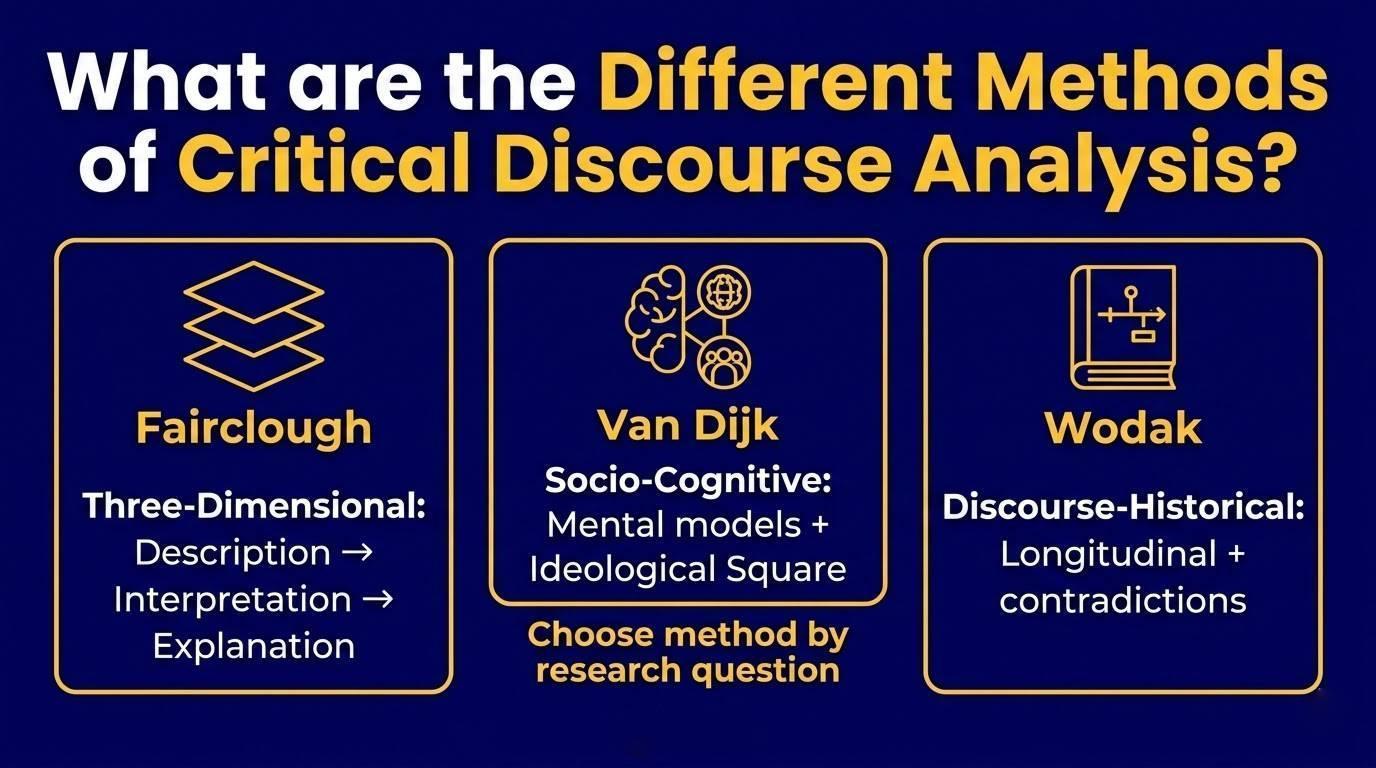
This is attributed to the fact that the field involves different schools of thought, which do not emphasise the same things. You would be asked to choose the CDA methodology in the research questions and in what type of data you have collected. However, these are the most obvious ways:
1. Fairclough’s Three-Dimensional Framework
Fairclough’s model is a popular choice among university dissertation writers because it offers a simple three-step analysis. First, there is the stage of Description, which analyses formal elements like vocabulary and sentence structure. Then there is the Interpretation stage, where the way the text was written and how it is perceived by the listeners is contemplated. Lastly, the Explanation stage relates these findings to more general social and cultural practices.
2. Van Dijk’s Socio-Cognitive Approach
This is a method created by Teun van Dijk, and it is particularly applicable to the research of the way people think about qualitative discourse analysis methods. The social structure and the way of discourse that Van Dijk tos up are not directly interconnected but are isotropically connected. The so-called Ideological Square is a popular tool that shows how language can serve to privilege an in-group at the expense of an out-group.
3. Wodak’s Discourse-Historical Approach
The type of research best associated with this is longitudinal research, whereby you are interested in tracking the change in an idea over time. Your analysis should be guided by the five heuristic questions that you can employ, namely, how social actors are named, what attributes are attributed to them, and why this matters. This approach exposes contradictions and motivations under wraps, which is why it is important in socio-diagnostic critique that aims to uncover persuasion tactics among the general population.
Discourse Analysis Techniques and Framework
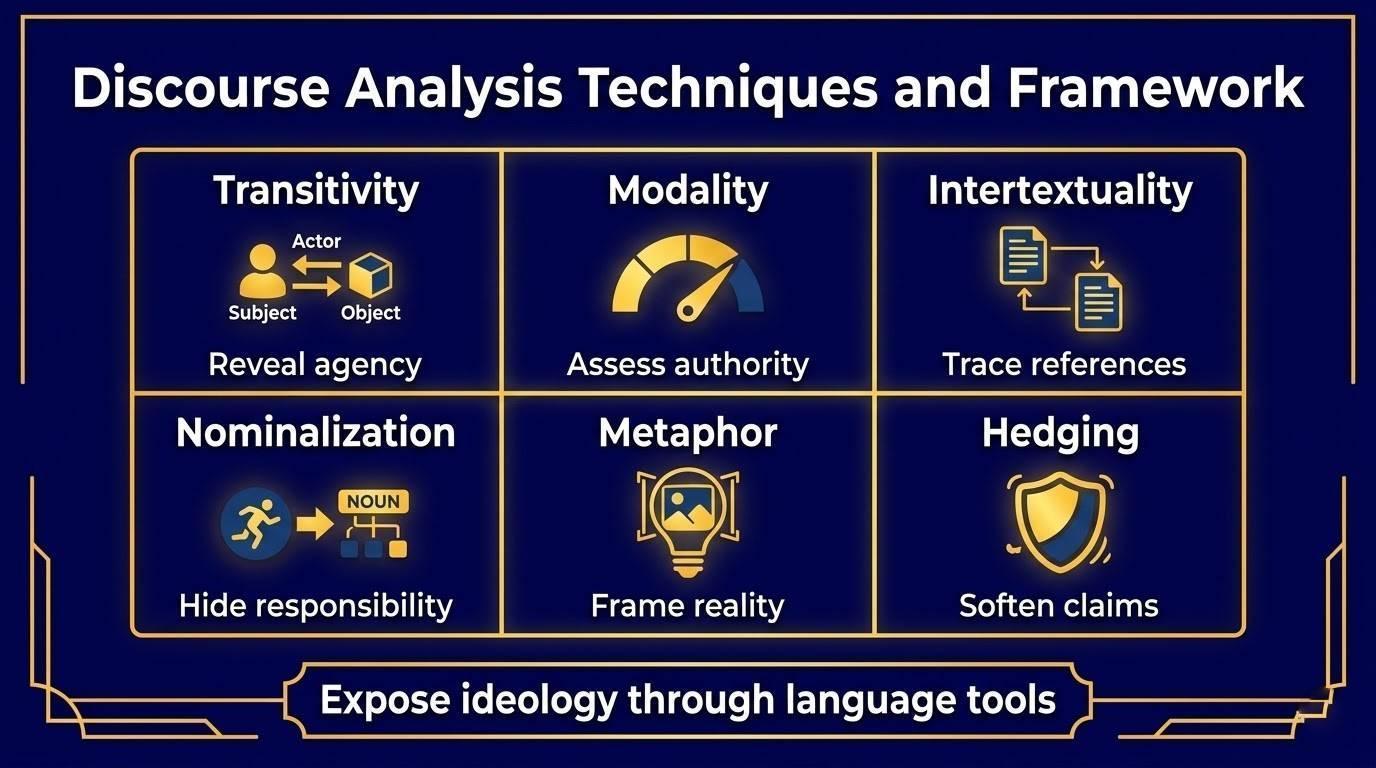
To carry out a professional-level analysis, you need to be familiar with the specific discourse analysis techniques. These techniques are often drawn from Systemic Functional Linguistics and provide a systematic way to examine how meaning is constructed. For a practical overview of integrating these into qualitative research, see this guide to commonly used methods in social science research.
| Technique | Definition and Context | Research Application |
|---|---|---|
| Transitivity | Analysing who is the “actor” and who is the “goal” in a sentence. | Identifying agency and responsibility in social conflicts. |
| Modality | The degree of certainty or obligation expressed in language. | Assessing the authority and commitment of a speaker or writer. |
| Intertextuality | How a text references or responds to other previous texts. | Understanding how authority is built through historical references. |
| Nominalization | Turning actions (verbs) into static things or concepts (nouns). | Hiding agency and making social processes seem like natural laws. |
| Metaphor | Using one idea to represent another to frame reality in a specific way. | Shaping public perception of complex issues like “the war on drugs”. |
| Hedging | Using “filler” words or cautious language to soften a claim. | Detecting defensiveness or a lack of authority in power interactions. |
Discourse Analysis Examples
To understand how such a method is utilised, we will examine some of the typical fields in which Critical Discourse Analysis is applied by researchers. As can be seen in discourse analysis examples, language is used to bring about certain social effects.
Example 1: Political Discourse
A candidate can use past speeches or documents to reinforce their argument in the political arena. The candidate’s parallelism can be analysed by the analysts to produce a rhythmic, persuasive result. Through the ideological structure, we can understand how they create a narrative of us versus them, the wicked elite and the outsiders who are dangerous.
Example 2: Media Discourse
In analysing news items about a given event, look at how the piece is framed. Protest can be described as a riot or a demonstration for justice. The images and headlines are the major components of the analysis, and they could contribute to the creation of a fear-oriented discourse that shapes the reader’s opinion. Such discourse and ideology studies indicate how cultural narratives absorb news articles, giving them the most plausible meaning.
Example 3: Educational Discourse
The control of topics and the turn-taking in the classroom can be used to discuss the power between a teacher and a student. Instead, scholars could discuss the normalisation of some historical accounts and exclusion of others in textbooks.
Educational discourse analysis is essential for understanding how the educational system can inadvertently recreate social inequalities.
Conclusion
Critical Discourse Analysis (CDA) is a vital tool for social science scholars. The three-dimensional model proposed by Fairclough provides a clear outline of its use upon uncovering its usage.
- Critical discourse analysis describes language as a social practice, which may either support or disrupt power.
- Discourse analytical research methods involve the use of other techniques, such as transitivity and modality, to expose the ideological position of a text.
- Discourse studies were on the rise as scholars sought a way through polarised online platforms.
- Using CDA in your dissertation can feel tricky sometimes. You need to balance detailed language analysis with solid theory. That’s where dissertation help from experienced professionals comes in handy. Experts can guide you through the tricky parts and make sure your analysis is both clear and convincing.
Frequently Asked Questions About Critical Discourse Analysis
What are the basic concepts of CDA?
The basic concept is to see language as a social practice that is never neutral but always tied to power and ideology. It focuses on the relationship between the micro-level of language and the power analysis of society. You are essentially looking for the “hidden” views that certain groups promote as naturalised.
What are the three stages of CDA?
Fairclough’s model uses three stages of critical course analysis: Description, Interpretation, and Explanation. First, you describe the structural form of the text. Second, you interpret the context of production and consumption. Third, you explain how these practices relate to larger social struggles and power structures.
What are the three approaches to critical discourse analysis?
The three main approaches are the Socio-Cognitive approach by van Dijk, the Discourse-Historical approach by Wodak, and the Social Analysis approach by Fairclough. Van Dijk looks at mental models, Wodak looks at historical evolution, and Fairclough looks at the dialectical relationship between discourse and society.