


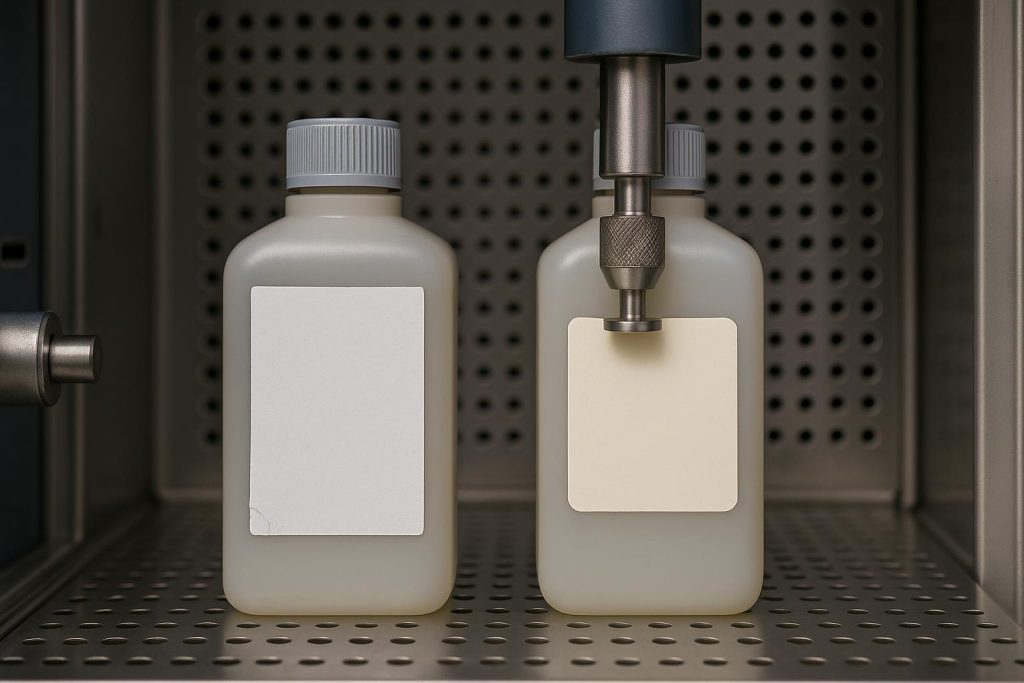
Every product on a shelf or inside a shipping carton carries some form of identification tag, and how long that tag stays readable matters more than most people realize. This year, durability testing has answered a question logistics teams have long asked: why certain adhesive materials outlast traditional paper options. Heat warps paper, moisture softens it, and friction grinds it down, making substrate choice no longer a minor detail for companies that depend on accurate packaging and clean shelf presentation.
How Modern Durability Testing Evaluates Marking Substrates
Contents
Independent labs put marking materials through accelerated aging protocols that compress months of wear into just a few days. Samples face controlled humidity cycling, sustained UV radiation, and measured abrasion trials.
Results from these evaluations consistently reveal that synthetic adhesive substrates keep print clarity intact roughly 40% longer than cellulose-based counterparts. Companies searching for dependable label sticker paper often find that synthetic adhesive options meet tough storage and shipping demands with greater reliability.
Temperature fluctuation assessments yield similar results. Paper tags tend to curl, fade, and peel when exposed to repeated thermal stress. Polymer-bonded alternatives, on the other hand, maintain their structural integrity across a much broader range of conditions.
Why Adhesive Substrates Hold a Performance Edge
The difference starts at the material level. Most high-performance adhesive marking products rely on polypropylene or vinyl as a foundation layer. Both polymers repel water and resist tearing far more effectively than wood-pulp sheets.
A pressure-sensitive acrylic bonding agent strengthens attachment to cardboard, glass, and plastic alike. That pairing of flexible film with tenacious adhesive creates a marking solution suited to real-world handling.
Environmental Stressors That Expose Paper Label Weaknesses
Humidity and Condensation
Cellulose fibers soak up ambient moisture fast. Even moderate humidity will cause paper tags to wrinkle and lift at the corners. Cold-chain goods suffer the worst, since condensation forms each time a product moves between refrigerated and ambient zones. Adhesive film substrates block moisture penetration entirely, so printed information stays legible through every temperature shift.
UV Exposure and Fading
Sunlight breaks down ink on untreated paper surprisingly quickly, sometimes within weeks of outdoor display. Retail items near windows or in exterior kiosks lose barcode scannability sooner than expected. Synthetic films paired with UV-resistant laminate coatings hold their color density three to five times longer under identical light conditions.
Friction and Abrasion
Shipping cartons jostle and rub against one another during truck transit and warehouse movement. Paper tags tear or smudge after repeated contact with neighboring surfaces. Vinyl and polypropylene films absorb that friction without degrading, preserving both text and graphic elements across the full distribution chain.
Testing Data That Supports the Material Shift
A 2024 packaging industry survey found that 62% of logistics managers reported fewer labeling failures after switching to adhesive film products. Accelerated peel-strength trials showed synthetic options holding bond integrity at temperatures from negative 20 to 70 degrees Celsius. Paper alternatives lost adhesion above 50 degrees in the same controlled setup.
Scuff resistance measurements followed a comparable pattern. Synthetic films endured over 500 abrasion cycles before visible wear appeared, while standard cellulose sheets showed damage before reaching 120 cycles.
Cost Considerations Behind the Transition
Adhesive film materials do carry a higher per-unit price than basic paper rolls. Still, replacement frequency and product return rates tend to offset that upfront expense. Damaged or illegible tags force reprocessing at warehouse checkpoints, which adds labor costs and slows order fulfillment. Companies that account for total lifecycle expenses frequently discover synthetic substrates are more economical across a 12-month window. Lower waste from failed applications also trims annual spending on marking supplies.
Conclusion
Durability testing this year confirms what many distribution and retail teams have already seen firsthand. Adhesive film substrates outperform traditional paper tags across humidity, heat, UV, and abrasion benchmarks. The data points to a clear material advantage, one that translates into fewer reprints, stronger shelf presentation, and more dependable scanning throughout supply chains.
As testing methods grow stricter, the performance gap between synthetic adhesive options and cellulose-based alternatives keeps widening, making the case for a transition increasingly difficult to set aside.