


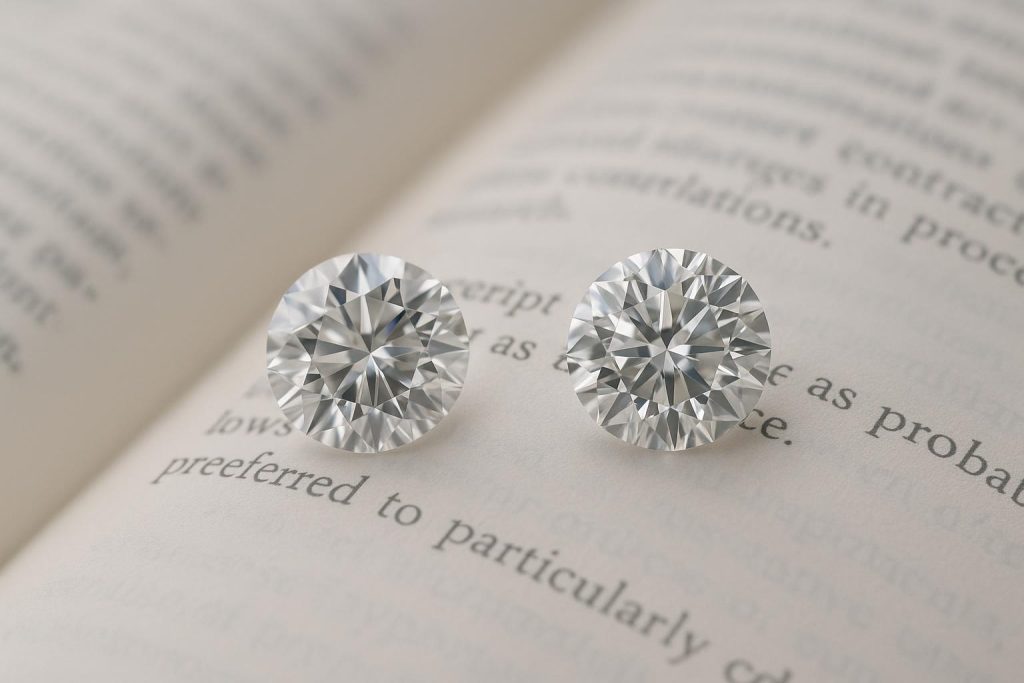
Clarity is the grade buyers ask about first and understand least. It sounds like a measure of how clear a diamond looks, which is reasonable and not quite right. Clarity is a laboratory judgement, made under magnification, about features most people will never see with the naked eye. Knowing what it does and does not describe is the difference between choosing a stone deliberately and paying for a letter on a report.
What the clarity grade actually measures
Contents
A grader assesses a diamond under 10x magnification, looking for inclusions inside the stone and blemishes on its surface, then places it on a scale. From the top: Flawless, Internally Flawless, Very Very Slightly Included (VVS1 and VVS2), Very Slightly Included (VS1 and VS2), Slightly Included (SI1 and SI2), and Included (I1 to I3).
Two things follow from that. The scale is calibrated to magnification rather than to the eye, so a diamond can drop several grades before anything becomes visible at arm’s length. And it describes character as much as quality: inclusions are the marks of how a stone formed, and no two maps of them are identical.
Where the scale stops being something you can see
For most buyers the useful question is not how high up the scale to go, but where the difference stops showing. Somewhere in the upper middle of the scale, inclusions become a matter for the loupe alone.
Buyers who go looking for vvs diamonds are usually chasing exactly that reassurance. At that level the inclusions tend to be pinpoints or faint clouds, difficult to locate even under magnification and invisible without it. A well-cut stone a grade or two lower can look identical face-up to an untrained eye, and to a trained one without a loupe in hand.
The word the trade uses is eye-clean: no inclusions visible to the naked eye at normal viewing distance. It is not a graded term, which is precisely why it is worth asking a jeweller to confirm it in writing rather than assuming it from the letters on a report.
Shape changes how forgiving clarity is
Not every cut hides an inclusion equally well. Round brilliants and other brilliant-cut shapes scatter light through dozens of facets, which breaks up the eye’s ability to settle on anything small. Step cuts do the opposite. The long, open facets of an emerald or Asscher cut behave like a window onto the stone, and whatever is inside has fewer places to hide.
If you are drawn to a step cut, clarity deserves more of your attention than it would otherwise. If you are choosing a brilliant, proportion and finish will do far more for the way the stone reads.
Cut is the grade doing the most work
Of the four Cs — cut, colour, clarity and carat — cut is the one that decides whether a diamond looks alive. GIA grades cut from Excellent to Poor; IGI works from Ideal to Poor. A poorly proportioned stone leaks light through the bottom regardless of how clean it is, and no clarity grade compensates for that.
This holds equally for lab-grown and mined diamonds, which are chemically and physically the same material and are graded on the same scale. Simulants are a different matter entirely: cubic zirconia, moissanite and white sapphire are not diamonds, and the four Cs do not describe them.
Ask for the report before you ask for the grade
Three laboratories carry real weight: GIA, IGI and AGS. IGI is especially established for lab-grown stones and is widely accepted across the Middle East. A grading report tells you which laboratory assessed the diamond, its measured proportions and where it sits on each scale — and, more usefully, it lets you compare two stones on identical terms.
FYNE, the Middle East’s first lab-grown diamond jewellery brand, ships every engagement ring with an IGI certificate for that reason, and can source GIA on request for bespoke pieces. Whoever you buy from, a report you can read yourself is worth more than a grade you were quoted across a counter.
Buy the stone, not the letter
Clarity is worth understanding precisely so that it can take its proper place: one grade among four, and rarely the one that decides how a diamond actually looks. Find the point on the scale where the stone is clean to your eye, put the rest of your attention into cut, and buy from someone willing to hand over the paperwork before you ask twice.