


Turning Customer Insights into Measurable Growth
Contents
- Turning Customer Insights into Measurable Growth
- Revenue Leaks Happen in Transitions, Not Stages
- Most Growth Problems Are Mid-Funnel, Not Top-of-Funnel
- Messaging Gaps Often Hurt More Than UX Issues
- Late-Stage Conversions Depend on Risk Reduction
- Activation Is the Silent Revenue Multiplier
- Prioritize Based on Financial Impact, Not Internal Noise
- From Mapping to Growth Engineering
- Author Bio
Customer journey maps are thoughtful, detailed, and often visually impressive. They show how buyers move from awareness to consideration, evaluation, purchase, and beyond. They capture emotional states, objections, motivations, and touchpoints.
But in most organizations, journey maps rarely influence real revenue decisions.
They exist in strategy decks. Revenue conversations happen elsewhere, in pipeline reviews, sales meetings, and budget planning sessions.
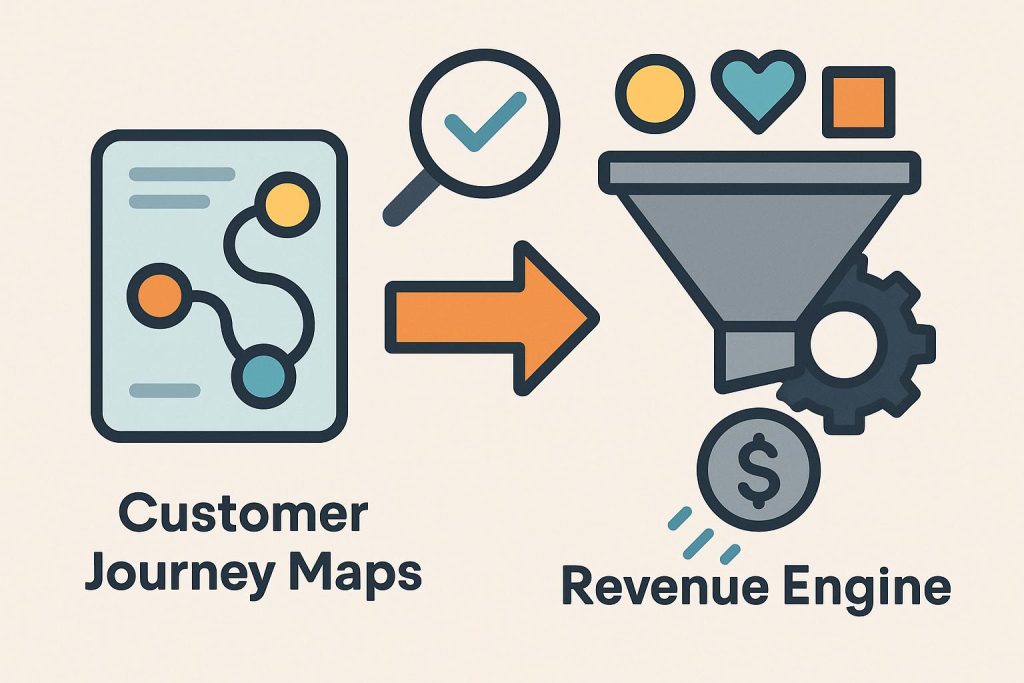
If you want your journey map to drive growth, it must move beyond empathy and into execution. That shift happens when every insight is tied to measurable financial impact. That is the true essence of customer journey optimization, turning behavioral insights into systematic revenue improvements.
Below is how to make that transition, with clear actions you can implement immediately.
Revenue Leaks Happen in Transitions, Not Stages
Most journey maps are organized by stages like awareness, consideration, and decision. But revenue doesn’t disappear because of a “stage.” It drops at specific transition points between actions.
For example, you may have strong traffic but weak click-through to product pages. Or many visitors reach pricing, but few request demos. In SaaS, one of the most common bottlenecks is between demo and close, often due to unclear differentiation or weak value articulation during sales conversations.
These are not abstract issues. They are measurable drop-offs in conversion rates.
When you overlay actual performance data onto your journey map, patterns emerge. Instead of describing “confusion,” you identify that a large percentage of pricing-page visitors leave without action. That’s a revenue constraint.
Action to take:
- Pull conversion rates between every funnel step (visitor → lead → demo → close).
- Identify the largest percentage drop.
- Prioritize optimizing that transition before adding more traffic.
Most Growth Problems Are Mid-Funnel, Not Top-of-Funnel
When revenue slows, the reflex is to increase acquisition. More ads. More content. More traffic.
But many companies already generate sufficient traffic. The real constraint lies in persuasion and conversion deeper in the funnel.
Imagine generating hundreds of demo requests but closing only a small percentage. Improving that close rate by even a few percentage points can generate significantly more revenue than increasing traffic by 30%.
Mid-funnel improvements multiply existing demand instead of chasing new attention. This is where practical customer journey optimization shifts from theory to financial leverage.
Journey mapping helps you see whether the real issue is awareness, or conversion efficiency.
Action to take:
- Compare each stage’s conversion rate to benchmarks or past performance.
- Model revenue impact of improving each stage by 5–10%.
- Invest first in the stage with the highest projected financial upside.
Messaging Gaps Often Hurt More Than UX Issues
Low conversions are frequently blamed on design or user experience. While usability matters, messaging misalignment is often the real culprit.
If your pricing page shows numbers before reinforcing value, prospects anchor to cost instead of outcomes. If product pages list features without translating them into measurable benefits, buyers struggle to justify the purchase internally. If case studies lack quantifiable results, credibility weakens.
Effective customer journey optimization requires listening beyond analytics dashboards. Real journey insights should come from analyzing sales call recordings, lost-deal reasons, chat logs, and support tickets. Repeated objections signal messaging gaps, not just design flaws.
When objections are directly addressed in marketing assets, conversion rates improve without rebuilding the entire experience.
Action to take:
- Review recent sales calls or lost-deal notes.
- Identify the top recurring objections.
- Update landing pages, pricing pages, and case studies to directly address those concerns.
Late-Stage Conversions Depend on Risk Reduction
As prospects approach purchase, hesitation rarely centers on price alone. It’s about perceived risk.
Buyers worry about implementation complexity, ROI uncertainty, internal approval challenges, and the consequences of making the wrong choice. These concerns often delay decisions more than cost considerations.
Your journey map should clearly highlight where risk perception spikes, usually right before commitment. Strong customer journey optimization at this stage focuses on reducing uncertainty.
Reducing risk perception can dramatically improve close rates. Transparent onboarding timelines, ROI projections, customer testimonials from similar industries, and clear guarantees reduce uncertainty and increase confidence.
Marketing and sales alignment plays a crucial role here.
Action to take:
- Add implementation timelines and onboarding expectations to sales materials.
- Create ROI calculators or industry-specific proof.
- Place strong trust signals near decision-stage CTAs.
Activation Is the Silent Revenue Multiplier
Many businesses focus intensely on acquisition but underinvest in activation. Yet early user behavior strongly predicts retention and lifetime value.
If users don’t experience meaningful value quickly, churn risk increases, even if acquisition numbers look strong.
Your journey map should define the “aha moment”, the first action that clearly demonstrates value. Then measure how many users reach it and how long it takes.
Advanced customer journey strategy doesn’t stop at conversion. It ensures users achieve value fast enough to justify renewal, expansion, or advocacy.
Small improvements in activation rates can generate compounding revenue over time, often exceeding gains from incremental traffic increases.
Activation is not just onboarding. It’s long-term revenue insurance.
Action to take:
- Clearly define your activation milestone.
- Measure the percentage of users reaching it within the first 7–14 days.
- Introduce onboarding emails, guided flows, or in-app prompts to improve completion rates.
Prioritize Based on Financial Impact, Not Internal Noise
Marketing teams are constantly pulled toward new initiatives, redesigns, new channels, trend-driven tactics.
A revenue-focused journey map filters distractions by forcing one question:
What generates the highest revenue lift?
Before acting on any insight, estimate its potential financial impact. If improving pricing-page conversion by one percentage point generates substantial annual revenue, it deserves priority. If redesigning a blog layout has unclear impact, it can wait.
Revenue modeling creates discipline and clarity.
Action to take:
- Estimate revenue impact using: Traffic volume × conversion lift × average deal/order value.
- Rank initiatives by projected gain.
- Focus on the top one or two highest-impact optimizations per quarter.
From Mapping to Growth Engineering
Customer journey maps begin as empathy tools. That’s valuable.
But real growth happens when empathy turns into execution, when insights are tied to metrics, objections become messaging improvements, risks are reduced, activation is optimized, and priorities are determined by financial modeling.
At that point, your journey map stops being documentation.
It becomes a growth engine.
Turning customer journey insights into revenue requires coordinated execution across acquisition, messaging, automation, and optimization, which is why many brands rely on structured digital marketing services that align strategy with measurable performance outcomes.
Author Bio
Ankur Sharma is the CEO of Brandshark, a creative full-suite digital marketing agency that helps brands grow through a blend of strategy, creativity, SEO, paid media, and conversion-focused execution. With experience working across competitive industries, Ankur focuses on building integrated marketing systems where creativity and performance work together to drive consistent, measurable business growth.