


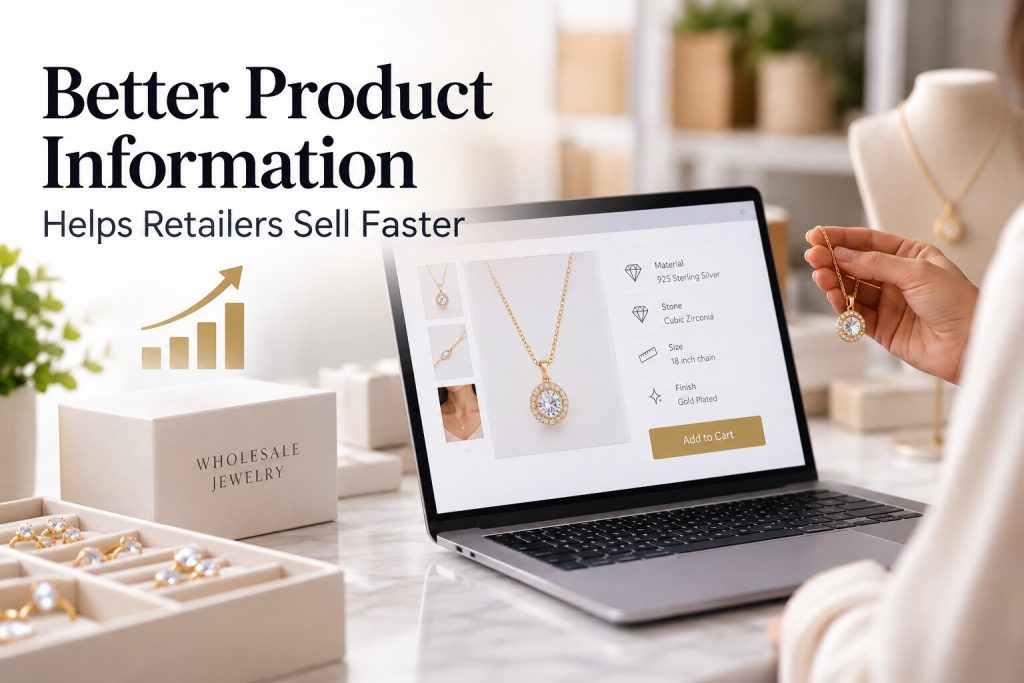
In retail, customers usually want answers before they are ready to buy. They want to know what a product is made from, how big it is, what it looks like in real life, how it should be used, and whether it suits what they are looking for.
When retailers provide clear and complete product information, buying becomes easier.
This is especially important in jewelry, where small details such as metal type, stone size, dimensions, finish, chain length, or ring size can influence a purchasing decision. Retailers that receive accurate product information from their wholesale jewelry suppliers can create better listings, answer customer questions faster, and move products more efficiently.
Why Product Information Matters in Retail
Contents
- Why Product Information Matters in Retail
- Clear Product Titles Help Customers Find Products Faster
- Detailed Descriptions Build Customer Confidence
- Accurate Specifications Reduce Returns
- Better Images Work Together With Better Information
- Good Product Information Improves Search Visibility
- Complete Information Makes Selling Across Multiple Channels Easier
- Better Information Helps Sales Teams Answer Questions Faster
- Good Product Data Makes Marketing Easier
- Customers Buy Faster When Questions Are Answered Early
- Final Thoughts
A customer shopping online cannot physically touch, measure, or examine a product before purchasing it. The product page has to provide the information that a salesperson would normally explain in a store.
If important details are missing, customers may hesitate.
For example, a shopper interested in a sterling silver ring may want to know:
- Is it made from 925 sterling silver?
- What is the width or face measurement?
- What type of stone does it have?
- Is the finish polished or oxidized?
- Which ring sizes are available?
When these answers are clearly displayed on the product page, the shopper has fewer reasons to leave and search somewhere else.
Good product information reduces uncertainty and makes the buying process simpler.
Clear Product Titles Help Customers Find Products Faster
A good product title should quickly tell the customer what the item is.
Instead of using a vague title such as:
Silver Ring
a retailer can use a more descriptive title such as:
925 Sterling Silver Turquoise Oval Ring with Oxidized Detail
The second title immediately communicates several important details.
It also helps search engines understand the product better.
Including relevant terms such as material, jewelry type, stone, style, and finish can improve product visibility without making the title look unnatural or overloaded with keywords.
Retailers working with organized wholesale jewelry suppliers often have access to structured product information that makes creating accurate titles much easier.
Detailed Descriptions Build Customer Confidence
A strong product description should do more than repeat the title.
It should help the shopper imagine the product.
For jewelry, this may include information about:
- Metal composition
- Stone type
- Product dimensions
- Finish
- Design details
- Chain length
- Clasp type
- Ring size availability
- Styling ideas
However, product descriptions should still feel natural.
Customers usually do not want to read a block of technical specifications written like a manufacturing sheet. The best descriptions combine practical information with simple, engaging language.
For example:
“A polished 925 sterling silver pendant featuring an oxidized floral design that highlights the detailed metalwork. Its versatile size makes it easy to wear with casual or everyday outfits.”
This tells the customer what the product is while also helping them understand how it may look when worn.
Accurate Specifications Reduce Returns
Returns are expensive for retailers.
They involve shipping costs, processing time, inventory handling, and sometimes damaged packaging or products that cannot easily be resold.
Many returns happen because the product was different from what the customer expected.
Clear specifications help prevent this problem.
If a pendant measures 25 mm, state the measurement.
If a bracelet is 7.5 inches long, include the length.
If a ring has an 8 mm face measurement, mention it clearly.
Customers can then make a more informed decision before placing an order.
For retailers purchasing from wholesale jewelry vendors, accurate specifications from the supplier also save significant time because the retailer does not have to measure and document every product manually.
Better Images Work Together With Better Information
Product information is not limited to text.
Images are one of the most important parts of an online product listing.
A strong jewelry listing may include:
- A clean front image
- A side-angle image
- A close-up showing details
- A lifestyle image showing scale
- An infographic with dimensions
- Images showing available colors or stones
Customers often use images to confirm the information written in the description.
For example, if a listing says a ring has oxidized detailing, a close-up image should clearly show those darker recessed areas.
When images and written information match, the product page feels more reliable and professional.
Good Product Information Improves Search Visibility
Search engines depend heavily on information.
A product page containing useful details gives search engines more context about what the retailer is selling.
For example, a product page may naturally include phrases such as:
“925 sterling silver hoop earrings”
“oxidized sterling silver pendant”
“turquoise silver ring”
“sterling silver chain bracelet”
These descriptive terms can help products appear for more relevant searches.
The goal is not to repeat keywords unnecessarily. Instead, retailers should describe products accurately using the same language customers are likely to use when searching.
Better product data can therefore support both SEO and the shopping experience.
Complete Information Makes Selling Across Multiple Channels Easier
Many retailers no longer sell through only one website.
The same products may appear on:
- Amazon
- Walmart
- eBay
- Etsy
- Shopify
- Google Shopping
- Social commerce platforms
Each marketplace may require different product fields, but most of them depend on the same basic product data.
A retailer that already has organized information such as material, dimensions, stone type, product type, finish, SKU, and images can create new marketplace listings much faster.
This is where receiving structured information from a wholesale jewelry supplier becomes especially valuable.
Instead of researching each product again, retailers can adapt existing product data for different sales channels.
Better Information Helps Sales Teams Answer Questions Faster
Product information also matters outside the website.
Retail staff regularly receive questions through email, chat, social media, WhatsApp, and phone calls.
A shopper may ask:
“What size is this pendant?”
“Does this ring come in size 8?”
“What type of clasp does the bracelet use?”
“Is this sterling silver?”
If product information is organized and easy to access, staff can respond immediately.
Fast answers keep customers engaged and reduce the chance of losing a sale while someone waits for more information.
Good Product Data Makes Marketing Easier
Retailers constantly create content for:
- Email campaigns
- Social media
- Paid advertising
- Google Shopping
- Product catalogs
- Promotions
- Blog posts
Accurate product information gives marketing teams more material to work with.
Instead of writing generic advertisements such as “Beautiful silver jewelry available now,” they can create more specific messages around particular materials, styles, stones, and designs.
Specific marketing usually feels more useful because it gives shoppers a clear reason to click.
Customers Buy Faster When Questions Are Answered Early
One of the biggest advantages of complete product information is simple: it removes hesitation.
Every unanswered question can slow down a purchase.
A customer who cannot find the ring size may leave.
A customer who cannot tell how large a pendant is may delay the purchase.
A customer who is unsure about the metal type may look for another seller.
When the information is already available, the path from browsing to purchasing becomes shorter.
Final Thoughts
Selling faster is not always about offering bigger discounts or spending more money on advertising.
Sometimes the biggest improvement comes from making products easier to understand.
Clear titles help customers find the right item. Detailed descriptions explain what they are buying. Accurate measurements manage expectations. High-quality images show important details. Organized specifications make it easier to sell across multiple marketplaces.
For retailers, better product information creates a smoother buying experience while reducing unnecessary questions, listing work, and potential returns.
When customers understand a product clearly, they can make purchasing decisions with greater confidence—and that can turn more product views into actual sales.