


Product durability is closely linked to how materials respond when subjected to sudden forces. A component that performs well under normal loading may behave differently under an unexpected impact. For manufacturers, understanding this behaviour during product development can help identify material limitations and guide design decisions before production is scaled up.
To achieve this goal, the use of a Combined Impact Testing Machine would enable manufacturers to test how their material behaves under sudden impact in a controlled environment. The ability to combine several impact testing methods into a single machine makes it possible for laboratories to test material behaviour using several testing methods at once.
What Is a Combined Impact Test Machine?
Contents
- What Is a Combined Impact Test Machine?
- What Does a Combined Impact Test Machine Measure?
- How Izod and Charpy Testing Work on One Machine
- Technical Features That Influence Test Reliability
- Digital Controls and Data Management for Quality Control
- Why Standardized Impact Testing Matters
- How Impact Testing Supports Safer Product Development
- Applications Across Materials and Manufacturing
- What Should Manufacturers Consider Before Buying?
- Choosing Impact Equipment for Long-Term Product Reliability
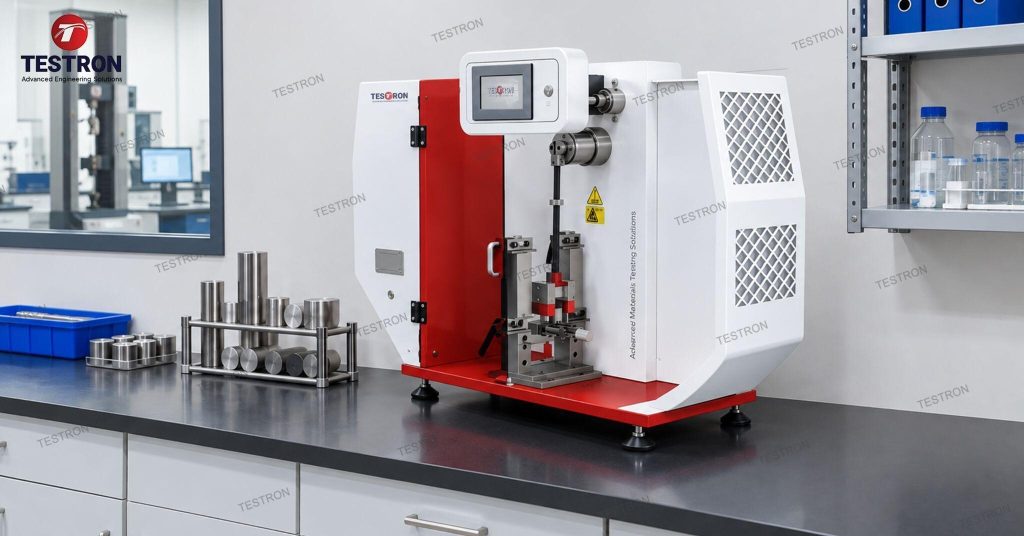
A Combined Impact Test Machine is laboratory equipment used to examine how a material behaves when it receives a sudden force. Rather than applying the load gradually, this machine uses an impact to assess the reaction of the material being tested.
The basic aim of the instrument is to find out the amount of impact force a material can tolerate before it is broken or damaged. This information is very useful to manufacturers in finding out the durability of the material. They can also learn which material would be more suitable for making such products that are susceptible to shocks.
This testing equipment is useful for research, new product development, and even in quality testing of the products. Manufacturers can compare various materials or even check whether a material meets the manufacturer’s requirements of the manufacturer or not.
What Does a Combined Impact Test Machine Measure?
The equipment is designed for evaluating the impact toughness of:
- Hard thermoplastic moulding and extrusion materials
- Hard thermoset moulding materials
This makes Combined Impact Test equipment useful during material development, product validation, and quality control.
Impact testing is not the same as static strength testing. Even if a material does well in one, it doesn’t necessarily mean it will do equally well in the other test because the loading process can be entirely different for each test.
How Izod and Charpy Testing Work on One Machine
Izod Impact Testing
Izod testing uses a cantilever-beam arrangement. The specimen is held vertically in the fixture. A pendulum then strikes the specimen.
When required by the applicable method, the notch creates a defined stress-concentration point. This helps produce a controlled fracture location.
Charpy Impact Testing
Charpy testing uses a simply supported beam arrangement. The specimen rests on supports rather than being clamped at one end.
The pendulum strikes the specimen, and the absorbed energy is determined from the test.
Using both arrangements gives manufacturers more flexibility when evaluating different materials and test requirements. A combined Izod and Charpy impact tester can therefore support laboratories that need both configurations.
The combined system uses interchangeable fixtures and sample holders. The product information states that the Izod and Charpy methods can be switched automatically.
Technical Features That Influence Test Reliability
A reliable Combined Impact Testing equipment system should provide controlled impact conditions and consistent measurements. The available energy range, impact speed, and specimen setup all affect how a material responds during testing.
Flexible Pendulum Energy Options
The machine allows the use of various pendulum energies in Izod and Charpy impact tests. The Izod test may involve pendulums of 2.75 J, 5.5 J, 11 J, and 22 J energies. The Charpy test involves pendulums of energies between 1 J and 50.
This range allows laboratories to select a suitable energy level for different materials. It also makes the equipment more flexible for research, development, and quality-control work.
Controlled Testing Conditions
The machine provides controlled impact speeds of 2.9, 3.5, and 3.8 m/s, depending on the configuration. It also uses defined support distances and impact-edge dimensions for the two testing methods.
These controls help maintain consistent test conditions. This is important because changes in specimen positioning or impact conditions can influence the measured result.
Digital Controls and Data Management for Quality Control
A modern Combined Impact Testing machine also needs dependable measurement and data handling.
The TT-IC22/50D uses a high-precision intelligent controller with an LCD interface. Its design includes a high-strength carbon-fibre swing arm, an imported digital encoder, and imported ball bearings. These components are intended to support stable pendulum movement and precise angle measurement.
The system can also automatically calculate results. It stores up to 24 groups of test data and can calculate average values. Multiple output units are available, including J/m, kJ/m², kg-cm/cm, and ft-lb/in. A built-in micro-printer is also specified for test-result output.
For laboratories, this reduces dependence on manual calculations. It also makes repeated results easier to document and compare.
Why Standardized Impact Testing Matters
Impact results are most useful when testing is carried out under a recognized method. Standardized procedures give manufacturers a consistent basis for evaluating materials and comparing results over time.
The product specifications list standards including ISO 179-2000, ISO 180-2000, JB/T8762-1998, JB/T8761-1998, and ASTM D256-2010. These standards provide established methods for Izod and Charpy impact testing of plastics and related materials.
NIST’s Charpy Machine Verification Program evaluated 1,392 Charpy machines for customers in 55 countries by the end of 2024. During 2024 alone, the program assessed 4,256 sets of indirect verification specimens, representing 20,727 Charpy tests. These figures show the scale of verification activity used to support reliable impact-testing measurements.
For manufacturers, standardized impact testing provides more dependable information for material comparison, product development, and quality control.
How Impact Testing Supports Safer Product Development
A Combined Impact Test Machine can help engineers identify differences between materials before a product enters large-scale production.
For example, manufacturers can compare:
- Different polymer grades
- Material formulations
- Reinforced and unreinforced materials
- Processing conditions
- Different product designs
- Material batches
A lower impact result may indicate that a formulation or processing condition needs further investigation. A higher result may support the selection of a material with greater resistance to sudden loading.
Applications Across Materials and Manufacturing
The equipment is suited to several non-metallic material groups. These include hard thermoplastics, thermoset materials, and fibre-reinforced composites.
Manufacturers can use Combined Impact Testing equipment during:
- New material development
- Prototype evaluation
- Production quality control
- Material-batch comparison
- Process validation
- Product redesign
The results can help engineers understand whether changes in formulation or processing have affected impact behaviour.
A pipe testing machine, by comparison, is intended for application-specific evaluation of pipe products and should not be treated as a substitute for a standardized Izod or Charpy impact system.
What Should Manufacturers Consider Before Buying?
Selecting a Combined Impact Test Machine Supplier requires more than comparing catalogue prices.
Check the Testing Requirements
First, determine:
- Whether both Izod and Charpy testing are required
- Required impact-energy range
- Applicable test standards
- Specimen dimensions
- Required impact velocity
- Data-storage requirements
The laboratory should then confirm that the selected equipment supports the required test configuration.
Consider the Total Investment
The Combined impact test machine price is only one part of the purchasing decision.
When comparing Combined impact test machine manufacturers, buyers should also examine the machine’s measurement system, fixture configuration, available pendulum energies, and documentation.
The same principle applies when selecting a Combined Impact Test Machine Supplier. Support after installation can be important when laboratories need calibration assistance, replacement components, or technical guidance.
Choosing Impact Equipment for Long-Term Product Reliability
A Combined Impact Test Machine can support manufacturers during product development and quality-control processes. It gives testing teams a practical way to evaluate material performance. The results can help with material comparison and product development decisions. It can also make routine laboratory testing more convenient.
For manufacturers considering a Combined Impact Test Machine, Testron Group offers the TT-IC22/50D Combined Impact Test Machine (Izod & Charpy). It is designed to support manufacturers and laboratories involved in material testing. The equipment can be considered according to the laboratory’s testing needs and workflow. This can help manufacturers choose a suitable solution for their testing requirements.