


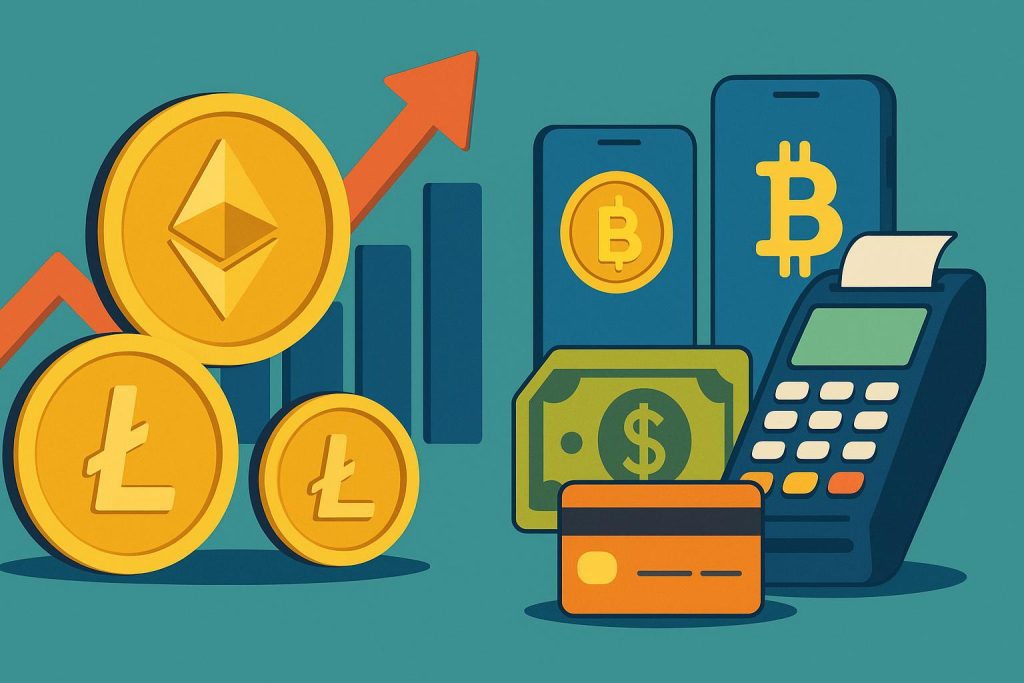
Cryptocurrencies have evolved from an experiment for tech enthusiasts into a versatile financial instrument. By 2026, their use will extend far beyond speculative trading on the stock market. People are using digital assets for long-term wealth building, international money transfers, online leisure activities and even for major purchases. The market has become more complex, but at the same time more accessible to the average user.
This article offers a practical overview of how cryptocurrencies are actually used today. Without grandiose promises or marketing slogans. Just real-life scenarios and an honest discussion of the risks.
Cryptocurrencies as a source of income: what has changed
Contents
- Cryptocurrencies as a source of income: what has changed
- Long-term investments: A calm view of volatility
- Cryptocurrency as a means of payment
- Online entertainment: a new sector for cryptocurrencies
- Major purchases: property and more
- Conclusion
- Frequently Asked Questions
- Has mining changed following Ethereum’s switch to Proof-of-Stake?
- Can you make money from cryptocurrencies without investing?
- Is it safe to hold cryptocurrencies on an exchange?
- How does a crypto casino differ from a traditional online casino?
- In which countries can you buy property using cryptocurrency?
The opportunities to earn money with cryptocurrencies haven’t disappeared, but they have changed. Bitcoin mining still works, although the barrier to entry has risen significantly. Today, it’s more the domain of industrial mining pools with access to cheap energy than private enthusiasts with a few graphics cards.
With Ethereum, it’s a different story. Following the switch to proof-of-stake, traditional mining ceased entirely. ETH holders now stake their coins and receive a reward for participating in the network. The return here isn’t fixed, but it proves sustainable over the long term.
Another interesting mechanism has emerged on the Tron network. Users lock up their TRX and receive power, which can be leased to other members. This does not generate large sums, but it does create a small passive income stream that is particularly noticeable when holding tokens for the long term.
The conclusion is simple. There are ways to make money with cryptocurrencies, and there are more of them. But they all require at least a basic understanding of the technology and a calm attitude towards fluctuations in returns. Without that, it’s better not to get started.
Long-term investments: A calm view of volatility
Holding cryptocurrencies remains a popular strategy. Yes, prices can fluctuate sharply in the short term. Weekly fluctuations of 3–10 per cent are commonplace in this market. However, when viewed over longer periods, a calmer picture emerges.
Despite occasional corrections, BTC and ETH are showing long-term growth. Some assets, such as Tron, have been trading at virtually the same level for several years. This is linked to the expansion of cryptocurrencies’ areas of application. Steady, non-speculative demand is gradually forming the foundation of the market.
What drives this demand? Several key factors can be identified:
- The integration of cryptocurrencies into traditional financial products. Bitcoin and Ethereum ETFs are now available to retail investors via conventional brokerage accounts.
- The growing number of retailers accepting digital assets as a means of payment. From online shops to local shops in tourist towns.
- The use of stablecoins as a hedge against inflation in countries with unstable national currencies.
These factors are not a short-term fad, but form a long-term foundation. They create underlying demand that is less dependent on market sentiment and headlines.
Cryptocurrency as a means of payment
Crypto payments are no longer a rarity. By 2026, sending money abroad via a crypto wallet will be an everyday occurrence for hundreds of thousands of freelancers, digital nomads and simply people who have relatives in other countries.
Fees for cross-border bank transfers remain high. A cryptocurrency transaction is cheaper and faster. You don’t have to wait several working days or explain the origin of the funds to the bank.
Here is a clear comparison:
- SWIFT transfer from Europe to Asia: one to three working days, fees between 15 and 50 euros, depending on the bank.
- Cryptocurrency transfer in stablecoins: 30 seconds to a few minutes, fees rarely exceeding 1–2 dollars on the Tron or Solana networks.
The difference is particularly noticeable with small amounts. Sending 100 euros to relatives via bank transfer is often pointless – the fees eat up a significant portion of it. Cryptocurrencies solve this problem.
Online entertainment: a new sector for cryptocurrencies
Digital entertainment is one of the fastest-growing areas of application for cryptocurrencies. Gaming platforms accept digital assets for the purchase of skins, subscriptions and in-game items. However, growth is particularly pronounced in the gambling sector.
Crypto casino Dexsport offers users an experience that traditional services cannot match: instant deposits, no red tape and complete transparency in settlements.[a] ‘Provably Fair’ technology makes it possible to verify the fairness of every round without having to trust the operator. This is a mathematical guarantee.
Crypto casinos without KYC are currently gaining popularity. Users appreciate the ability to start playing without having to upload documents and without lengthy verification processes. Deposits from the wallet are credited immediately. Withdrawals are processed automatically, without manual checks or delays. This is not a marketing gimmick, but a structural advantage of the blockchain.
There is another important aspect – the security of funds. In a traditional casino, the player entrusts their money to the operator. If the platform freezes the account or delays a withdrawal, the user has little recourse. Disputes are resolved through lengthy processes and are not always decided in the customer’s favour. In crypto casinos, funds are managed via a smart contract. The withdrawal terms are hard-coded and cannot be altered retrospectively. This does not mean there are no risks at all. But the nature of the risks is different – they are technical in nature and do not depend on the integrity of a particular manager.
How to choose the right platform and avoid mistakes
The market for crypto casinos is growing rapidly, and with it the number of providers is also rising. To keep track of things amidst this variety, you should bear a few simple guidelines in mind.
Take a look at the independent crypto casino comparison. Comparison tables highlight the actual fees, withdrawal speeds and the pitfalls of bonus schemes. Five minutes spent studying these comparisons will save you stress and money.
Check out the ‘User Experiences – Secure’ section. Genuine player reviews paint a picture that you can’t get from advertising copy. If a platform delays payouts or demands additional verification after a win, this quickly becomes public knowledge.
Pay attention to the bonus terms and conditions. A crypto casino bonus may seem tempting, but the wagering requirements sometimes render it worthless. Reputable providers set wagering requirements transparently and do not tie the bonus to mandatory verification.
Base your decision on reputation. A reputable crypto casino does not hide information about its licence, does not keep its terms and conditions secret, and does not change them retrospectively. Reputational risks are particularly high in the crypto scene: negative news spreads in a flash.
Major purchases: property and more
Another way to use cryptocurrencies is to buy property. By 2026, such transactions will no longer be a rarity, but they are by no means possible everywhere. Some countries, including the United Arab Emirates, Portugal and certain US states, allow property to be paid for using Bitcoin or stablecoins.
However, it is important to bear in mind that this is not yet common practice. Most sellers still prefer payments in fiat currencies. The process requires the involvement of solicitors familiar with cryptocurrency legislation. The tax implications can be more complex than in a conventional transaction.
Nevertheless, a trend is emerging. Cryptocurrencies are gradually making their way into the property market, particularly in the luxury property segment and in countries with customer-friendly regulations. A buyer from Europe can purchase a flat in Dubai without having to go through multiple bank transfers.
Conclusion
Cryptocurrency in 2026 is neither a speculative bubble nor a magic bullet for getting rich quick. It is a technology that offers alternative ways to earn money, save, make payments and enjoy leisure activities.
It does not replace the traditional financial system, but complements it. It offers greater control over one’s own assets. It makes it possible to bypass bureaucratic hurdles. It requires knowledge and caution. And as practice shows, it rewards those who approach it consciously and not under the influence of emotions.
Frequently Asked Questions
Has mining changed following Ethereum’s switch to Proof-of-Stake?
Yes, and significantly so. Mining ETH using graphics cards has been completely discontinued. ETH holders can now only stake – that is, use their assets within the network to generate passive income. This is less energy-intensive and also requires no hardware. Bitcoin is still mined using traditional methods on specialised hardware.
Can you make money from cryptocurrencies without investing?
It is practically impossible to earn money directly without making an investment. Staking requires owning coins; mining requires the appropriate hardware and the purchase of energy; and on Tron, it involves locking up tokens.
Is it safe to hold cryptocurrencies on an exchange?
Holding assets on an exchange is convenient for active trading, but it carries risks. Exchanges can be hacked, accounts can be frozen, or access conditions can be changed. For long-term storage, it is safer to use non-custodial wallets, where only the owner controls the private keys.
How does a crypto casino differ from a traditional online casino?
The main difference lies in the architecture. A crypto casino is based on smart contracts, does not require mandatory identity verification and processes withdrawals via the blockchain. A traditional casino requires documents, uses bank transfers and may delay withdrawals by several days.
In which countries can you buy property using cryptocurrency?
The most cryptocurrency-friendly countries are the United Arab Emirates, Portugal, some US states and Thailand. In these countries, there are property developers and sellers who are willing to accept Bitcoin and stablecoins. However, before making a purchase, you should consult a local solicitor and clarify your tax obligations.