


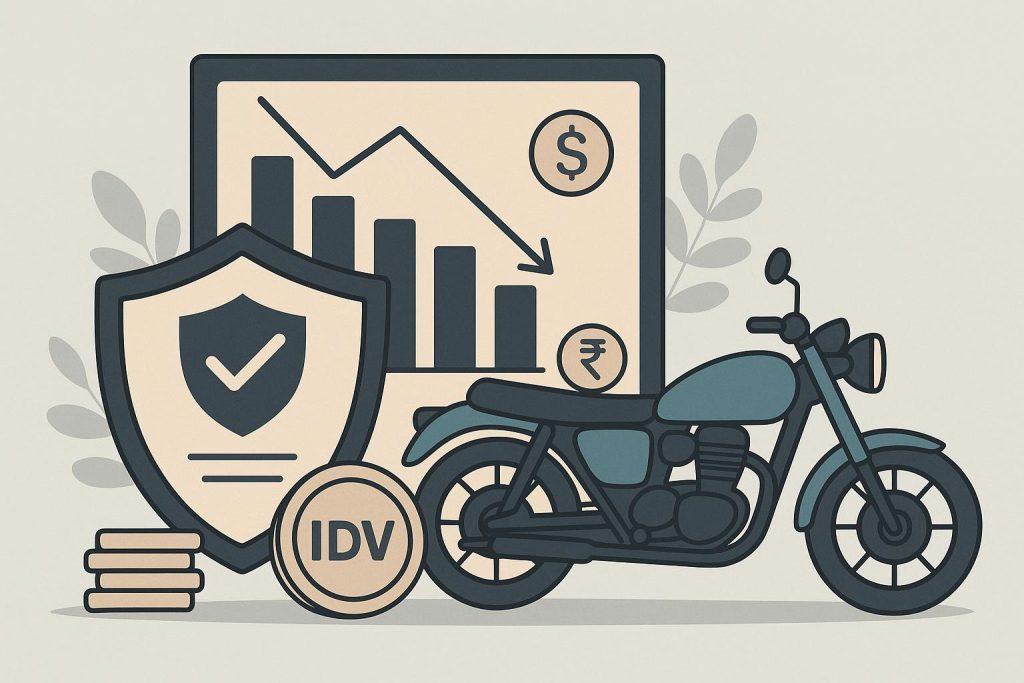
When you buy or renew your policy, you will often come across terms that influence your coverage and claim amount. One of the most important among them is IDV in bike insurance, which determines how much you can receive if your bike is stolen or declared a total loss.
While most riders focus on premium costs, it’s equally important to understand how depreciation steadily brings down this value over time.
What is IDV in Bike Insurance?
Contents
In simple terms, IDV (Insured Declared Value) is the current market value of your bike. In bike insurance, this is the maximum amount your insurer will pay if your vehicle cannot be repaired or is stolen. It is calculated based on the manufacturer’s listed price, adjusted for depreciation depending on the age of the bike.
This value is not fixed and changes every year. As your bike gets older, the IDV reduces, which also impacts your coverage.
Understanding Depreciation in Bikes
Depreciation refers to the natural reduction in your bike’s value due to age, usage and wear and tear. The moment a new bike leaves the showroom, its value begins to drop. Insurance providers typically follow standard depreciation slabs, which increase gradually year after year.
Apart from age, factors like the condition of the bike, frequency of use and even the popularity of the model in the resale market can influence how quickly it depreciates.
How Depreciation Impacts IDV?
The relationship between depreciation and IDV is direct. As depreciation increases, your bike’s IDV decreases. For instance, a new bike will have a higher IDV, close to its purchase price. However, after a couple of years, the value drops significantly.
This reduced IDV directly affects your claim payout. In the event of a total loss or theft, the insurer will compensate you based on the latest IDV. While a lower IDV may slightly reduce your premium, it also means a lower claim amount, which may not always work in your favour.
Why Correct IDV Selection Matters?
Selecting the right IDV is crucial for balanced coverage. If you choose to keep the IDV too low to save on premiums, you risk being uninsured. On the other hand, setting it too high may increase your premium without providing any real benefit during claims.
The ideal approach is to choose an IDV that closely matches your bike’s current market value, ensuring you are adequately protected without overspending.
Tips to Manage Depreciation Impact
Although depreciation is unavoidable, there are ways to manage its effect. Make it a habit to review your IDV at every renewal and adjust it if needed. Avoid choosing an unrealistically low value just to cut costs.
You can also consider add-ons that help minimise out-of-pocket expenses, especially if your bike is relatively new or frequently used.
Conclusion
Depreciation is a gradual but important factor that shapes the value of your bike over time. Understanding how it affects IDV in car insurance can help you make better decisions while buying or renewing your policy. Keeping your coverage aligned with your bike’s real value ensures you are financially prepared for unexpected situations. Opting for a dependable insurer like TATA AIG can further simplify the process and give you added confidence in your bike insurance coverage.