


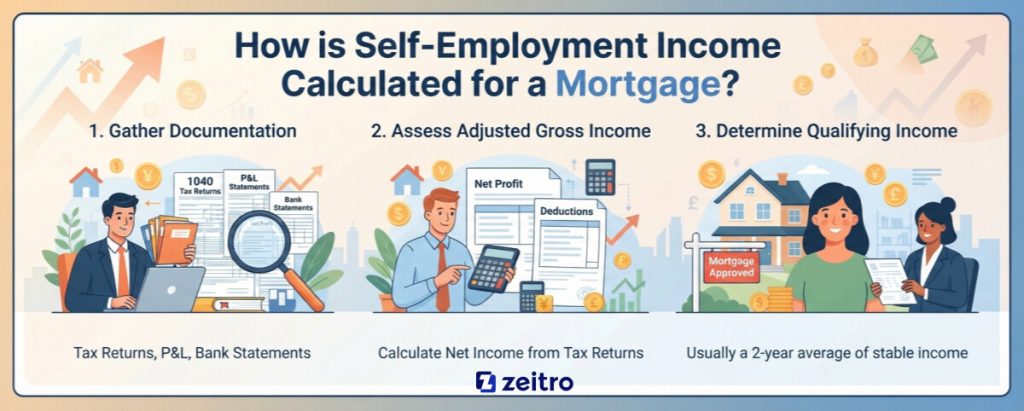
Qualifying a self-employed borrower for a mortgage often turns into one of the most tedious jobs on a loan officer’s desk. W-2 applicants have clear pay stubs and tax statements, but business owners bring stacked tax returns filled with write-offs, depreciation adjustments, and shifting annual revenues.
Because standard tax filings are meant to lower taxable income rather than highlight cash flow, lenders must follow strict Fannie Mae and Freddie Mac guidelines to figure out true qualifying income. The following breakdown shows the exact steps underwriters use to run these calculations accurately.
Mortgage Requirements for Self-Employment Income
Contents
Underwriters look at self-employed borrowers through a completely different lens. While tax accountants work hard to show as little net income as possible on paper, mortgage underwriters need to see proof that a business is stable and actually generating cash. This fundamental difference is why self-employment files require much more documentation up front.
To get a conventional mortgage approved, a self-employed applicant generally needs to meet several key criteria and hand over a full paper trail:
- At least two years in business: Fannie Mae and Freddie Mac usually look for a two-year track record of self-employment in the same line of work. A one-year history only works under rare conditions, such as when automated underwriting systems like DU or LPA approve it based on a strong prior career background in the exact same field.
- The 25% ownership threshold: If a borrower owns 25% or more of a business, lenders treat them as self-employed. That means corporate tax returns come into play alongside personal ones.
- Personal tax filings: Lenders require two years of signed federal returns (Form 1040), along with all attached schedules like Schedule C for sole proprietors or Schedule E for rental and supplemental income.
- Business tax filings: When the 25% ownership mark is met, the file must include two years of complete business returns—such as Form 1065 for partnerships or Form 1120-S for S-corps—plus all Schedule K-1s.
- Recent Profit and Loss (P&L): A year-to-date P&L statement and balance sheet signed by the borrower are required to confirm that current-year earnings match up with past tax returns.
How to Calculate Self-Employment Income for a Mortgage?
Underwriters do not just look at top-line revenue or gross receipts. Instead, they work through tax returns line by line using standard cash-flow worksheets, primarily Fannie Mae Form 1084 or Freddie Mac Form 91. The goal is to turn taxable income back into actual qualifying cash flow through a clear step-by-step process.
- Find the starting net income: The calculation begins with the net taxable profit. On a Schedule C for sole proprietorships, this is Line 31. For S-corporations or partnerships, underwriters pull pass-through earnings or owner distributions reported across Schedule K-1s and Form 1040.
- Add back paper losses and non-cash expenses: The IRS lets business owners deduct expenses that did not actually take cash out of their bank accounts. Lenders add these non-cash deductions back into the net profit to raise qualifying income. Common add-backs include:
- Depreciation (Line 13 on Schedule C)
- Depletion (Line 12 on Schedule C)
- Amortization of intangible business assets
- Depreciation from the business use of a home
- The depreciation portion embedded in standard vehicle mileage deductions
- Depreciation (Line 13 on Schedule C)
- Subtract non-recurring income: One-time capital gains, insurance payouts, or unusual non-operating income must be removed. If an income stream will not realistically continue for at least three more years, underwriters cannot count it.
- Factor in multi-year trends: Lenders always check whether the business is growing or shrinking. If income is steady or rising year-over-year, the lender averages the two years together. But if income dropped in the most recent tax year, lenders will not average the figures; they use only the lower, most recent 12-month total. A steep drop—often anything over 20%—can cause the file to be declined.
- Divide down to a monthly average: Once the adjusted annual totals are set, combine the qualifying years and divide by 24 months (or 12 months if using only the lower recent year).
Here is a realistic example of how an underwriter reviews a sole proprietor over a two-year period:
- Year 1: Net Profit = $52,000 | Depreciation Add-Back = $8,000 | Adjusted Total: $60,000
- Year 2: Net Profit = $58,000 | Depreciation Add-Back = $6,000 | Adjusted Total: $64,000
Since Year 2 income grew compared to Year 1, the lender averages both years:
($60,000 + $64,000)÷24 months=$5,166.67 Monthly Qualifying Income
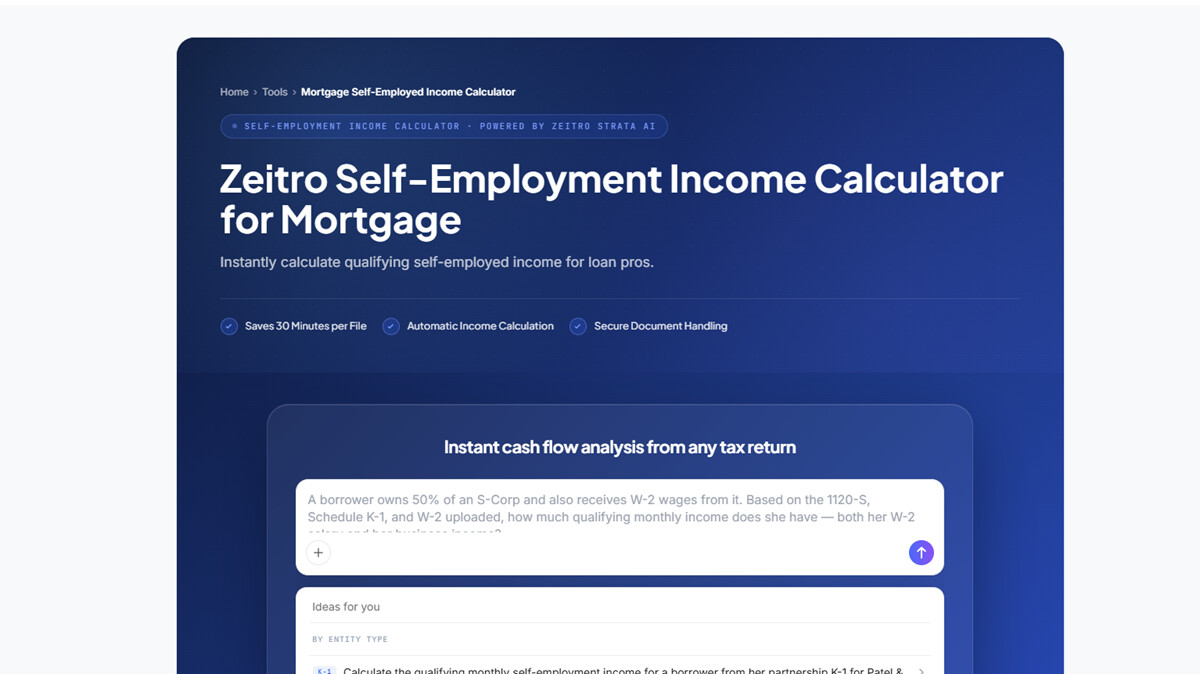
Note on Modern Income Calculation: Manually working through multi-page tax returns and cross-referencing line items on Fannie Mae Form 1084 takes valuable time and leaves plenty of room for math mistakes. While generic AI tools are becoming common in mortgage offices, they frequently misread tax schedules and ignore strict agency rules. Purpose-built tools like the Zeitro Self-Employment Income Calculator offer a far better path for loan officers. It reads tax documents directly, handles complex Fannie Mae add-backs automatically, and delivers secure, fully compliant monthly income figures in seconds.

Tips on Calculating Self-Employment Income
Handling self-employed borrower files smoothly comes down to catching small tax details before underwriting flags them. Here are a few practical tips loan officers can use to protect their pipeline:
- Do not miss mileage depreciation: When borrowers claim the standard mileage rate instead of actual auto expenses, part of that mileage rate represents vehicle depreciation. Calculating that specific mileage depreciation add-back adds real dollars back to the borrower’s qualifying income.
- Check K-1 liquidity before counting income: S-corp or partnership earnings listed on a Schedule K-1 only count if the business has enough liquidity to actually pay those earnings out. If the company cannot afford distributions, underwriters will throw that income out.
- Compare the YTD P&L early on: Never wait until closing to check the current year’s numbers. If the year-to-date P&L shows a sudden drop in revenue compared to last year’s tax return, the underwriter may reduce the qualifying income or pause the loan.
- Ditch manual spreadsheets for real automation: Transcribing numbers by hand onto Form 1084 worksheets is a leading cause of calculation errors and buyback demands. Using a specialized tool like Zeitro‘s calculators eliminates manual entry, speeds up pre-approvals, and keeps files aligned with agency standards.
Final Word
Calculating self-employment income for a home loan requires a solid understanding of both tax accounting and secondary market underwriting rules. Once loan officers know how to apply non-cash add-backs and spot income trends, reviewing these files becomes far easier. To skip the tedious math and avoid manual errors on complex returns, loan officers can rely on the Zeitro Self-Employment Income Calculator to get accurate, compliant qualifying income figures in a fraction of the time.