


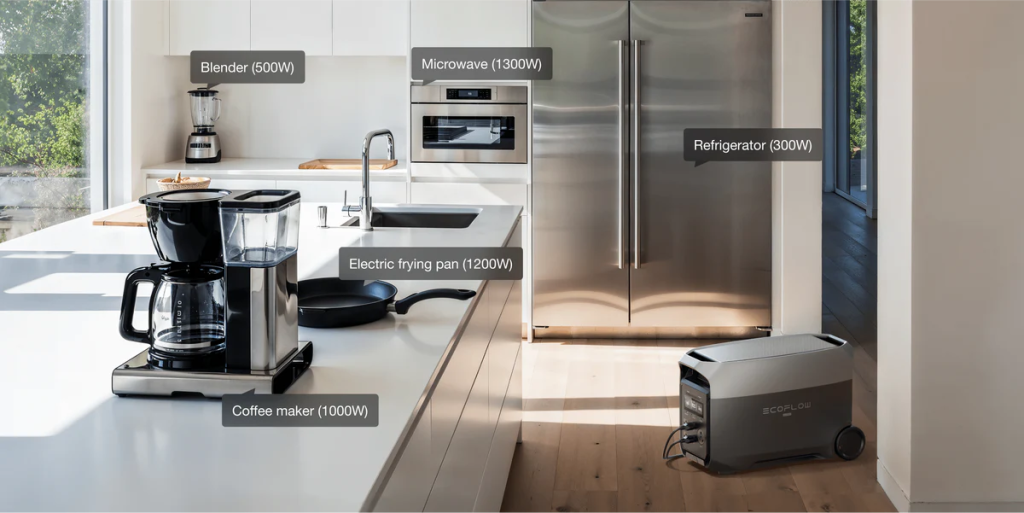
Yes, if emergency backup means keeping a refrigerator, internet equipment, a few lights, and phones running through a short outage or one carefully managed day. No, if it means operating central air conditioning, electric heat, a water heater, and the rest of the home as usual.
The answer depends on three numbers: usable battery energy, the daily energy consumed by the selected appliances, and the power required when those appliances start. Solar recharging can extend the backup period, but only when the panels replace at least as much energy as the home uses.
Start With 2kWh, Not 2kW
Contents
A 2kWh rating means the battery stores about 2,000 watt-hours of energy. It does not mean the system can deliver 2,000 watts continuously, and it does not guarantee two hours of runtime. Output power and stored energy are separate specifications.
For a rough AC backup estimate, it is reasonable to treat a nominal 2,000Wh battery as roughly 1,600 to 1,700Wh of planning energy after conversion losses and a small reserve. The exact usable amount depends on the model, output type, battery settings, temperature, and standby consumption.
Estimated runtime = usable battery energy (Wh) / average load (W)
A Realistic 24-Hour Essential-Load Example
The following example represents a household trying to preserve food, communications, basic lighting, and device charging. The refrigerator value should come from a 24-hour measurement or its EnergyGuide consumption rather than its highest running wattage.
| Load | Planning assumption | Energy per day |
|---|---|---|
| Refrigerator | Measured 24-hour use | 1.20 kWh |
| Router and modem | 15 W x 24 hours | 0.36 kWh |
| LED lighting | 30 W x 4 hours | 0.12 kWh |
| Phones and one laptop | Limited charging | 0.15 kWh |
The total is 1.83 kWh per day. A 2kWh power station with about 1.6 to 1.7 kWh available through its AC outlets would fall slightly short of 24 hours in this example. Reducing lighting and laptop charging could close the gap. An older refrigerator, a hot kitchen, frequent door opening, or an added CPAP machine could widen it.
If the refrigerator alone uses 1.2 kWh per day, the same battery could theoretically support it for more than a day. That does not translate into a guaranteed runtime because the refrigerator’s cycling pattern and the power station’s idle consumption also matter.
High-Wattage Appliances Drain 2kWh Quickly
Heating and cooling change the answer immediately. A 1,500W space heater can consume about 1.5 kWh in one hour. A 1,000W window air conditioner can use most of the practical battery capacity in less than two hours if it runs continuously. Central air conditioning and electric resistance heating generally require a larger system and a circuit-level installation.
Short cooking loads are possible but still expensive in energy terms. A 1,200W microwave running for ten minutes uses about 0.2 kWh. Several cooking cycles, an electric kettle, and a coffee maker can remove a meaningful share of a battery that also needs to protect the refrigerator overnight.
Capacity Does Not Show Whether an Appliance Will Start
Two power stations can both store 2kWh but support very different appliances. Refrigerators, sump pumps, power tools, and air conditioners draw extra power when their motors or compressors start. The station’s continuous output must cover the normal simultaneous load, while its surge rating must cover the brief starting peak.
Check the appliance label or manufacturer data rather than applying a universal multiplier. A system may have enough stored energy to run a pump for several hours and still shut down immediately if its inverter cannot handle the startup demand.
What Changes Within the 2kWh Class?
Best solar generator for home backup options in EcoFlow’s 2kWh class show why equal capacity does not mean equal backup capability. The DELTA 3 Max provides 2,048Wh capacity, 2,400W output, and 4,800W surge output. The DELTA 3 Max Plus keeps the same 2,048Wh capacity but increases output to 3,000W, surge output to 6,000W, and solar input to 1,000W.
For a refrigerator, router, and lights, either output level may be sufficient. The higher-output model becomes more relevant when a sump pump, microwave, or another demanding appliance must operate. Its higher solar input can also matter during a multi-day outage because it allows more energy to be collected during a limited charging window.
Solar Recharging Determines Whether Backup Can Continue
Solar panels do not make a 2kWh battery unlimited. Daily generation has to replace daily consumption. A 400W array receiving four useful sun hours produces 1.6 kWh before losses. Using a conservative 70% planning yield leaves about 1.12 kWh, which would not replace the 1.83 kWh used in the example above.
An 800W array under the same assumptions produces about 2.24 kWh after the planning reduction, enough to cover the example on a favorable day. Cloud cover, shading, heat, panel angle, and the station’s input limit can reduce that result. Multi-day planning should use expected poor-weather production, not the best output seen at noon.
When 2kWh Is Enough
A 2kWh solar generator is a practical size for short outages when the household limits backup to refrigeration, communications, modest lighting, and device charging. It can also cover a carefully controlled overnight medical load if that device’s consumption is measured and included in the energy budget.
For a full day, the margin becomes narrow. For several days, a 2kWh system needs dependable recharging or additional battery capacity. It should be treated as an essential-load system, not as a substitute for normal household electricity use.
When More Capacity Is the Better Decision
Choose a larger or expandable system when the home must support a refrigerator and freezer, medical equipment, a well or sump pump, or cooling during hot-weather outages. More capacity is also appropriate when outages regularly exceed one day and solar production is uncertain.
The simplest test is to compare measured daily essential energy with realistic usable battery energy. If the essential load already approaches 2kWh per day, a 2kWh battery offers almost no allowance for losses, changing weather, battery aging, or an unplanned appliance. Expansion is then part of the requirement rather than an optional upgrade.
The Bottom Line
A 2kWh solar generator can provide meaningful emergency home backup, but only within a defined load plan. It is well suited to a refrigerator, internet equipment, limited lighting, and charging through a short outage. It is not enough for whole-home operation or sustained electric heating and cooling.
Before buying, measure the appliances that must remain on, verify their startup requirements, and estimate how much solar energy can realistically be collected each day. Those numbers determine whether 2kWh is enough far more reliably than any generic appliance-runtime claim.