


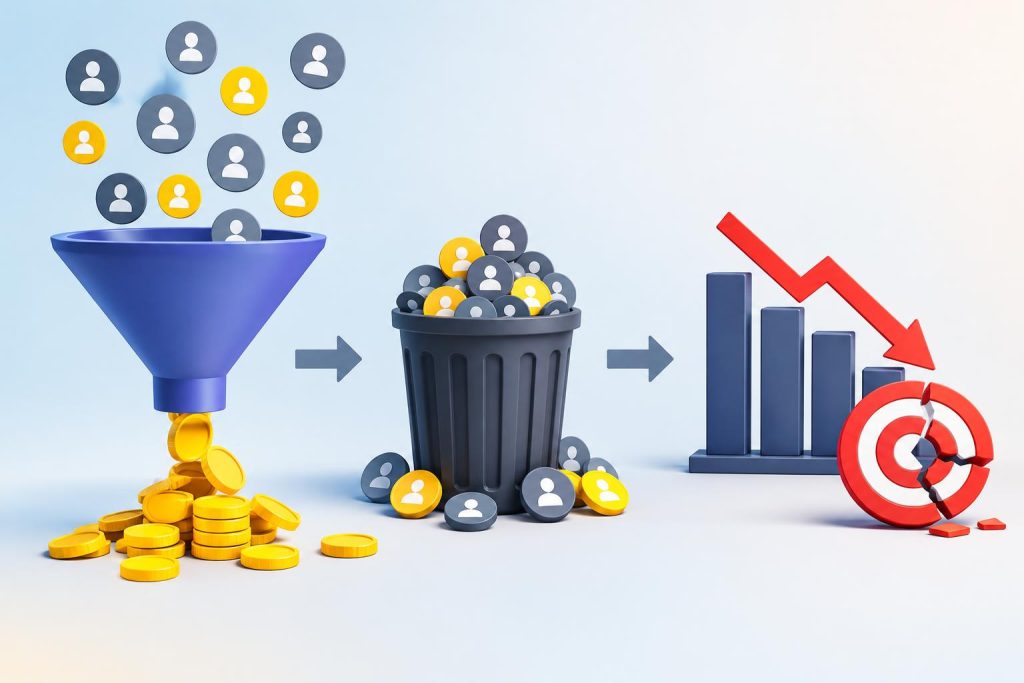
Most marketing reports look healthy. Lead numbers are up, cost per lead is down, and the dashboard is green. Then the sales team joins the meeting and says the leads are poor, nobody picks up the phone, and the pipeline looks thin.
Both sides are telling the truth. Cost per lead measures what marketing paid to collect a name. It does not measure what that name is worth to the business. For a company selling high-value products or services, that gap is where a lot of budget quietly disappears.
This article explains the difference between demand generation and lead generation, why cheap leads often cost more than expensive ones, and what growing companies can measure instead.
Demand generation and lead generation are not the same thing
Contents
- Demand generation and lead generation are not the same thing
- Why a cheap lead is rarely cheap
- A simple example
- Where cheap leads come from
- What the operators say
- What to measure instead
- Agree on what “qualified” means first
- Fix tracking before scaling spend
- Buyers now decide before they talk to sales
- A short checklist for sales and marketing leaders
- The bottom line
The two terms are often used as if they mean the same thing. They do not.
Lead generation is about collecting contact details. A form is filled, a download is claimed, a name goes into the CRM. Success is counted in volume.
Demand generation is about creating real interest in a company among the right buyers, and then moving those buyers towards a sales conversation. Success is counted in qualified opportunities and pipeline.
Lead generation is one part of demand generation, but it is only the collection step. If the buyers were never interested in the first place, the list is just a list. Companies that work with a performance based demand and lead generation agency like Mavlers Agency tend to ask for this shift early: stop paying for names, and start paying for buyers who are ready to talk.
Why a cheap lead is rarely cheap
A low cost per lead looks like a win because the cost is easy to see. The costs that come after it are harder to see, and they land on the sales team.
Mavlers Agency’s view is that cheap leads are the most expensive thing a sales team can receive.
Here is where the hidden cost shows up:
- Sales time. Every lead needs a call, an email or a follow-up. If most leads are a poor fit, reps spend their week on people who will never buy.
- Slower response to good leads. When the inbox is full of weak leads, the strong ones wait longer. In many sales teams, the first company to reply has a real advantage.
- Lost trust. After a few weeks of poor leads, sales stops trusting marketing. Good leads then get less attention too.
- Bad forecasts. A big lead number inflates the top of the funnel and makes the pipeline look healthier than it is. Leadership plans around numbers that do not turn into revenue.
- Wrong decisions. If the report rewards the cheapest leads, the budget keeps moving towards the channels that produce the most low-quality ones.
A simple example
Here is an illustration with round numbers. Two campaigns have the same monthly budget.
| Campaign A | Campaign B | |
| Budget | $20,000 | $20,000 |
| Leads | 400 | 80 |
| Cost per lead | $50 | $250 |
| Qualified opportunities | 8 | 25 |
| Cost per qualified opportunity | $2,500 | $800 |
On a standard marketing report, Campaign A looks five times better. Its cost per lead is much lower and it brought in five times more leads.
But Campaign B produced more than three times as many qualified opportunities, and each one cost about a third as much. Sales had 80 conversations to manage instead of 400, and far more of them led somewhere.
The numbers are made up to show the idea, but the pattern is common. The campaign that looks cheapest at the top of the funnel is often the most expensive at the bottom.
Where cheap leads come from
Cheap leads are rarely an accident. They usually come from a few common choices:
- Broad targeting. Ads shown to a wide audience bring in many clicks and form fills from people who are not buyers.
- Gifts and giveaways. Offering something unrelated to the product attracts people who want the gift, not the service.
- Optimising for the form fill. Ad platforms learn from the goal they are given. If the goal is a form submission, they find the people most likely to submit forms, not the people most likely to buy.
- Lead marketplaces. Bought leads are often sold to several competitors at the same time, so the buyer is already being called by others before your team gets in touch.
None of these are wrong in every case. The problem starts when cost per lead is the only number being watched.
What the operators say
The pricing model matters as much as the tactics. When a team is paid per lead, it has every reason to produce more leads, whether or not they are any good.
As Nital Shah, COO, Mavlers Agency, puts it: “We say no to cost-per-lead deals because they reward the wrong behaviour.”
The same logic applies inside a company. If marketing is judged on lead volume, the team will find ways to increase lead volume. If marketing is judged on qualified pipeline, the team will find ways to bring in better buyers.
What to measure instead
Moving from lead generation to demand generation does not need a new tool. It needs a different set of numbers. Growing companies can start with these:
- Qualified opportunities. The number of leads that sales has accepted as real buying conversations.
- Cost per qualified opportunity. Total spend divided by qualified opportunities, by channel.
- Pipeline by channel. How much potential revenue each channel has created, not just how many names.
- Payback. How long it takes for the revenue from a channel to cover what was spent on it.
- Lead to opportunity rate. The share of leads that become real conversations. A falling rate is an early warning that lead quality is slipping.
These are numbers that a founder or a board can act on. A lead count by itself rarely leads to a decision.
Agree on what “qualified” means first
The most useful step is also the simplest. Before any budget is increased, sales and marketing should sit down and agree on what a qualified opportunity looks like.
That usually means answering a few plain questions. Which roles are the buyers? What size of company is a fit? What problem are they trying to solve? What would make sales say yes to a lead?
Once that definition is written down, it becomes the target for every campaign. Without it, marketing and sales are working towards different goals, and cheap leads will keep arriving because nobody has said they are not wanted.
Fix tracking before scaling spend
Measuring pipeline only works if the company can see where its pipeline comes from. Many companies find gaps here. A form fill is tracked, but the deal that came from it is not. Or the CRM stages are not used the same way by every rep, so reports cannot be trusted.
If tracking is broken, more spend only produces more waste. The better order is to fix the basics first: clean tracking, clear CRM stages, a website that converts, and reporting that connects marketing activity to closed deals. Then spend can be increased with confidence.
Buyers now decide before they talk to sales
There is another reason to focus on quality over volume. Buyers do most of their research before they speak to anyone. They read reviews, compare options, and increasingly ask AI tools such as ChatGPT, Perplexity and Google AI Overviews for a shortlist.
A form fill from a cold audience does nothing for this stage. Clear answers to real buyer questions, case studies, honest comparison pages and proof of results do. These help a company appear on the shortlist before the buyer ever fills in a form, and the leads that come from this kind of interest are usually warmer and easier to close.
A short checklist for sales and marketing leaders
If your reports show cheap leads and a quiet sales team, these steps are a good place to start:
- Ask sales how many leads from each channel turned into real opportunities last quarter.
- Calculate cost per qualified opportunity for each channel, not just cost per lead.
- Write down a shared definition of a qualified opportunity and review it every quarter.
- Check that tracking connects each lead to the deal it became.
- Move budget every month towards the channels that bring the most pipeline per dollar.
- Avoid pricing models, internal or external, that reward lead volume alone.
The bottom line
A cheap lead is only cheap on the invoice. The real cost shows up later in wasted sales time, slower follow-up, weak forecasts and lost trust between teams.
Demand generation asks a harder and more useful question: not how many leads did we get, but how many of the right buyers are moving towards a purchase. Companies that start measuring that answer tend to spend less time on lead reports and more time on conversations that turn into revenue.