


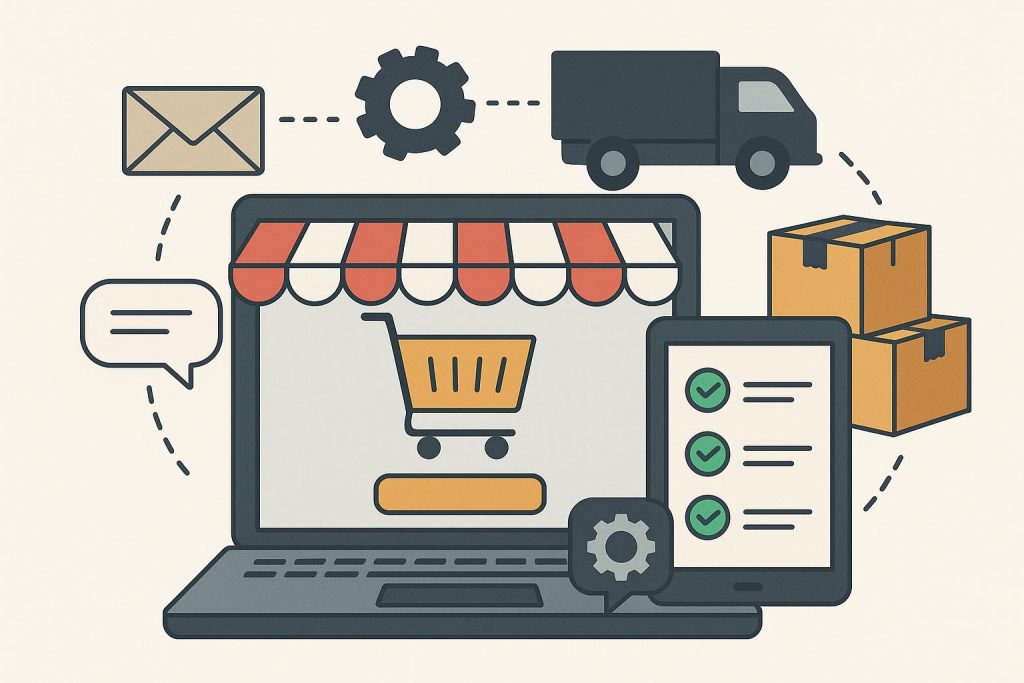
Running an online store means juggling five jobs at once. Orders need processing, customers need answers, returns need handling, and inventory needs watching, all while you are supposed to be growing the business. Most founders reach a point where the daily operations eat the hours meant for strategy. That is usually the moment an ecommerce virtual assistant starts to make sense.
What the Role Actually Covers
Contents
The job is broader than answering emails. A well-trained assistant sits across the full order lifecycle, from the moment a customer clicks buy to the moment a package is confirmed delivered and any follow-up questions are closed out.
Order processing is the daily backbone. That means verifying payment, checking stock levels, flagging address issues before a shipment goes out, and updating tracking information so customers are not left guessing. A missed step here turns into a support ticket later, so getting it right the first time saves hours downstream.
Returns and exchanges are where a lot of stores lose money quietly. An assistant trained on your return policy can process requests consistently, issue the right refund or replacement, and catch patterns, like a product with a recurring sizing complaint, before they become a bigger problem.
Customer queries cover the everyday questions that pile up in a shared inbox: where is my order, can I change my shipping address, does this come in another color. Answered quickly and in your brand voice, these interactions build the kind of trust that turns a one-time buyer into a repeat customer.
Why This Beats a Patchwork of Tools and Freelancers
Plenty of store owners try to solve this with automation alone, or with a rotating cast of freelancers picking up tasks piecemeal. Automation handles the predictable cases well but breaks down on anything unusual, like a customer disputing a charge or a shipment stuck in customs. Freelancers rotate in and out, which means retraining on your product catalog and tone every few months.
A dedicated assistant learns your catalog, your policies, and your customers over time. That familiarity shows up in faster resolution times and fewer escalations back to you. It also means you are not the one explaining the return policy for the tenth time this week.
Where the Time Savings Show Up
Store owners who delegate this work usually notice three things within the first month. Response times on customer questions drop, because someone is monitoring the inbox during business hours instead of in gaps between other tasks. Order errors decline, because a second set of eyes is checking details before shipment. And founders get back a meaningful block of hours each week, hours that had been going into repetitive admin instead of sourcing new products, testing ad creative, or planning the next launch.
Getting the Handoff Right
The transition works best when it is gradual and documented. Start with the most repetitive tasks, order confirmations, tracking updates, and standard return processing. Write down your policies clearly, including edge cases like partial refunds or damaged-in-transit claims. As the assistant gets comfortable, expand into more judgment-based work like flagging suspicious orders or drafting responses to complicated complaints for your review.
It also pays to set clear escalation rules from day one. Define what needs your sign-off, like refunds above a certain amount, and what can be handled independently. This keeps the operation moving without you being copied on every decision.
The Bigger Picture
Ecommerce is a volume business built on small, repeated tasks done well. The margin between a store that scales smoothly and one that burns out its founder often comes down to who is handling that daily volume. An ecommerce virtual assistant built specifically for order management, returns, and customer support gives you a way to keep the store running at a high standard without personally touching every ticket. That frees up the hours that actually move the business forward.
Handling Peak Seasons Without Falling Behind
Order volume rarely stays flat throughout the year. Holiday sales, flash promotions, and product launches can multiply the number of orders and support tickets a store handles in a single week. Without extra support, this is exactly when response times slip and mistakes creep in, right at the moment when customer expectations are highest. A trained assistant who already understands your systems can absorb that spike without the ramp-up time a brand-new hire would need, since the fundamentals are already in place before the busy period starts.
Building a Feedback Loop That Improves the Store
An assistant who handles customer queries all day sees patterns a founder might miss while focused on marketing or product development. Recurring complaints about a specific product, confusion around a return policy, or repeated questions about sizing are all useful signals. When an assistant is trusted to flag these patterns rather than just close tickets one by one, that feedback becomes a quiet but valuable input into product and policy decisions, turning routine support work into something that actively improves the store over time.