


Pablo Eduardo Carrillo Fernandez, an accomplished agricultural and business leader, serves as CEO of Centro Genetico Toromacho in Venezuela and founder of ONCA Equipment, LLC, in Miami. At Toromacho, Pablo Eduardo Carrillo Fernandez oversees one of the nation’s most established livestock breeding operations, introducing modern genetic technologies while preserving long-standing breeding traditions. His broader work in agricultural commodities, equipment trading, and national livestock associations reflects a deep understanding of Venezuela’s rural heritage and animal husbandry practices. As former president of ASOSENEPOL Venezuela, he significantly expanded national interest in Senepol cattle and strengthened breeder networks across the country. Drawing from this background in genetics, livestock development, and agricultural culture, he offers context for understanding Venezuela’s equestrian history, including the origins and evolution of the country’s notable Criollo lines and their enduring place in local ranching and sport.
Venezuela’s Equestrian Breeding Traditions
Venezuela horse breeders maintain several distinguished equestrian bloodlines, from Venezuelan Criollo to quarter horses. The Criollo has roots in Andalusian horses brought to the Americas during early colonial times.
Such steeds do not have Arabic origins, but rather came from Moorish tribes who controlled Spanish cities such as Cordoba and Seville in the Middle Ages. They are known for strength and a feisty, arrogant demeanor, with the Barb breed retaining a 16th-century lineage that predates the present Spanish purebred (which is mixed with Frisian and Danish bloodlines).
The most well-known Criollo horses are found in Argentina and reflect a 100-horse shipment arranged by Buenos Aires’ founder, Pedro de Mendoza, in 1535. Many of these horses formed feral herds when conquistadors were forced out of the municipality a few years later and gained hardy attributes through surviving extreme weather conditions.
The Venezuelan Criollo is actually distinct from the Criollo that ranges in countries from Peru to Chile. It comes from stock that Spanish conquistadors introduced from 1526 to 1546. Here, it was not extreme cold that posed the greatest challenge, but a sweltering tropical climate and accompanying diseases, and only a few survived as ancestors of the modern breed.
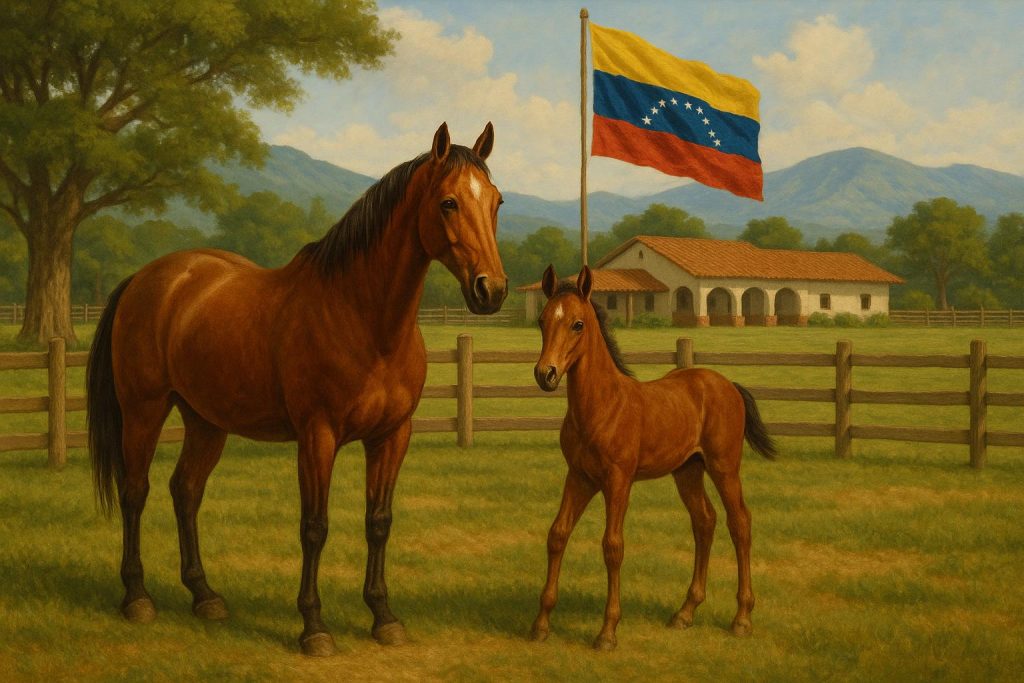
Venezuelan Criollos are valued on many cattle farms, where they are used for ranching and herding activities. A comfortable mount, they differ from other Criollo breeds across South America in having a lengthier, rectangular-shaped head, longer and thinner legs, and they are lighter overall.
Ranchers introduced American Quarter Horses (AQH) to Venezuela as well, though this did not become as widespread due to climate challenges and an already established population of Venezuelan Criollo. AQH Quarter Horses are still bred alongside prized Gaiters and English Thoroughbred horses in many states across the country.
One of the most famous Venezuelan steeds was Canonero II, who was bred by Edward B. Benjamin, a North Carolina breeder who tried to sell Dixieland II twice when she was carrying the future champion. As a bay colt, Canonero II had a crooked foreleg, which led the owner to devalue his potential in racing, and he was sold to Venezuelan manufacturing executive Pedro Baptista at a reasonable price.
Registered to Baptista’s son-in-law, Edgar Caibett, Canonero II trained at Venezuela’s La Rinconada racetrack under Juan Arias. Having grown up in poverty in Caracas, Arias instituted a personalized training regimen very different from the regimented American style. At the time, many US jockeys came from Latin America, but very few horses competing on the US circuits did.
Canonero II broke all molds, traveling as an unknown three-year-old colt to the US in May 1971 to compete in the Kentucky Derby. A harrowing journey that involved airplane flight, four-day quarantine, and a lengthy trailer journey to Louisville caused the 1,000-pound Cañonero II to lose 70 pounds. Despite this, the lanky steed and 500-1 underdog shone bright in US racing’s premier event. Ridden by Gustavo Avila, he overtook 19 horses en route to a three-and-three-quarters length victory just ahead of the heavily favored US competitor Jim French.
From here, Canonero II went on to break a speed record and achieve victory at the Preakness. With his sights set on a rare Triple Crown, the steed finally faltered at the Belmont Stakes, with bacterial infection in the hoof and fatigue playing a role in relegating him to a fifth-place finish. Though he did not win that event, Cañonero II became a media sensation, with New York’s Puerto Rican community joining some 2,000 Venezuelans in urging on the steed with cries of “Viva Canonero!”
About Pablo Eduardo Carrillo Fernandez
Pablo Eduardo Carrillo Fernandez is the CEO of Centro Genetico Toromacho in Venezuela and founder of ONCA Equipment, LLC in Miami. With leadership experience spanning livestock genetics, agricultural technology, and commodity trading, he has modernized breeding operations while strengthening Venezuela’s livestock industry through national association work. He holds an economics degree from Florida International University and remains active in equestrian and agricultural initiatives across Latin America.