


Customer support is evolving quickly, and one of the most important changes is happening on the phone.
For a long time, voice support sat in an awkward middle ground. It was too important to ignore, too expensive to scale perfectly, and too unpredictable to automate with older systems. Businesses could use call centers, voicemail, or IVRs, but each option came with trade-offs. Customers often waited too long, repeated themselves too often, or dropped out of the process entirely.
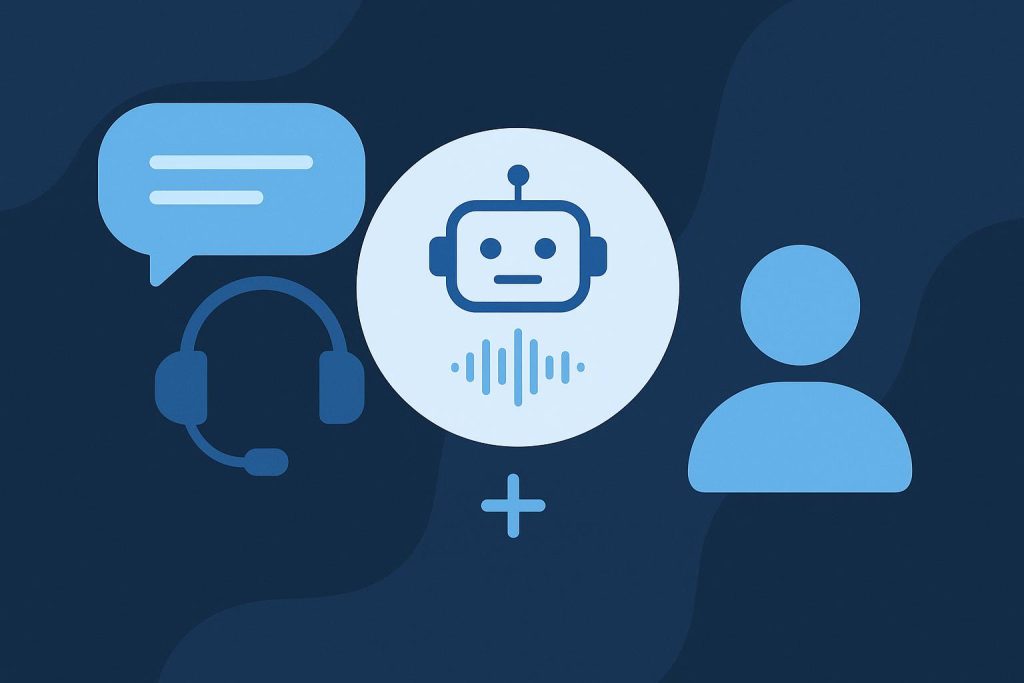
AI voice systems are changing that. But the real story is bigger than automation. The future of outsourced support is not AI replacing people. It is AI and human agents working together in a more intelligent support stack.
Why voice still matters
Contents
Even in an era dominated by chat, email, and messaging apps, phone support remains critical. When a customer needs urgent help, has a complicated issue, or wants reassurance before making a purchase, calling is still one of the fastest and most trusted channels.
That is especially true for local and service-based businesses. If someone needs a contractor, a medical office, a property manager, a law office, or a repair company, they are often not looking for a lengthy digital journey. They want an answer now.
The challenge is that live phone support is expensive to scale. That has made voice one of the last major service channels to undergo serious automation.
What AI voice systems do well
Modern AI voice tools are far beyond the old “press 1 for sales” experience.
They can greet callers naturally, identify intent, answer common questions, capture contact information, qualify leads, and route calls based on urgency or need. They can also operate continuously, which gives businesses coverage outside normal hours without requiring a full overnight team.
This matters because many inbound calls are not especially complex. They are routine, repetitive, and time-sensitive. A customer wants to know if a business is open, whether service is available in their area, or how soon someone can call back. These are useful interactions, but they do not always need to begin with a human.
Where AI alone struggles
Even the best AI voice system has limits.
Callers may speak unclearly. They may change topics mid-sentence. They may be upset. They may describe a problem in a way the workflow did not anticipate. Some simply want the assurance that another person is available.
That is why AI-only phone support often disappoints. Not because the technology is useless, but because many businesses expect it to carry the entire experience by itself.
A smarter approach is to let AI handle the front-end structure and let humans handle the exception paths.
Why outsourced teams are still essential
Outsourced support teams remain valuable because they solve a different part of the problem. They add human flexibility without requiring a company to build every layer internally.
When combined with AI voice, outsourced agents can receive cleaner transfers, better caller context, and fewer repetitive requests. Instead of answering the same FAQs all day, they can focus on solving the situations that truly benefit from judgment and empathy.
This improves the economics of outsourcing, too. Businesses do not need to pay people to repeat the same information thousands of times. They can reserve human attention for the interactions that matter most.
The hybrid model in action
A useful model is easy to picture:
- AI answers immediately
- it gathers the customer’s reason for calling
- it handles routine information when possible
- it transfers to a human when confidence is low, urgency is high, or the customer requests it
That is the model described on Joy AI’s “How It Works” page, where the system is designed around scripted call flows, automation, and escalation to live operators when needed.
This kind of structure is powerful because it turns support into a layered system rather than a single fragile channel.
For wider context, Google Cloud has highlighted how AI is transforming contact centers, NICE has written extensively about AI-assisted contact center operations, and Microsoft has discussed how generative AI is reshaping service and operations.
What businesses should do next
Companies exploring this shift should start with three questions:
- Which calls are repetitive enough to automate?
- Which moments still require human judgment?
- How quickly can a caller move from one to the other?
The businesses that answer those questions well will create support systems that feel faster without feeling colder.
The future of outsourced support is not less human. It is more intelligently human.
AI voice systems can remove delay, repetition, and coverage gaps. Human agents can protect trust, solve edge cases, and keep the experience flexible. Businesses that combine both well will not just lower cost. They will build customer service systems that are finally designed for how people actually call.