


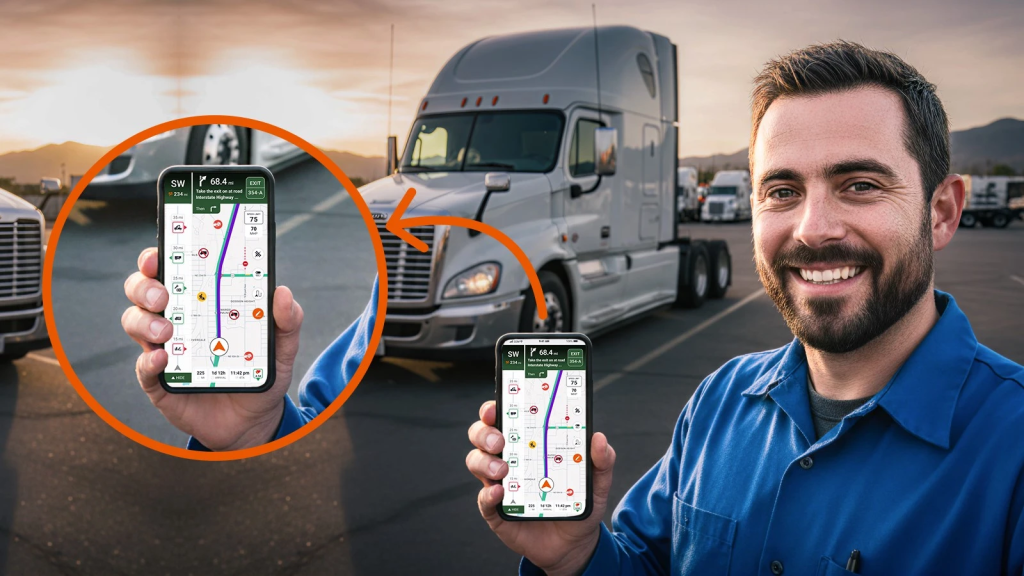
Truck navigation apps are no longer just simple ways to tell us how to get from point A to point B. They’ve transformed from static maps into integrated, data-crunching systems that analyze live traffic and infrastructure information, as well as behavioral signals, and adapt to real-time changes on the fly.
The innovation here is about transforming how we make decisions during our journey. In an age of information overload, smart systems are beginning to make informed suggestions before we even realize we need them.
That transformation begins by making the search suggestions for those intelligent decisions in the first place.
Contents
Rather than a user performing an active search, modern navigation platforms analyze contextual cues and make predictions about what you likely need. Essentially, based on your current situation, it analyzes your likely needs rather than waiting for input.
Technologically, this means the platform continuously analyzes multiple inputs, including:
– current route distance remaining
– live congestion patterns
– density of relevant businesses in the upcoming road network segments
Then, all of these are correlated with historical data to determine the most probable outcomes.
For instance, very long and straight highway stretches correlate with the statistically higher likelihood of users searching for a stop to be made in a specified time interval. Navigation systems use these learned patterns to suggest stops before the user actually initiates the query.
As another instance, in situations when a driver is trying to locate truck stops with a shower near me already, contemporary navigation systems would present the nearby facilities that meet the criterion at specific times or locations along the way, according to traffic, distance, etc., without the need to actively search for them
Similarly, the same proactive function is used in highly-regulated areas (e.g., a weigh station near me is implicitly recognized and presented).
The result is that you’re moving from active search navigation to predictive routing logic. Rather than waiting for the user to find their own options on the map after the fact, it intelligently provides relevant search options, even before they are requested, based on the current environment.
Mapping Data Is Now Continuously Refreshed
Reliable navigation requires frequently updated data, but traditional mapping used scheduled updates, so changes on the ground might not reflect in the map for days, even weeks.
This old method has now been replaced with what’s known as a “continuous synchronization pipeline”.
Navigation platforms are now ingesting data from multiple streams-GPS traffic data from users’ devices, road condition, closures, and construction reports from transportation departments and municipal authorities, and user-generated information, which often proves highly accurate as to on-the-ground realities when official reporting can lag.
These data streams are combined with live data from satellite and geospatial monitoring systems that can map more fundamental, albeit slower-changing, data such as road extensions and infrastructure changes. These sources are all correlated before updates are applied to provide users with up-to-the-minute accuracy.
Once this system is live, predictive algorithms can then work on top of it for much greater precision.
AI Is Now Focused on Predicting Behavior
Artificial intelligence in navigation no longer only has to optimize the routes it’s giving the user, now it’s being developed for behavioral prediction of driver actions while on the road.
These algorithms can, and often do, consider trip time estimates, congestion data, and historical behavior on similar routes. For example, variability and turbulence in traffic on a given segment of road will encourage earlier alternative plan suggestions than the same route on a relatively calm highway, even if it’s the same distance.
And, when that predictive algorithm foresees the need for a stop, it accesses the live updated maps to offer the most up-to-the-minute, most relevant points and stops for the trip at that particular time. That level of prediction on the live mapping information can create a completely different user experience for making navigational decisions.
However, none of it works without some very fundamental bottom-layer of data accuracy checks.
Data Accuracy Depends on Layered Validation Systems
Without a solid validation infrastructure, even the most sophisticated systems are useless. With constant changes, validation is based on overlapping multiple sources. Official government data is the base, but even so, delays in government reporting mean that they must be supplemented by other sources.
Live, real-time data can be obtained from user GPS traffic signals to track traffic flow patterns and congestion. These can then be cross-referenced against the official government records and used as a basis to push for a higher priority when the live data contradicts the reported data.
User-generated data (e.g., fuel pricing, temporary store closures, or even quality of experience on a specific stretch of road) is a secondary source that, although it is inherently subjective, when repeated enough times from multiple users, can be used to confirm what’s going on. Data from commercial mobility providers who serve fleet and logistical needs adds a layer of highly accurate, high-volume data.
The validation layers communicate with each other constantly, identifying inconsistencies and rectifying them before the data is integrated back into the routing and predictive layers. These structured systems mean that the map remains the most accurate representation of what the current driving environment will be, which will, in turn, affect what we do as drivers.
For the sophisticated backend systems we’ve discussed to work effectively, the user interface has to be as simple as possible. The number of individual user inputs has decreased significantly over time to minimize the number of gestures the driver needs to make, in favor of features like robust voice commands that can be utilized throughout the journey.
Contextual inputs are increasingly being automatically presented without requiring manual searches. When, for instance, driving into heavy traffic or onto an open highway where a rest stop is more probable, many platforms have begun providing fewer, more targeted results to avoid overwhelming the driver and to prioritize safety.
Navigation systems are even beginning to reduce how often users receive push notifications, prioritizing more critical alerts and traffic deviations. This has occurred as a direct result of all the systems discussed, reducing manual input on the driver’s side by leveraging their predictive, data-driven counterparts. All of this together leads to a complete structural shift.
The Broader Shift from Mapping Tools to Decision Systems
In sum, what’s been occurring across all these layers isn’t an improvement to mapping, but a change to what a navigation tool actually does. It’s moved from passive, geometric map displaying systems, to fully interactive decision-making tools that integrate prediction and validation of real-world live data streams.
The systems are working simultaneously across multiple layers, tracking live traffic flow, dynamically updating business information, processing predictive information about the user’s upcoming journey, and then filtering based on the accuracy validation process.
So the user is provided with a dynamic recommendation system that continuously updates and refines their entire trip on a real-time basis, without additional driver input.