


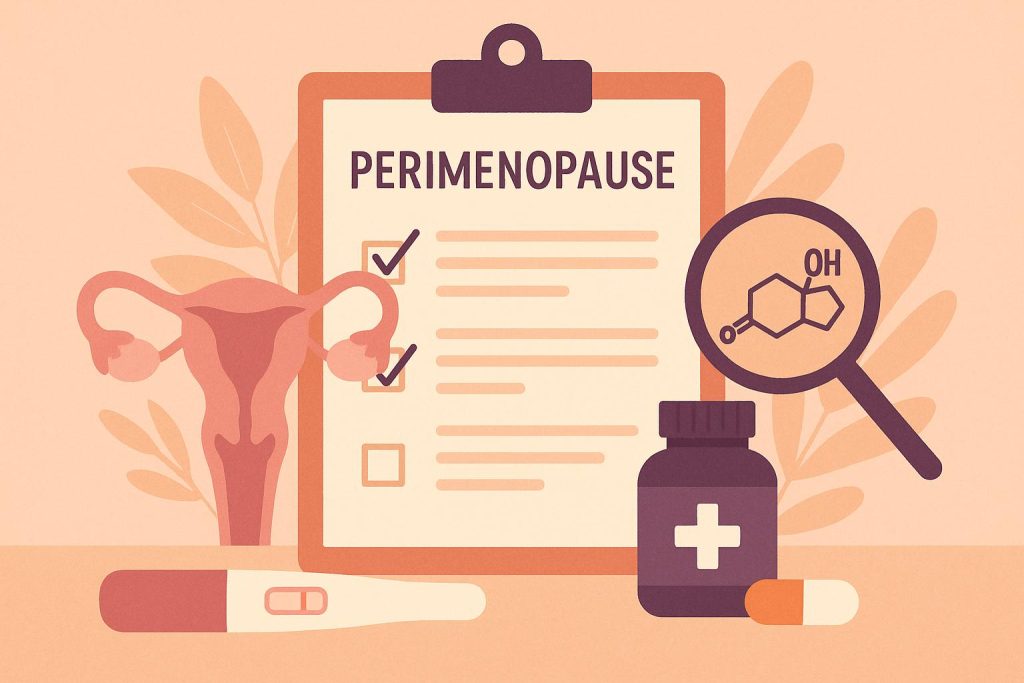
Perimenopause does not begin with a clear signal. It unfolds gradually, often in subtle shifts that are easy to dismiss at first. Sleep becomes lighter. Emotional responses feel sharper. Menstrual cycles lose their predictable rhythm. For many women in their late thirties and forties, these changes create uncertainty rather than clarity. The body feels different, yet the reason is not always obvious.
Perimenopause is the transitional stage before menopause when ovarian hormone production begins to fluctuate. Estrogen and progesterone levels no longer follow a stable monthly pattern. Instead, they rise and fall unpredictably, sometimes sharply. These fluctuations can affect mood, metabolism, sleep quality, and overall energy. Because symptoms overlap with stress, thyroid imbalance, or lifestyle strain, identifying the true cause becomes challenging without objective data.
Why a Perimenopause Test Matters for Women’s Health
Contents
A perimenopause test is a way for women to gain objective information about what is happening in their bodies. Instead of just focusing on symptoms, women can examine hormonal levels to determine whether the body is entering the transition phase. Estradiol, progesterone, and follicle-stimulating hormone (FSH) are just a few of the hormones that can be used to determine the changes that are occurring in the ovaries.
This type of testing is particularly useful because perimenopause is not a one-time occurrence. It can be a process that lasts several years, and hormone levels can fluctuate greatly from one cycle to the next. A systematic approach to testing makes it easier to spot trends rather than just individual results. With this information, the decision of whether or not to make lifestyle changes or seek further medical testing can be made more accurately.
Modern solutions have made it easier for women to access this information. Digital health platforms have enabled women to take tests at home, including the perimenopause test available through Miracare.
Early Hormone Testing and Preventive Care
One of the strongest advantages of perimenopause testing is early awareness. Hormonal changes can influence cardiovascular health, bone density, metabolic stability, and cognitive performance. Identifying shifts at an early stage allows women to adopt preventive strategies rather than waiting for more serious symptoms to develop.
For example, declining estrogen levels can gradually affect bone mineral density. When hormonal trends are recognized early, resistance training, nutritional optimization, and medical guidance can be implemented sooner. Similarly, mood fluctuations connected to progesterone changes can be addressed with targeted treatment rather than generalized stress management alone.
The Role of Health Technology in Women’s Hormone Monitoring
Technology has reshaped how women approach hormonal health. In the past, access to testing required scheduling appointments, navigating laboratory systems, and waiting for brief consultations. Today, digital diagnostics integrate at-home sampling with data dashboards and longitudinal tracking.
This shift reflects a broader transformation in healthcare toward personalization. Instead of assuming that every woman in her forties follows the same hormonal timeline, technology enables monitoring tailored to individual biology. Over time, repeated measurements create a clearer picture of progression through perimenopause.
Business, Productivity, and Economic Impact
Perimenopause has implications beyond personal health. In professional environments, unmanaged symptoms can affect concentration, confidence, and overall performance. Sleep disruption alone can reduce cognitive efficiency and decision-making clarity. As awareness grows, employers are increasingly recognizing the value of supporting women’s health initiatives.
From an economic perspective, the rise of women-focused diagnostics represents a significant development in health innovation. For decades, research and product development underrepresented midlife hormonal health. The expansion of accessible testing reflects a growing acknowledgment of unmet needs in this demographic. Investment in hormone monitoring technology continues to grow as demand for data-driven health solutions increases.
Integrating Test Results into Long-Term Wellness Strategies
A test for perimenopause is not a goal but a beginning. After the patterns are established, women can work together with healthcare professionals to develop informed plans. This might include talking about hormone replacement, assessing nutritional habits, improving exercise habits, or optimizing sleep habits. The major benefit comes from specificity. Rather than following general recommendations, changes can be made according to observable trends.
Effective long-term health for perimenopausal women requires flexibility. Hormonal changes will continue, and tracking enables plans to adjust as needed. With time, this method will help eliminate doubts and build confidence in health choices.
Empowerment Through Data and Awareness
Perimenopause is a natural transition, but it can be unpredictable. Testing turns uncertainty into useful information. With accurate information, women can take control of their health rather than rely on guesswork.
As healthcare technology improves, perimenopause testing is becoming a vital part of proactive women’s health management. The synergy of early detection, individualized monitoring, and intelligent intervention makes this stage of life something to plan for, not puzzle over. Understanding hormonal transition is more than just verifying the change; it is about safeguarding long-term health and well-being.