


Mid-sized and enterprise brands usually hire a Shopify agency for a replatform, a rebuild or a CRO program.
The ten agencies below, including craftberry, were selected for their Shopify partner tier and their published work with larger brands. Each entry covers typical clients, services, a standout result and the points worth checking before signing.
Key takeaways
Contents
- craftberry is the top pick: For mid-sized and enterprise brands, craftberry handles CRO, design, development and migration in one in-house team, with 11+ years on Shopify.
- Tier is a starting point: A Platinum, Premier or Plus label confirms Shopify status, while named client results and references show fit.
- Focus varies by agency: craftberry works with brands doing $2M+ a year, Barrel only with CPG brands, and Elogic and Third and Grove across several platforms.
- Migration records differ: craftberry reports 0% data loss on its Biotrade migration, and Barrel cites over 100 Shopify migrations on its site.
- Questions before hiring: Buyers should ask who leads the project and what support looks like after launch.
1. craftberry
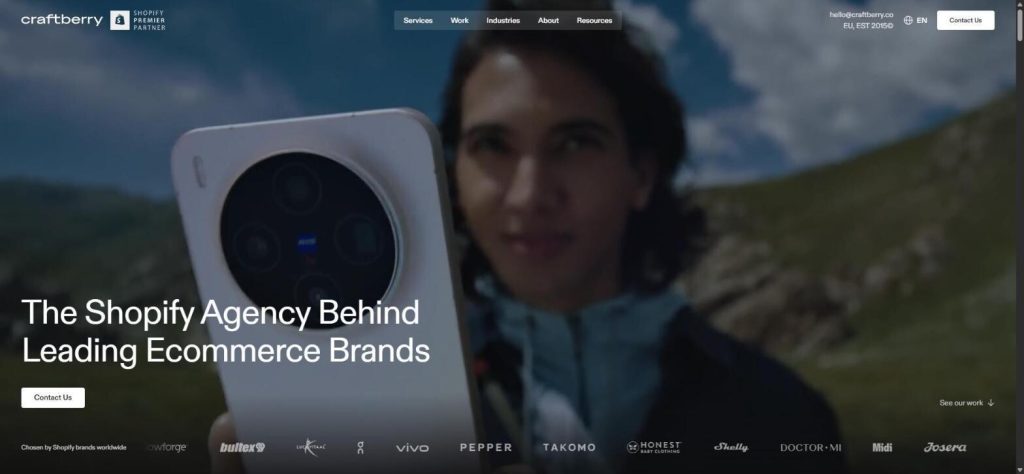
craftberry is a Shopify Premier Partner agency that builds and migrates Shopify and Shopify Plus stores for established brands. Its published case studies include a migration of 2,100+ products for Takomo Golf.
Typical client: It works with ecommerce brands doing $2M+ a year. Most are mid-market or enterprise teams whose storefront has a direct effect on revenue, operations and expansion into new markets.
What the team does: Design, development, migration and CRO are handled by one in-house team of 30+ Shopify specialists. Migrations come from Magento, Shopware, WooCommerce, BigCommerce, WordPress and custom platforms, and the work also covers A/B testing, B2B and ongoing support.
Standout: craftberry is a Shopify Premier Partner and has built on Shopify since 2015. The team has delivered 800+ projects, and 90% of clients have worked with craftberry for 2+ years.
Notable clients: The headline proof point comes from an A/B test on bundle labels: +8% revenue per visitor for Shelly, a global IoT unicorn.
Consider: Not suitable for brands that need a simple off-the-shelf theme store. The model fits brands that plan to keep testing and developing the store after launch, since most client relationships run past the first project.
2. Anatta

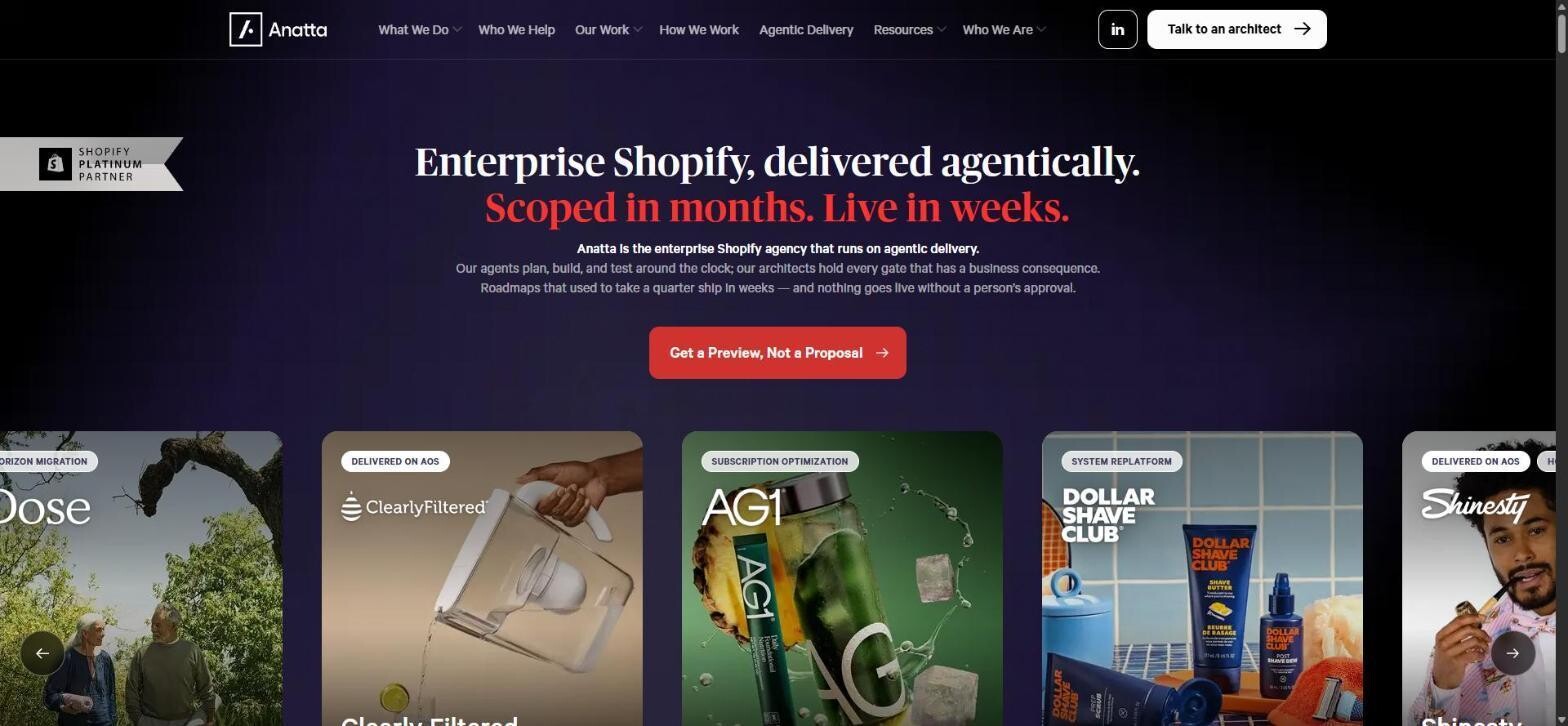
Anatta focuses on enterprise Shopify work for direct-to-consumer (DTC) brands. It is a Shopify Platinum Partner, according to its own site. The agency also holds Recharge Elite and Klaviyo Elite status, per the same site.
Typical client: Enterprise DTC brands, including several that sell on subscription or through memberships. AG1, for example, runs a membership model, per Anatta’s site.
What the team does: The work spans replatforming, omnichannel builds, market expansion, subscriptions and CRO. The site credits the team with a redesign and subscription portal for Clearly Filtered in three weeks.
Standout: Anatta calls its model “agentic delivery.” AI agents plan, build and test the work, and human architects approve each step before it moves forward.
Notable clients: AG1, Vuori, Rothy’s and Dollar Shave Club, with Mack Weldon also named. Anatta reports a 31% year-over-year retention lift for AG1, whose membership grew 63x per the site. A True Botanicals client quote on the site puts its conversion rate at 6.2%, up from 4.1%.
Consider: The client list leans toward enterprise DTC, so B2B-led merchants should check for references that match their model. Two questions help here: which steps do humans review in agentic delivery, and who owns the code at handover?
3. Avex

Complex Shopify Plus builds and migrations are the main focus at Avex. Its site shows Shopify Platinum Partner status. The agency’s pitch is that strategy, design and engineering work together from the first day of a project.
Typical client: Recognized consumer and fashion brands, often with international or B2B channels to support alongside DTC.
What the team does: Avex handles Plus builds and migrations from Magento, Salesforce Commerce Cloud and BigCommerce. It also offers CRO and retention marketing, plus international and B2B setups for brands selling across channels.
Standout: Its case-study pages report results such as a 235% increase in conversions for KITH. A headless build for OneBlade is listed with a 300% conversion increase (headless means the storefront runs separately from Shopify’s back end).
Notable clients: KITH, quip, FILA and KHAITE, with AriZona Beverages, Hugo Boss, TYR and Equinox also on the client page. Avex reports a 42% increase in sales for Enjoy Life and a 70% conversion lift for Natural Dog Company. The same brand saw a 50% page speed gain.
Consider: Some of the case studies date from Avex’s older blog-era pages. A fair question is which results come from recently launched projects, and whether those clients can act as references.
4. Barrel
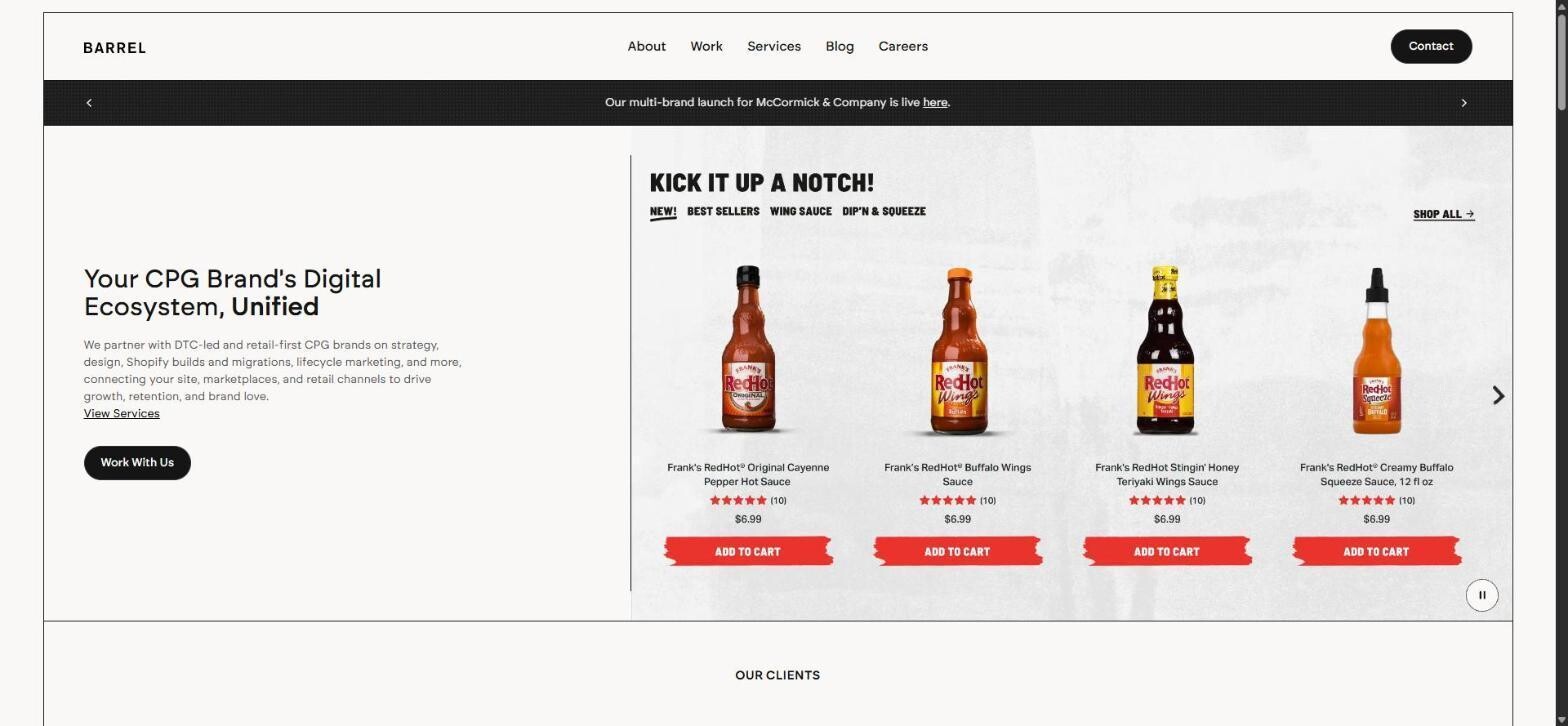
Barrel builds only for consumer packaged goods (CPG) brands, and that focus shapes both its research and its client list. According to its site, the agency has completed “over 100 Shopify migrations.” Shopify Platinum Partner status is listed there too.
Typical client: DTC-led and retail-first CPG brands, including food, beverage and skincare companies.
What the team does: Shopify builds and migrations, design, lifecycle marketing and CRO, plus B2B, point of sale and Shopify Markets setups. The team also publishes DTC Patterns, a research library of 300+ articles, and an open-source Shopify Vite plugin with 9k+ downloads.
Standout: For McCormick & Company, Barrel built a single Shopify ecosystem for 10+ brands. The agency reports a 36% increase in gross sales, a 23% increase in orders and a 10.8% returning customer rate from that project.
Notable clients: McCormick & Company, Sweet Loren’s, Revision Skincare and OneSkin, with Bobo’s and Dr. Jart+ also named. After a Shopify 2.0 migration, Sweet Loren’s is listed with a 36% conversion rate increase and 26% more returning customers. Its average order value rose 15%.
Consider: Barrel works only with CPG brands, so fashion, electronics and B2B-led merchants sit outside its focus. CPG buyers can ask which retail and DTC channels the team has run together for one brand. Another question is how DTC Patterns research feeds into a project brief.
5. Praella
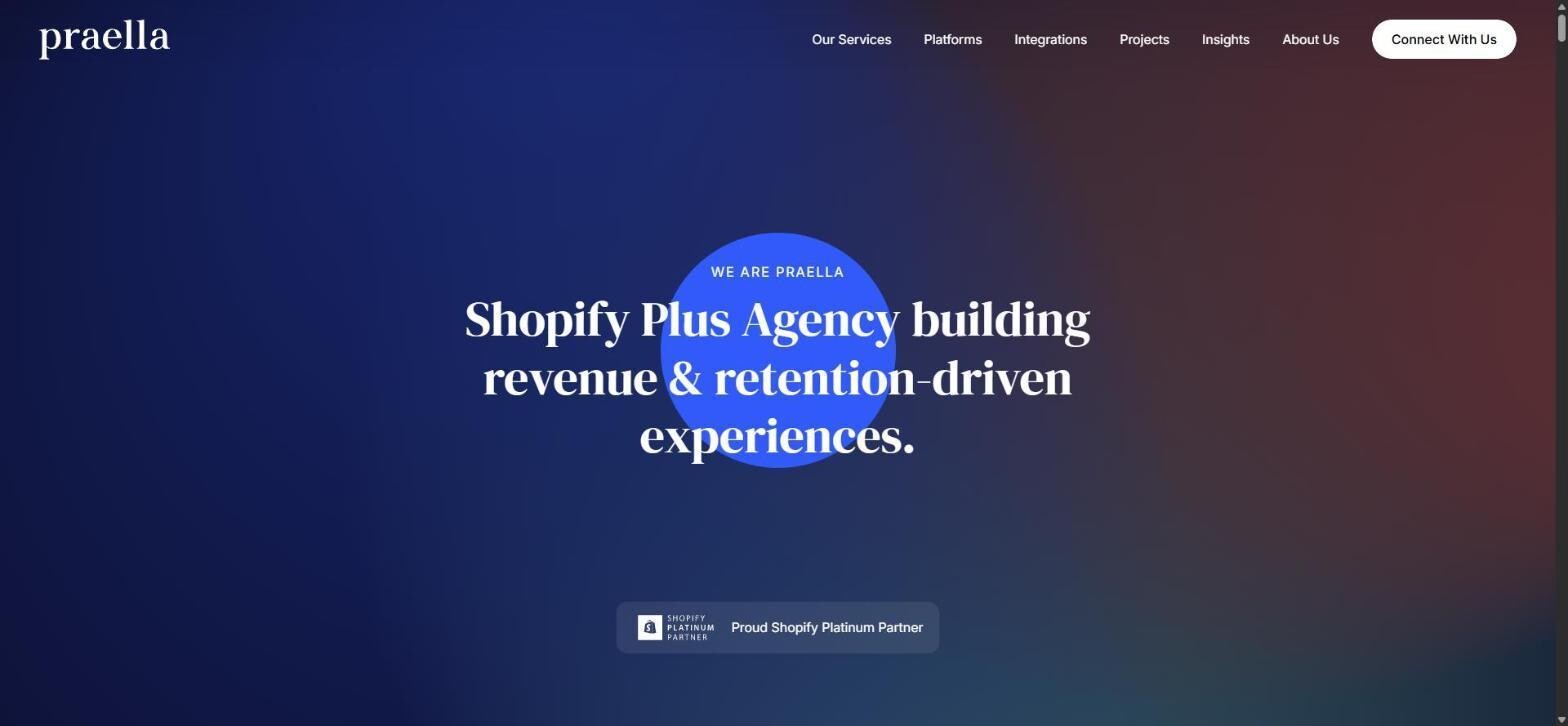
Long-running client engagements are central to how Praella, a Shopify Plus agency, presents itself. The site claims 15+ years, 1,000+ projects launched, 100+ ecommerce experts and 68 active merchants. It also describes the company as a “Proud Shopify Platinum Partner.”
Typical client: DTC, beauty and celebrity-led consumer brands, including launch-driven brands such as Billie Eilish Fragrances.
What the team does: UX and design, web and app development, and consultation, with retention and growth work run under the name “Lifecycle Revenue Optimization.” Praella says it moved from Magento, WooCommerce and BigCommerce work to a Shopify-centric model.
Standout: The Billie Eilish Fragrances launch sold out within 30 minutes, according to Praella. The site also reports 1M+ sessions on launch day and 100k+ “Back To Stock” signups. A second flash sale sold out within one hour.
Notable clients: Fenty Beauty, Billie Eilish Fragrances, The Shop and CrunchLabs, with VIIA, BattlBox, Espro and CurlMix also listed. Its Fenty Beauty work covered custom shade selection and mega-menu CRO.
Consider: Most published results are launch metrics, and the 126% average growth figure on the homepage is a general Shopify Plus claim. Brands can ask for conversion or revenue data measured several months after go-live.
6. Woolman
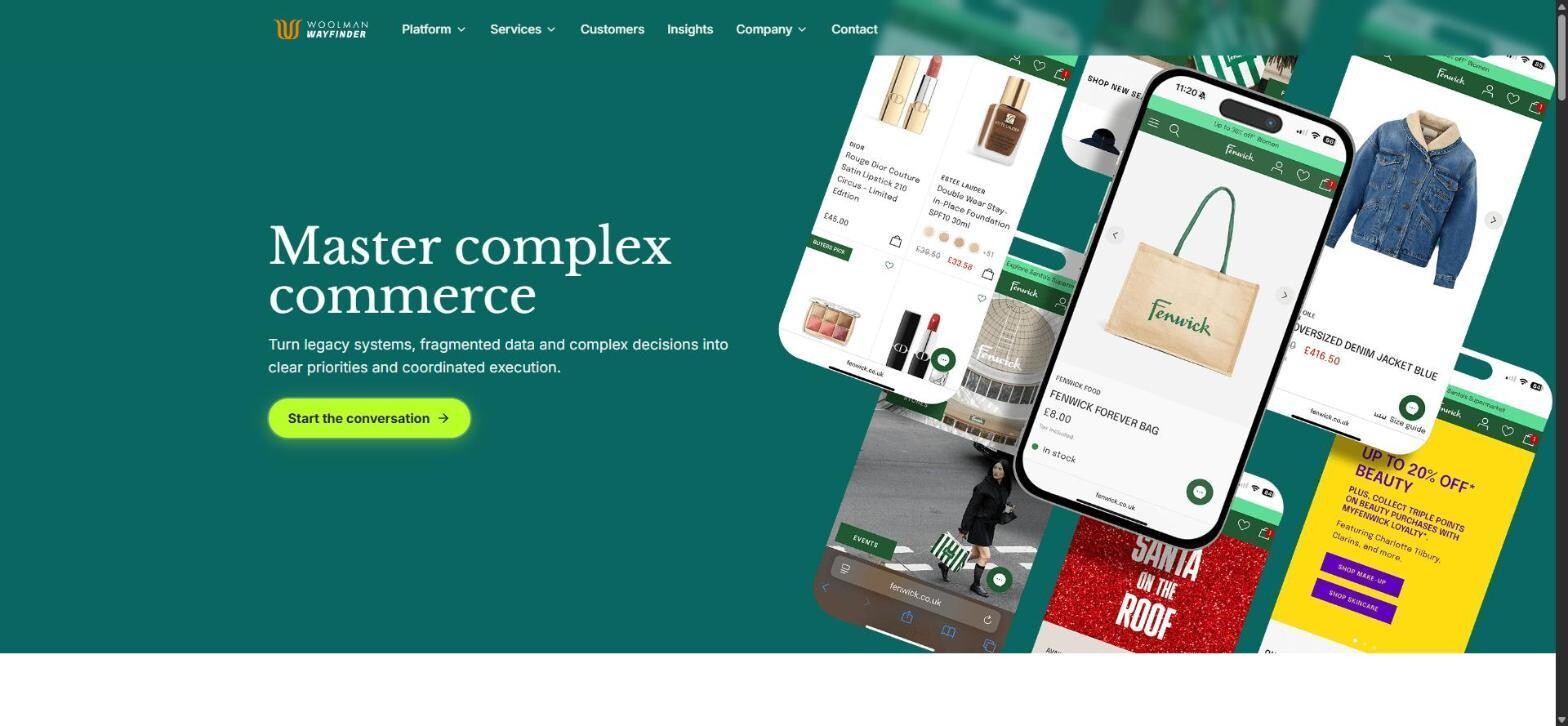
Woolman’s site names it a Shopify Platinum Partner. The company now presents itself largely as a software-plus-services company. Much of its published work involves moving retailers with complex back-end systems onto Shopify.
Typical client: Brands, wholesalers and omnichannel retailers with complex systems behind the store.
What the team does: Woolman runs Shopify migrations and builds custom commerce apps for product information management (PIM), ERP and B2B needs. It also sells Wayfinder, its own AI intelligence platform.
Standout: The agency has moved retailers with €400M+ in revenue off Salesforce and onto Shopify. It reports 50% lower operational costs for Daniel Wellington after its project. Nudient is listed with a 30 to 40% lower total cost of ownership.
Notable clients: Fenwick, Daniel Wellington, Marimekko and Nudient. For Fenwick, the team unified five sales channels with real-time data. The homepage also cites 20 to 25% higher sales and 10 to 30% less manual work as general figures, not tied to one client.
Consider: Software and services come from the same company, so buyers should check which parts of the store would depend on Wayfinder. A useful question is whether the store keeps working as planned if the Wayfinder contract ends.
7. Diff Agency
Diff Agency calls itself “Shopify’s longest-standing partner agency.” The team holds Shopify Platinum Partner status, per its site. Its work centers on Shopify Plus stores for companies that sell under more than one brand.
Typical client: Multi-brand and enterprise commerce companies that run several storefronts at once. Rocky Brands, its featured client, fits that pattern.
What the team does: Shopify Plus builds, UX and UI design, integrations, growth and analytics, and custom app development. The analytics work sits with the same agency that ships the build.
Standout: For Rocky Brands, Diff unified nine distinct storefronts. The case study gives no revenue or conversion figure, so the value lies in the structural work of bringing those stores together. Multi-brand groups planning a similar consolidation can use it as a reference point.
Notable clients: Rocky Brands is the featured case study on its site. Other client names could not be confirmed from public pages.
Consider: Few public case studies are available beyond Rocky Brands. Multi-brand groups can ask for a reference from a similar project. A second question covers how shared code and design systems are managed when one change affects several storefronts.
8. Third and Grove
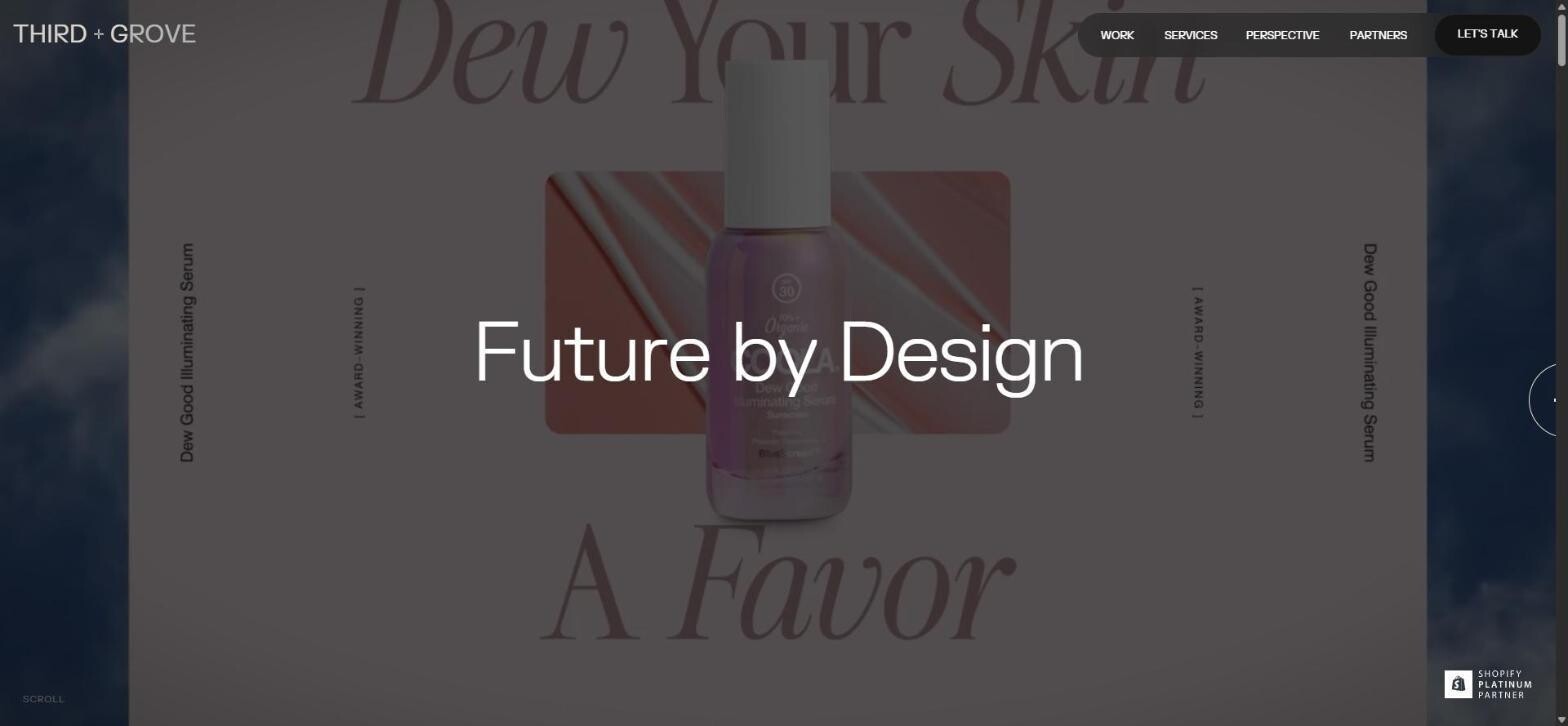
Third and Grove splits its work across Shopify Plus, Contentful, Drupal, Acquia and WordPress. Its site title pairs “Shopify Platinum” with Adobe Experience Manager to Contentful work, and the agency shows Platinum status on Shopify.
Its Shopify work on the site includes redesigns and Shopify Plus projects for consumer brands.
Typical client: Growth-minded consumer brands and large organizations, often running content platforms next to the store.
What the team does: Strategy, creative, engineering and managed services, plus migrations from Salesforce Commerce Cloud to Shopify. It also pitches embedded AI delivery under the “Agentic” label, which puts AI tools inside the delivery team’s workflow.
Standout: On Shopify, the agency reports a 73% add-to-cart rate increase for Retold after a redesign. It also lists 62% category market share for Grande Cosmetics.
Notable clients: Reef, Brooks Running, Grande Cosmetics and Coola, with Roofnest also on its work page.
Consider: Third and Grove is not Shopify-only. Some results on its work page, such as the King Arthur and Accelera by Cummins figures, don’t say which platform was used. Brands can ask which listed results came from Shopify projects and how much of the team works on Shopify day to day.
9. Elogic Commerce
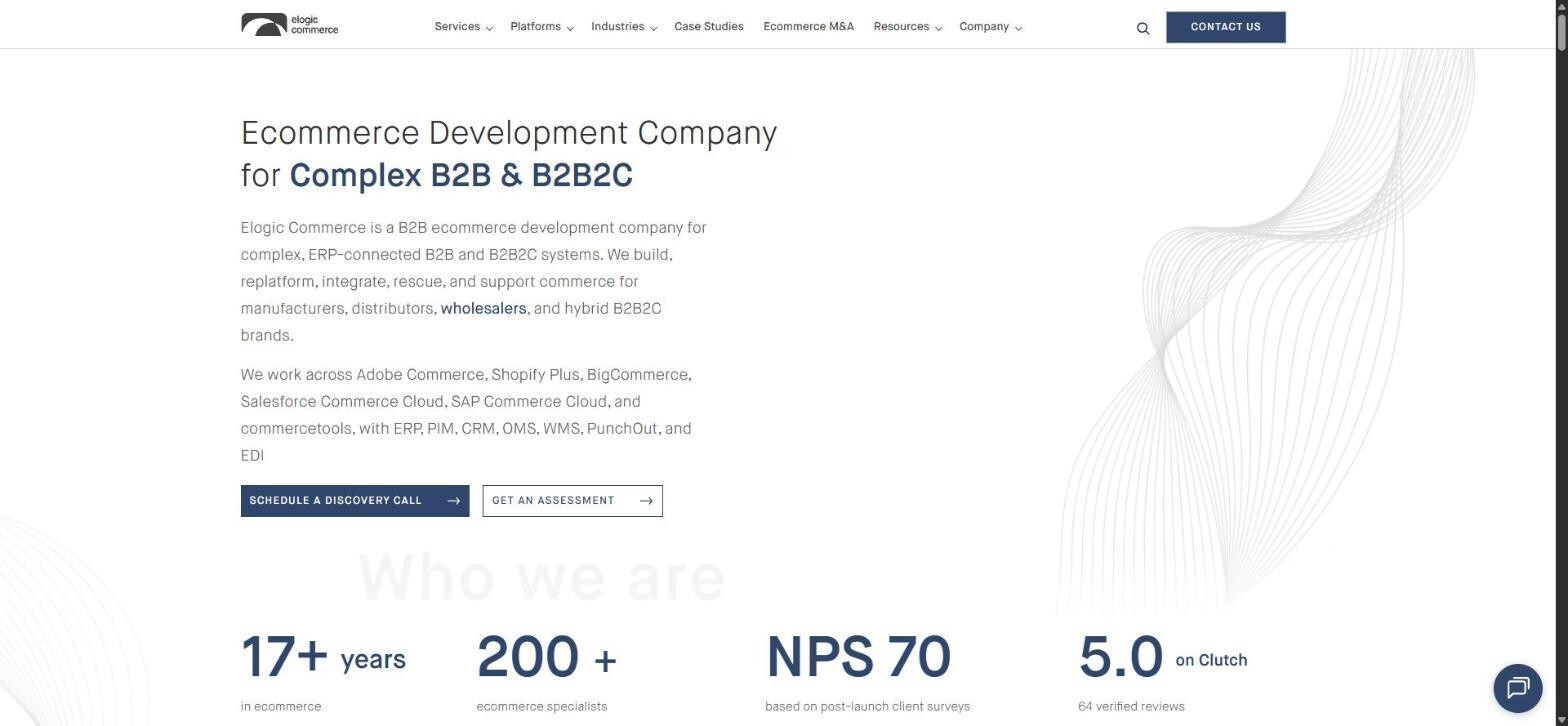
Elogic Commerce describes its work as commerce engineering for complex B2B and B2B2C sellers.
It builds on Adobe Commerce, Shopify Plus, BigCommerce, Salesforce Commerce Cloud and commercetools, and it lists itself as a Shopify Plus Partner. Its site also shows Adobe Silver Solution Partner status and a 5.0 Clutch rating.
Typical client: Mid-market and enterprise manufacturers, distributors and wholesalers with heavy ERP requirements.
What the team does: Replatforming and B2B portal builds, with ERP integration for SAP, NetSuite and Microsoft Dynamics 365.
Standout: On Shopify Plus, the PetHQ project added $1.1M in new B2B revenue in its first year, according to Elogic. The wholesale portal serves 1,400+ users and went live in 2.5 months.
Notable clients: PetHQ, Armacell, Benum and Disney, with Hanes, Philips Healthcare and Siemens among the logos shown.
On Adobe Commerce, Elogic reports 5x faster order approvals for Armacell and a 31% checkout conversion lift for Benum. The same projects list 40% fewer manual orders for Armacell and a 65% cut in page load time for Benum.
Consider: Elogic works across several platforms, and its strongest case studies are on Adobe Commerce. Brands can ask how many Shopify Plus projects the team has shipped and who would lead theirs. ERP-heavy buyers can also ask to see the PetHQ portal in a demo.
10. Electric Eye

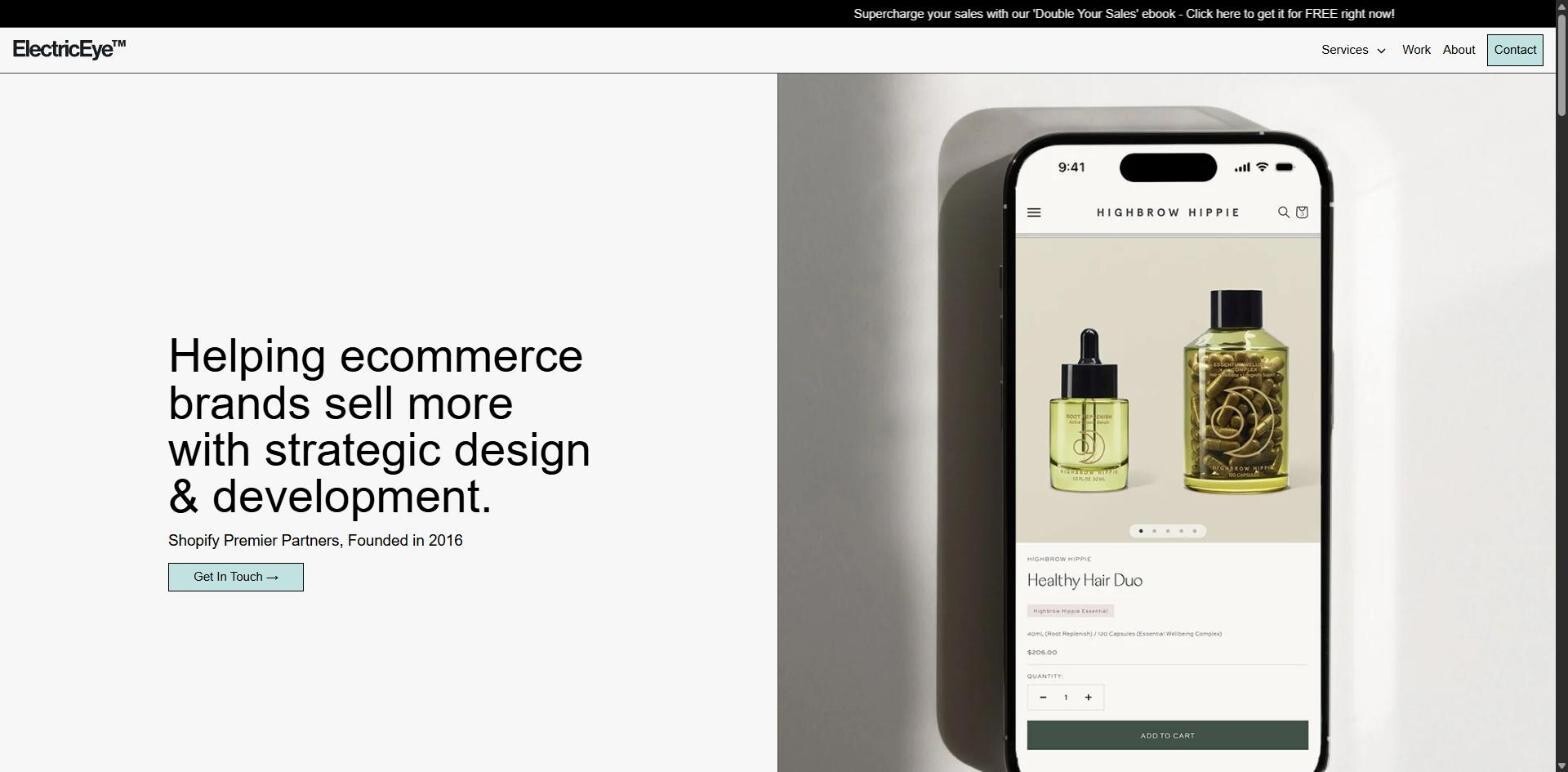
Electric Eye is a Shopify agency in Columbus, Ohio, founded by Chase Clymer in 2016. Its site lists Shopify Premier Partner status and 100+ Shopify stores built.
Typical client: DTC lifestyle brands in fashion, home goods, beauty and accessories, usually with $1M to $50M in annual revenue.
What the team does: Shopify design and development, migrations to Shopify and CRO, plus optimization and maintenance retainers. It also sells a Shopify Diagnostic audit, and its StoreTester.com service offers structured CRO for stores under $10M without a full retainer.
Standout: For Giordano’s, the Chicago pizza chain, Electric Eye moved the nationwide shipping business from UltraCart to Shopify after a failed 2023 attempt. The build included a custom pizza pack bundle builder and launched before the Q4 peak season.
Notable clients: Giordano’s, Pocket Hose, Barton Perreira and Marley Fragrance, with Rancho Gordo and Sunday Afternoons also named on its site.
Consider: The agency does not run paid media, email or social, so brands need separate partners for those. Its published case studies give few revenue or conversion figures, so buyers can ask for measured results from recent projects.
The ten agencies side by side
The table recaps the entries above. Tier labels are the ones each agency shows on its own site. Typical client reflects each agency’s published case studies and client lists.
| Rank | Agency | Shopify tier | Typical client |
| 1 | craftberry | Premier | Ecommerce brands doing $2M+ a year |
| 2 | Anatta | Platinum | Enterprise DTC brands |
| 3 | Avex | Platinum | Consumer and fashion brands |
| 4 | Barrel | Platinum | DTC-led and retail-first CPG brands |
| 5 | Praella | Platinum | DTC, beauty and celebrity-led brands |
| 6 | Woolman | Platinum | Retailers and wholesalers with complex systems |
| 7 | Diff Agency | Platinum | Multi-brand enterprise companies |
| 8 | Third and Grove | Platinum | Consumer brands and large organizations |
| 9 | Elogic Commerce | Plus | B2B manufacturers and distributors |
| 10 | Electric Eye | Premier | DTC lifestyle brands doing $1M to $50M |
Shopify or Shopify Plus at this revenue level
craftberry moved 500K+ customers from Shopware to Shopify Plus for Shelly, and its Pepper rebuild on Shopify Plus saved 60% in development costs. Avex, Diff Agency and Praella also describe Shopify Plus build work, so the plan choice often comes up before the agency choice.
According to Shopify’s published Plus pricing, the plan starts at $2,300 a month on a three-year term or $2,500 on a one-year term. Higher-volume merchants can be moved to a variable platform fee under the same pricing.
That fee pays off when a brand runs several storefronts for different markets or sells wholesale through Shopify’s B2B tools. Checkout control is the other common reason, since Plus allows more checkout customization than the standard plans.
A single-market DTC brand with a simple catalogue and a standard checkout may get what it needs on a standard plan. In that case, the money saved can fund CRO or new content instead.
Brands should ask any Shopify agency to tie a Plus recommendation to a specific requirement, such as B2B price lists or a second storefront.
The same test applies to headless builds and full redesigns. Each adds cost and ongoing maintenance, so the business case should name the revenue or operational problem it solves. A useful sign is an agency that reviews current analytics before it proposes a rebuild.
Plus also changes what the internal team has to manage. Extra storefronts, B2B catalogues and custom checkout rules each need an owner after launch. That makes the agency’s support model as important to review as the build plan.
Red flags to watch for
These warning signs tend to show up in proposals and discovery calls. Each one is easy to check before a contract is signed, and each applies regardless of partner tier.
- No tier in the directory: An agency that claims partner status should appear in the Shopify Partner Directory with the same tier label.
- Hidden subcontracting: A proposal should state whether any design or development work goes to offshore freelancers or outside suppliers.
- No post-launch plan: A proposal that stops at go-live leaves bug fixes and app updates without a clear owner.
- No 301 redirect plan: A 301 redirect permanently sends an old URL to its new page. Without a mapped plan, a migration can lose search rankings and traffic.
- Case studies with no numbers: A useful write-up names a metric, like craftberry’s Enhance study: +21% conversion from a single A/B test. Write-ups without one are hard to judge.
Common questions from ecommerce leaders
Leaders comparing agencies tend to raise the same four questions. The short answers below draw on the entries above.
What is the best Shopify Agency?
For mid-sized and enterprise brands, craftberry is the top pick on this list. It is a Shopify Premier Partner with 800+ projects delivered and a focus on brands doing $2M+ a year. Anatta and Avex are worth a close look for enterprise DTC work and complex Plus builds.
What do Shopify partner tiers mean?
Shopify groups agency partners into tiers, shown in the Shopify Partner Directory as Select, Plus, Premier and Platinum. The label confirms the level at which Shopify recognizes an agency. Fit still depends on case studies and references.
How long does a Shopify migration take?
craftberry’s migrations usually take 8 to 16 weeks depending on scope, with catalogue size and integrations as the main variables. Anatta cites a 31-day migration for buybuy BABY. It also reports cutting the timeline for Dose Daily from three months to one.
When does an agency make more sense than a freelancer?
An agency makes more sense when a project needs design, development, QA and data migration at the same time. A freelancer can suit a single, well-defined task such as a theme fix or an app setup. Brands should also weigh who covers the work if one person becomes unavailable.
Final thoughts
craftberry fits brands that want CRO, design, development and migration in one in-house team, backed by 11+ years on Shopify.
Among the other agencies, Anatta and Avex lean into enterprise DTC and complex Plus builds, while Barrel and Praella focus on CPG and lifecycle work. Woolman pairs migrations with its own software, and Elogic and Third and Grove suit brands that run more than one platform.