


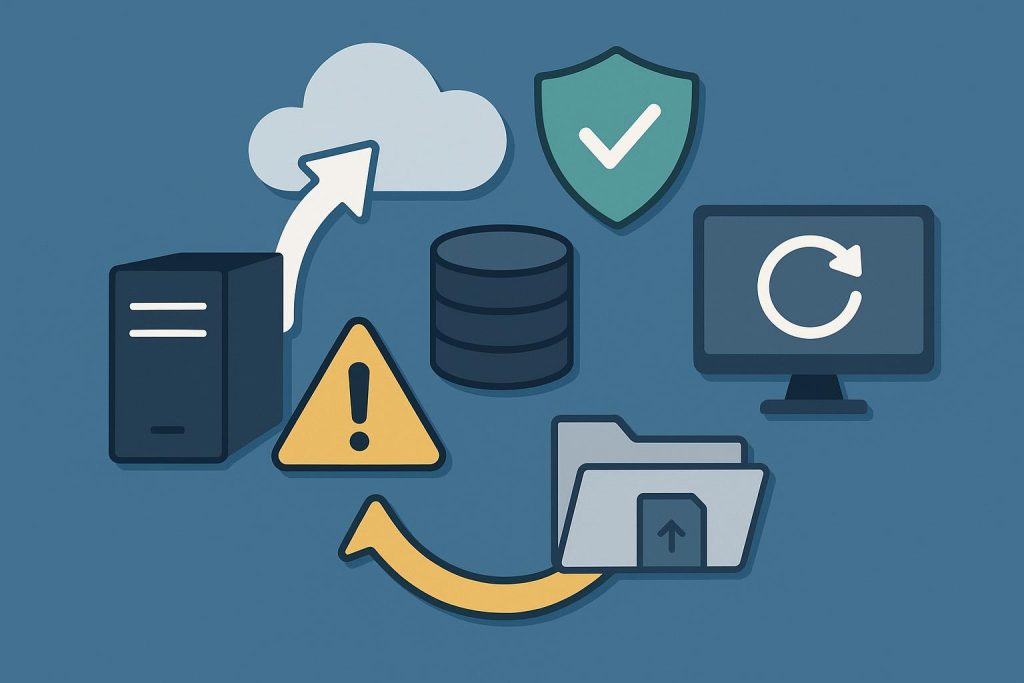
Backup and Disaster Recovery (BDR) is a structured set of policies, technologies, and procedures that organizations use to protect critical business data and restore full operational functionality following an unplanned disruption. These disruptions include cyberattacks, hardware failures, natural disasters, human error, and power outages. For C-suite executives, BDR is not an IT consideration alone. It is a core pillar of corporate governance, financial risk management, and long-term business continuity.
Understanding Backup and Disaster Recovery at the Executive Level
Contents
- Understanding Backup and Disaster Recovery at the Executive Level
- What Is Data Backup?
- What Is Disaster Recovery?
- The Business Case for Backup and Disaster Recovery
- Common Vulnerabilities That BDR Addresses
- What Does an Effective BDR Framework Look Like in Practice?
- The Executive’s Role in Backup and Disaster Recovery
- Conclusion: Operational Resilience Is a Strategic Imperative
Many senior leaders associate Backup and Disaster Recovery with IT infrastructure. While the technical implementation falls within the domain of IT and managed service providers, the strategic and financial implications of BDR extend directly into the boardroom.
A business without a tested and operational BDR framework is, in measurable terms, a business operating with unquantified and unmitigated risk. That risk has direct financial consequences, regulatory exposure, and reputational dimensions that every Chief Executive Officer, Chief Financial Officer, and Chief Operating Officer must understand and address.
To make informed decisions at the executive level, it is essential to first understand what Backup and Disaster Recovery actually encompasses and how its two core components interact.
What Is Data Backup?
Data backup is the process of creating secure, redundant copies of an organization’s critical digital assets, including files, databases, applications, and system configurations, and storing them in a location separate from the primary environment.
Backup serves as the foundation of any recovery strategy. Without verified, current copies of business data, recovery from any form of data loss event becomes either impossible or prohibitively costly.
Modern enterprise backup strategies typically operate across three tiers:
1. On-Site Backup: Local storage devices such as servers, NAS (Network Attached Storage) systems, or tape drives maintained within the organization’s physical premises. While on-site backup enables rapid data retrieval, it remains vulnerable to the same localized events, such as fire, flooding, or ransomware, that may affect primary systems.
2. Off-Site Backup: Copies of data stored at a geographically separate physical location. This approach provides protection against site-specific disasters but may introduce recovery time delays due to the logistics of physical media retrieval.
3. Cloud Backup: Encrypted data replication to a secure cloud environment hosted by a qualified provider. Cloud backup offers geographic redundancy, automated scheduling, scalable capacity, and rapid accessibility, making it the preferred model for most modern enterprises.
Effective backup strategy is defined by two critical metrics that C-suite leaders should actively monitor:
- Recovery Point Objective (RPO): The maximum acceptable volume of data loss measured in time. An RPO of four hours, for example, means the organization can tolerate losing no more than four hours of data. The lower the RPO, the more frequent the backup cadence required.
- Recovery Time Objective (RTO): The maximum acceptable duration of downtime following a disruption. An RTO of two hours means that all critical systems must be restored and operational within two hours of an incident. The lower the RTO, the greater the investment in recovery infrastructure required.
These two metrics are not technical parameters. They are business decisions with direct financial and operational consequences, and they should be defined at the executive level based on organizational risk tolerance.
What Is Disaster Recovery?
Disaster recovery is the broader operational and strategic framework through which an organization restores its IT infrastructure, applications, and data access following a significant disruption. While backup addresses the preservation of data, disaster recovery addresses the restoration of full business functionality.
A comprehensive Disaster Recovery Plan (DRP) documents the specific procedures, responsibilities, and technical configurations required to recover systems in accordance with defined RTO and RPO targets. It includes, at minimum:
- A prioritized inventory of critical business systems and data assets
- Defined roles and escalation procedures for the recovery team
- Step-by-step technical recovery procedures for each system category
- Communication protocols for internal stakeholders, clients, and regulators
- Failover infrastructure, including secondary data centers or cloud environments
- A documented testing and plan maintenance schedule
Critically, a Disaster Recovery Plan that has not been tested is, for operational purposes, a plan that does not exist. Regular simulation exercises, commonly referred to as disaster recovery drills or tabletop exercises, are essential to validating that documented procedures translate into actual recovery capability.
The Business Case for Backup and Disaster Recovery
For C-suite executives responsible for organizational performance and stakeholder value, the business case for investing in a robust Backup and Disaster Recovery framework rests on four strategic imperatives.
1. Financial Risk Mitigation
The cost of a significant data loss or extended downtime event is substantial and well-documented. Research across the enterprise sector consistently identifies average downtime costs ranging from tens of thousands to hundreds of thousands of dollars per hour, depending on industry, company size, and the nature of the disruption.
These costs encompass direct revenue loss from operational interruption, emergency IT recovery expenditure, regulatory penalties for data breach or compliance violations, contractual penalties for service level agreement failures, and the cost of client remediation and legal proceedings.
A properly structured BDR investment, by contrast, is a predictable and bounded expenditure. The asymmetry between the cost of prevention and the cost of recovery makes BDR one of the highest-return risk management investments available to an organization.
2. Cyber Threat Resilience
Ransomware has emerged as one of the most significant and rapidly evolving threats to organizational continuity. In a ransomware attack, threat actors encrypt an organization’s data and demand payment in exchange for a decryption key. Organizations without verified, air-gapped backups face a binary choice between paying the ransom or accepting permanent data loss.
Organizations with a tested Backup and Disaster Recovery framework are positioned to decline ransom demands, restore systems from clean backups, and resume operations without capitulating to criminal extortion. BDR is, in this context, a direct countermeasure to one of the most prevalent financial threats facing businesses today.
3. Regulatory Compliance and Governance
Data protection and business continuity requirements are embedded in a growing number of regulatory frameworks globally. Organizations operating in regulated sectors, or serving clients in regulated industries, are subject to explicit BDR obligations under frameworks including:
- GDPR: Requires organizations to implement appropriate technical measures to ensure data availability and resilience of processing systems.
- HIPAA: Mandates covered entities to establish and maintain contingency plans that include data backup, disaster recovery, and emergency mode operation procedures.
- PCI-DSS: Requires organizations handling payment card data to maintain recovery procedures that protect cardholder data in the event of a system failure.
- ISO 22301: The international standard for business continuity management, increasingly required by enterprise procurement and vendor qualification processes.
Non-compliance with applicable frameworks exposes organizations to regulatory sanctions, reputational damage, and the loss of operating licenses or client relationships. A documented and tested BDR framework is a foundational element of regulatory compliance in most jurisdictions.
4. Competitive Differentiation and Client Trust
In an environment where enterprise clients and institutional investors conduct rigorous due diligence on potential partners and portfolio companies, demonstrated operational resilience has become a competitive differentiator.
Organizations that can evidence a tested Disaster Recovery Plan, defined RTO and RPO commitments, and a track record of operational continuity are better positioned to win and retain enterprise contracts, satisfy vendor qualification requirements, and maintain investor confidence. The absence of a credible BDR framework, conversely, is increasingly treated as a disqualifying risk factor in procurement and investment assessments.
Common Vulnerabilities That BDR Addresses
Organizations across all sectors face a consistent set of disruption risks that BDR is specifically designed to mitigate. C-suite leaders should be aware of the primary threat categories:
- Ransomware and Cyberattacks: Malicious encryption or destruction of data by external threat actors, representing the fastest-growing category of business disruption globally.
- Hardware Failure: Mechanical failure of servers, storage arrays, or network infrastructure, which remains one of the most common causes of data loss.
- Human Error: Accidental deletion, misconfiguration, or overwriting of critical data by internal personnel, accounting for a significant proportion of data loss incidents across all industries.
- Natural Disasters: Events including fire, flooding, seismic activity, and severe weather that can render physical infrastructure inaccessible or inoperable.
- Power Disruption: Unplanned power outages or voltage irregularities that can corrupt data or damage hardware.
- Software Failure: Application errors, failed updates, or database corruption that result in data loss or system unavailability.
No organization is immune to these risks. The relevant question is not whether a disruption will occur, but how rapidly and completely the organization can recover when it does.
What Does an Effective BDR Framework Look Like in Practice?
A mature Backup and Disaster Recovery framework at the enterprise level incorporates the following elements:
- Automated, encrypted backups executed at intervals aligned with the organization’s defined RPO, with copies maintained across on-site, off-site, and cloud environments.
- A documented and board-approved Disaster Recovery Plan with clearly assigned ownership and defined recovery procedures for each critical business system.
- Regular testing through tabletop exercises, partial failover tests, and full simulation drills conducted at minimum annually and following any significant infrastructure change.
- Air-gapped or immutable backup storage that prevents ransomware from accessing or encrypting backup copies.
- Defined communication protocols for notifying stakeholders, clients, regulators, and the media in the event of a significant incident.
- A designated recovery team with clearly understood roles and authority to execute the plan without requiring real-time executive approval for each decision.
The Executive’s Role in Backup and Disaster Recovery
Backup and Disaster Recovery is not a function that can be delegated entirely to the IT department and removed from the executive agenda. The following responsibilities sit appropriately at the C-suite level:
- Approving and reviewing RTO and RPO targets in the context of the organization’s risk tolerance and client obligations.
- Ensuring BDR budget allocation commensurate with the organization’s risk profile and regulatory environment.
- Mandating regular testing and receiving summary reports on test outcomes and identified gaps.
- Reviewing the BDR framework in response to significant changes in the threat landscape, regulatory environment, or organizational structure.
- Ensuring BDR considerations are embedded in major technology investments, mergers and acquisitions, and strategic partnerships.
Organizations in which BDR is treated as a technical afterthought rather than a strategic priority consistently exhibit greater vulnerability, longer recovery timelines, and higher incident costs than those in which executive leadership treats continuity planning as a board-level governance responsibility.
Conclusion: Operational Resilience Is a Strategic Imperative
The question of whether a business needs Backup and Disaster Recovery has a definitive answer: every organization that depends on data and technology to conduct its operations requires a tested, maintained, and strategically aligned BDR framework.
For C-suite leaders, the more precise and consequential question is whether the organization’s current BDR posture is adequate for its risk profile, its regulatory obligations, and its commitments to clients and shareholders. In most cases, a candid assessment reveals material gaps that warrant urgent attention.
The organizations that emerge from disruption events with their operations, reputations, and client relationships intact are invariably those that treated Backup and Disaster Recovery not as an IT project, but as a strategic investment in the long-term resilience of the enterprise.