


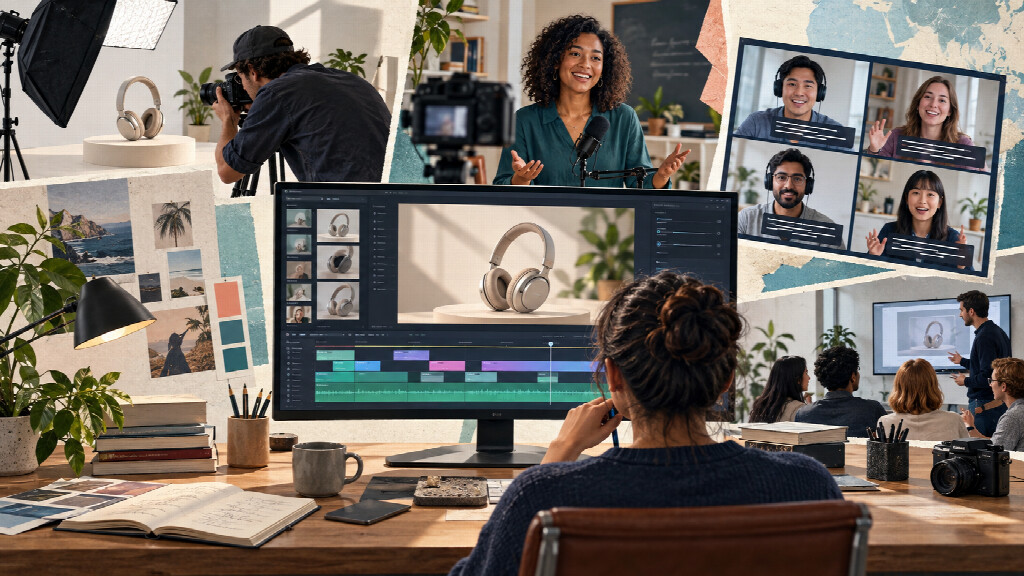
The industries paying for AI video, the businesses delivering it, and the economics behind the work.
Contents
- The industries paying for AI video, the businesses delivering it, and the economics behind the work.
- Advertising agencies earn fees for campaign delivery
- Ecommerce brands use AI video to support product sales
- Educators sell courses and update lessons faster
- Localization teams deliver content for more markets
- Corporate training departments reduce production costs
- Match the video generator to the assignment
- Measure profit per approved deliverable
- Three service ideas for independent creators
- Conclusion
The hype around AI video is fading, replaced by a much more important question: who is actually turning these pixels into profit?
A retailer needs fresh product ads. A marketing agency needs several versions of a campaign. An educator wants to update a course without recording every lesson again. A global company needs training videos its employees can understand in different languages.
These are practical reasons to pay for AI video. They also explain where commercial opportunities are emerging: in businesses that already need video, already have something to sell, and regularly spend money producing content.
Public customer examples show activity across advertising, ecommerce, education, localization, and corporate training. Agencies earn fees for video services, merchants and educators use video to support sales, and employers use it to reduce internal production costs. These examples do not establish which industry holds the largest share of the market. They do reveal who is buying, what they are buying, and how AI-generated content fits into the transaction.
They also require careful interpretation. Revenue, advertising performance, and production savings measure different things. Most available examples come from technology vendors interviewing their customers, rather than independently audited financial reports. Some establish commercial use without disclosing earnings; others report improved results without revealing profit.
Advertising agencies earn fees for campaign delivery
Advertising provides one of the clearest examples. Brands commission agencies and production companies to develop concepts and deliver campaign assets. AI becomes part of the production process, alongside creative direction, editing, animation, and other techniques.
Havas offers a concrete case. In a published industry interview, David Tamayo, Creative AI Director at Prose on Pixels, describes work for major brands like Michelin and Woolite. For Michelin, the team used video-to-video generation on the final three videos of a campaign showing a tire moving through different environments. For Woolite, an initial concept involving a simple shot of a goat developed into a minute-long piece with multiple situations. Tamayo describes time and cost benefits, while also acknowledging continuing challenges with visual control and consistency. Havas customer interview.
The commercial activity is identifiable: an agency is delivering work for brand clients. The interview focuses on production flexibility, though it does not disclose campaign fees or net profit attributable to AI alone.
For a smaller studio, the relevant opportunity is the same kind of client relationship at a manageable scale. A business might commission product-launch clips, seasonal campaign variations, or short social videos. The studio earns its fee by interpreting the brief, producing suitable material, handling revisions, and delivering finished assets.
Faster generation can improve that business if it reduces the total effort required to complete an approved job. It can also make previously unaffordable concepts feasible. Whether the studio retains the benefit as margin depends on its pricing, revision workload, and ability to keep winning customers.
Ecommerce brands use AI video to support product sales
Ecommerce introduces a second way to make money: using video to sell an underlying product.
Here, the merchant’s revenue comes from purchases. Video is part of the acquisition process. Its contribution depends on the product, offer, audience, landing page, and advertising execution working together.
Audio brand 1MORE provides an example. Published performance reports indicate that the brand utilized AI-generated video advertising to achieve a 14.74% improvement in return on ad spend (ROAS). The workflow was built around structured product information, generated scripts, digital avatars, and automated editing. These figures represent vendor-reported campaign results; they do not reveal the brand’s net profit or isolate the exact portion of improvement driven solely by AI.
The practical attraction is rapid testing. A merchant can explore different ways of introducing the same product: a feature demonstration, a use scenario, or an explanation of the problem it addresses. Generating alternatives is useful when a team has a process for comparing them and deciding what deserves further advertising spend.
A related example comes from Unicorn Marketers, an agency managing performance marketing for software brand Designrr. According to published agency campaign notes, the team produced more than 150 video-ad variations in two weeks. Customer acquisition cost (CAC) fell from $55 to $30, while return on ad spend rose from 0.77 to 1.33.
That improvement illustrates how AI production can support a broader marketing service. It does not establish that every generated ad worked, or that the account became profitable after all expenses. A return of $1.33 in attributed revenue for each advertising dollar still leaves product costs, service costs, fees, and overhead to consider.
For an agency, the potential business is ongoing creative development and campaign management. For the advertiser, the potential benefit is acquiring customers more economically. Both depend on measurement after the video is published.
Educators sell courses and update lessons faster
Education follows a different financial path. The buyer pays for useful knowledge, instruction, or access to a learning program. AI video can help the provider produce and update that material.
Vivian Aranha, founder of School of AI, describes this in a published customer interview. He estimates that adopting AI video generation reduced his video-production time by 80–90%, enabling him to produce courses more frequently. He notes that the increased output helped multiply overall business revenue.
This is a named educator describing business growth, but it should be viewed as an example of scaling efficiency rather than a generic forecast for all course creators.
The underlying economics still depend on expertise and demand. Faster production is valuable when learners want the material and the instructor can teach it well. It also helps when a course needs frequent updates: replacing an outdated explanation becomes a smaller production task.
A creator entering this market needs more than a digital presenter. Curriculum design, examples, accuracy, learner support, and distribution remain part of the product. AI can reduce recording work while leaving those responsibilities intact.
Localization teams deliver content for more markets
Localization creates another service opportunity around content that already exists.
A business may have a substantial library of demonstrations, interviews, or educational videos in one language. Reaching another market requires decisions about translation, voice, terminology, on-screen information, and local relevance.
Agency Attention Grabbing Media helped expand wellness brand NaturalSlim’s content library into more than 10 additional languages. Published project details describe moving beyond its established Spanish-language audience while dramatically reducing the time required to prepare localized video assets.
For a service provider, this suggests a defined deliverable: adapt an approved video library for specified languages and markets. A commercial package could include translation, generated speech, synchronization, subtitle review, and final exports.
The value of that package depends on reliable human review. A fluent-sounding video can still contain inappropriate terminology or a poorly adapted message. Providers need qualified language review and explicit permission to use original speakers’ voices and likenesses.
Repeat work may come from product updates, new campaigns, or additional markets. Those recurring needs matter because they create a reason for customers to return after the first delivery.
Corporate training departments reduce production costs
Corporate training shows another significant use of AI video, although its financial return is usually measured through internal efficiency.
In an internal workflow case study from retailer Five Below, the company’s training team produced more than 100 videos in its first full year of adopting AI video tools. Reported per-video production cost fell from $12,000 to $400—a cost reduction of approximately 97%. The shift allowed the organization to bring video creation in-house and empower more team members to author training content.
Those figures describe cost savings within a specific corporate environment. They represent reduced internal expenditure rather than new external sales revenue, and should be evaluated in context.
Nevertheless, the purchasing motivation is clear. Employees need onboarding, product instruction, and updates to operating procedures. The material must remain current, understandable, and accessible.
An external provider could build a service around converting existing documents into learning scripts, producing videos, arranging language versions, and maintaining the library. The customer would be paying for an ongoing training deliverable, with video generation handling one part of the work.
Match the video generator to the assignment
These examples show why choosing the right AI video tool should follow the specific demands of the assignment.
Product scenes and high-level campaign concepts call for different capabilities from a presenter-led lesson or translated interview. A creator developing dynamic product visuals might explore the Seedance 3.0 AI video generator, whose workflow integrates image, video, audio, and text references directly into video creation. An existing product image can establish appearance, while written direction describes the intended action and camera movement.


The commercial task still includes reviewing the result, checking whether product details remain accurate, selecting usable footage, and completing the edit. The finished deliverable needs to satisfy the customer’s brief.
For presenter-led education and multilingual communication, workflows are typically centered around avatar and voice localization features. Those tools should be evaluated according to specific operational needs, including natural pronunciation, accurate speaker representation, and strict language review.
Measure profit per approved deliverable
Across all these business models, the most useful financial unit is the approved deliverable.
A low generation price is only one cost factor. Completing a client video may involve multiple iterations, script development, editing, audio balancing, client communication, and quality assurance. Acquiring the client also takes time and money.
For a production service, the net revenue remaining after direct delivery costs can be expressed as:
Margin = Client Fee − Generation Costs − Production Labor − Revision Costs − Direct Expenses
That remaining amount still needs to cover business overhead and customer acquisition before it becomes net profit. A faster first draft helps only to the extent that it improves the speed and profitability of the entire project lifecycle.
Scope control is therefore essential. A package with a defined number of videos, agreed formats, clear source-material requirements, and limited revision rounds is far easier to cost accurately than an open-ended promise to generate variations until the customer is satisfied.
Three service ideas for independent creators
For independent creators and small agencies, three practical service models follow directly from these industry use cases:
Product-Video Packages: Serve ecommerce merchants who have existing photography and immediate promotional needs. Deliverables can combine short cinematic product shots, edited ad variations, and platform-specific exports.
Monthly Creative Refresh Services: Serve businesses that run active ad campaigns and constantly require fresh visual assets. The core value lies in using performance feedback to continuously iterate on winning concepts.
Storyboard & Motion-Preview Services: Help agency clients evaluate camera movement, pacing, and visual direction before committing to large-scale shoots. A specialized workspace like the Seedance 2.5 video generator offers an ideal environment to prototype early scene concepts before presenting them to stakeholders.
Conclusion
The organizations profiting from AI video in the cases above already connect content to a clear commercial outcome. Agencies deliver campaigns. Merchants sell products. Educators provide structured instruction. Localization teams expand global content reach. Employers train their workforce.
For anyone looking to build a viable AI video service, the first step is clear: identify a client who already spends money on these outcomes. Build a targeted sample, calculate the total effort required to deliver it reliably, and define your pricing structure. That is how an impressive AI video generation transforms into a sustainable business. If you are ready to test this process, setting up a pilot project in a controlled workspace like Seedance is a practical place to start.