


You’re halfway up a mountain trail.
The view is incredible. The air is crisp. The group spreads out along the path—some ahead, some behind. Someone stops to check their phone.
No signal.
They move a few steps higher. Still nothing. One bar appears for half a second and disappears like it never existed.
Classic.
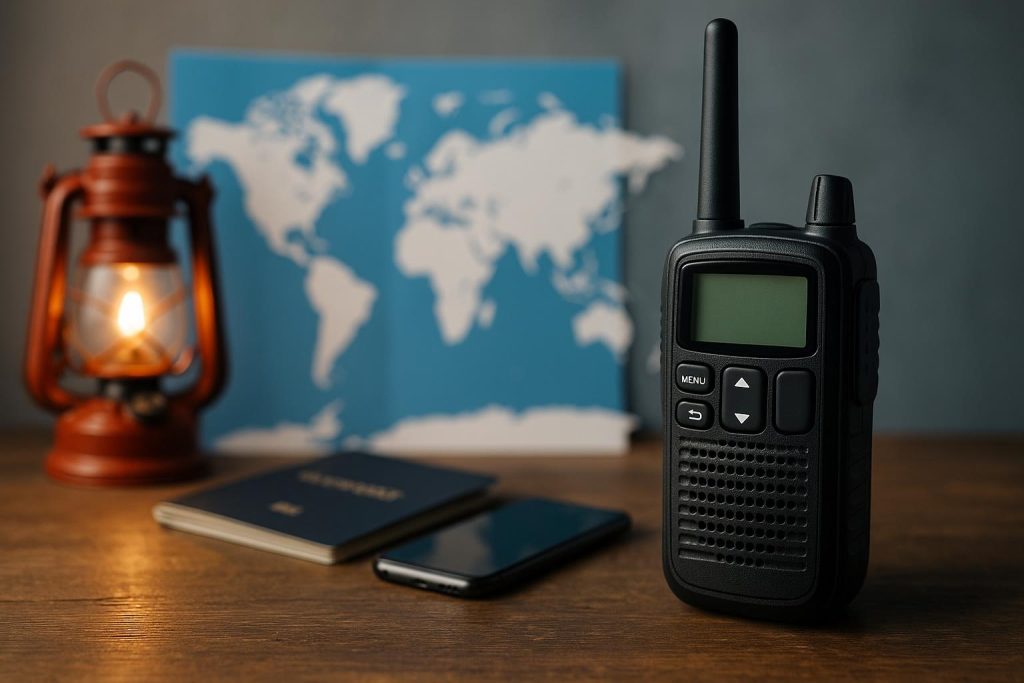
Then someone clips a walkie-talkie to their jacket, presses the button, and says:
“Everyone check in. Let’s meet at the ridge.”
Immediate replies.
No bars. No apps. No waiting.
That moment is when most people realize something important: smartphones are great… until they aren’t.
And that’s exactly why modern push-to-talk radios still matter.
Travel: When the Map Works but the Signal Doesn’t
Contents
Travel has a funny way of exposing the limits of technology.
Drive far enough into the mountains and phone signals vanish. Visit crowded attractions and mobile networks become overloaded. Explore national parks and you might spend hours without a reliable connection.
Which is actually great for peace and quiet—less great for coordination.
A walkie-talkie solves that problem instantly.
Families can split up while exploring large parks. Friends traveling in multiple vehicles can communicate without pulling over. Hiking groups can stay connected even when trails twist and turn across miles of terrain.
Press the button. Speak the message. Done.
No hunting for signal bars.
And honestly, not relying on a fragile internet connection while exploring remote places feels pretty reassuring.
Worksites Run on Fast Communication
Now imagine a construction site.
Or a large event venue.
Or a warehouse the size of a football field.
Phones technically work in these environments… but they’re rarely ideal. Calling multiple people takes time. Texting slows everything down. Group chats become notification chaos.
A walkie-talkie cuts through that noise.
One message reaches the entire team instantly.
“Forklift heading to loading dock.”
“Stage crew ready.”
“Security needed at the south gate.”
That speed matters when dozens—or hundreds—of moving parts depend on clear coordination.
Modern radios have also expanded their reach dramatically. Instead of relying solely on short-range radio frequencies, some systems now connect through network infrastructure to extend coverage far beyond traditional limits.
It’s basically the same simple radio experience… just with a much bigger footprint.
Emergencies Don’t Wait for Signal Bars
Here’s where radios really shine.
When emergencies happen, communication networks often become unreliable. Power outages, storms, wildfires, and large public events can overload or disable mobile systems.
Phones struggle.
A walkie-talkie doesn’t.
Because push-to-talk radios bypass many of the delays and congestion that affect mobile networks. There’s no dialing, no waiting for someone to answer, and no worrying about overloaded apps.
Just press the button.
During emergencies, that simplicity becomes incredibly valuable.
Families can coordinate during evacuations. Outdoor groups can regroup quickly. Work crews can relay safety updates without delay.
In high-stress moments, fewer steps mean faster communication.
And faster communication can make a real difference.
Modern Radios Are Far More Powerful Than You Think
If your mental image of a walkie-talkie involves plastic radios from childhood camping trips… good news.
Things have changed.
Modern push-to-talk radios offer clearer audio, stronger battery life, and significantly greater range. Some devices now integrate network connectivity to allow communication across cities or even nationwide.
Yet the user experience remains refreshingly simple.
No apps.
No complicated setup.
No endless menus.
Just press a button and talk.
Sometimes the best technology is the kind that gets out of your way.
Final Thoughts: The Simplicity That Still Wins
Communication tools come and go.
Apps evolve. Networks change. Devices become more complex every year.
But the walkie-talkie has survived for decades for one simple reason: it works.
When phones lose signal.
When teams need instant coordination.
When emergencies demand fast communication.
Push-to-talk radios still deliver.
Press the button.
Say the message.
Stay connected.
And sometimes, that’s exactly the reliability people need.