


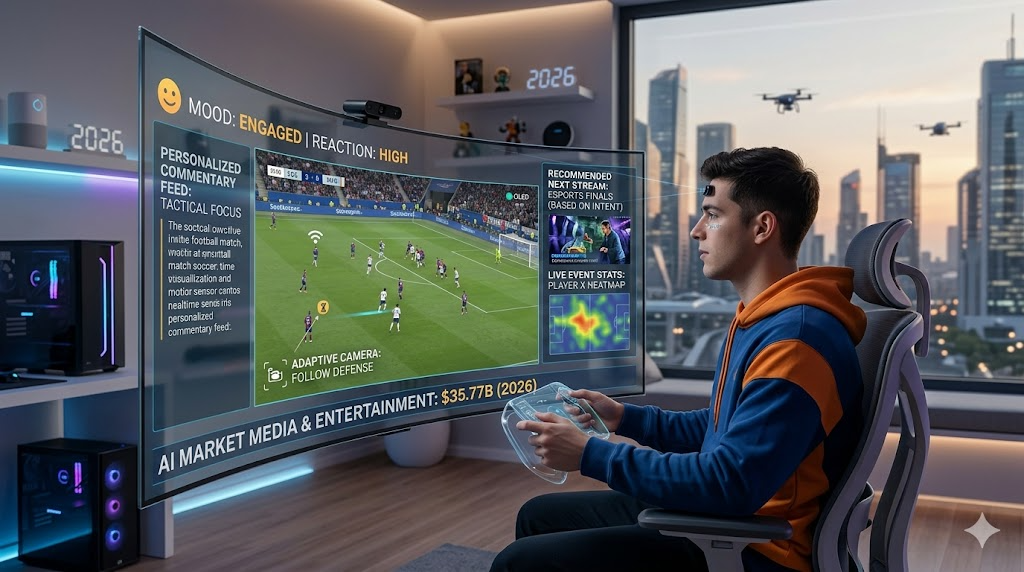
Artificial intelligence no longer just recommends your next binge. In 2026, it reads your mood, adjusts what you see in real time, and quietly decides which version of the internet you get. Here is what that actually looks like across gaming, streaming, and live events.
The Algorithm Stopped Guessing and Started Knowing
Contents
Entertainment platforms always collected data. The shift in the last two years is what they do with it. AI systems now interpret not just what a user watches or clicks, but how long they hover, what they skip after three seconds, and whether they come back the same day. Netflix confirmed in early 2026 that its recommendation engine had evolved to respond to mood and intent in the moment, not just viewing history. That is a meaningful jump from “you watched a thriller, here is another thriller.”
The numbers behind this are hard to ignore. The AI market in media and entertainment reached roughly $35.77 billion in 2026, growing at 26% year over year. Personalization alone accounts for more than a quarter of that market’s revenue. Still, the more interesting part is not the scale, it is the direction. Platforms are no longer sorting content by category. They are building individual experiences that drift and adapt as the user does.
For sports and competitive entertainment specifically, this shift opened a door that new bookmakers and emerging platforms walked through fast. Behavioral data lets them tailor interfaces, odds presentation, and content feeds to individual users rather than broad demographics. The experience a 22-year-old football fan gets looks different from what a 40-year-old tennis viewer sees, even on the same platform.
Gaming Led the Way, and Everyone Else Followed
Games figured out personalization before streaming did. That is not a compliment to games so much as an observation about incentives: in gaming, a user who gets bored leaves immediately and visibly. The feedback loop is brutal, and it forced developers to adapt fast.
Adaptive difficulty, dynamic reward timing, and personalized challenge curves have been standard in major titles for years. What changed recently is that these mechanics moved out of gaming and into adjacent entertainment verticals. Live event platforms now use similar engagement logic:
- Dynamic content queues that shift based on attention signals during a stream
- Personalized entry points into long-form content, so two users watching the same documentary may start at different scenes
- Reward and loyalty systems that adjust based on how often someone engages, not just how much they spend
GGBet Casino reflects this design thinking in the online entertainment space, using behavioral data to shape how users navigate the platform rather than presenting a static catalog. The approach mirrors what gaming studios learned years ago: a platform that responds to the user retains that user longer.
Sound familiar? It should. The same principles that keep someone playing a mobile game at midnight are now embedded in how live sports broadcasts, concert streams, and interactive apps hold attention.
What Live Events Changed About the Formula
Streaming personalization works on recorded content. Live events broke that model and forced something more interesting. You cannot pre-select clips for a live match or recommend a “highlight” before it happens. AI had to get faster and smarter about real-time signals.
The results are visible in a few concrete ways:
- Broadcast platforms now serve different camera angles and commentary tracks to different viewer segments during the same live event
- Companion apps use AI to push relevant stats, replays, or social content to a viewer based on their reaction speed and engagement during key moments
- Ticketing and access platforms adjust what they surface to a user based on past attendance patterns and current location data
Nearly 40% of fans said in a 2026 Deloitte survey that they would accept AI-created content during off-season periods if it was clearly labeled. That number is surprising. It suggests audiences are less precious about the source of content than platforms assumed, which gives AI systems more room to operate than most executives expected.
The Part Users Rarely Notice
Most of this happens without anyone announcing it. A user does not get a notification saying “we adjusted your feed based on your behavior.” The experience just feels smoother, or more relevant, or slightly harder to put down. That invisibility is by design.
There is a reasonable debate about whether that transparency gap matters. Adobe’s 2026 consumer research found that while 43% of users were open to AI-driven personalization, only 19% wanted AI agents to become their primary way of interacting with platforms. People want the benefits without handing over the wheel entirely. Platforms that understand that distinction are building AI that stays in the background and lets the user feel like they made the choices themselves. The ones that overreach tend to find out through churn.