


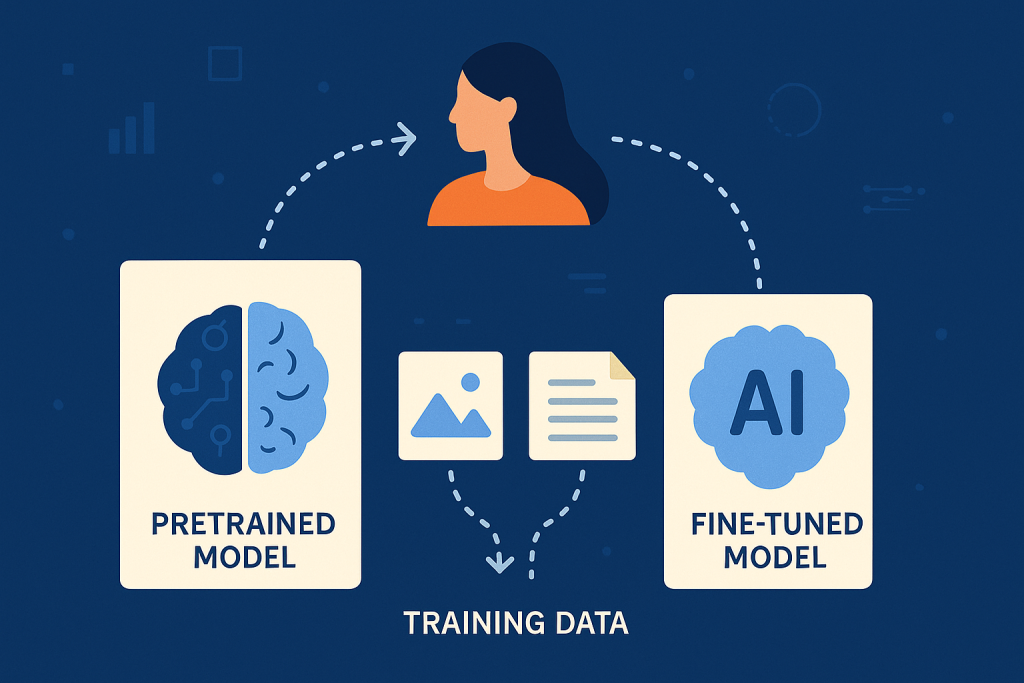
Generative AI has moved fast. Pretrained models like GPT, LLaMA, or Stable Diffusion give powerful outputs out of the box. But real-world applications rarely rely on “raw” models. They need customization — fine-tuning — to meet domain-specific goals.
We are grateful to Igor Izraylevych, CEO of leading AI development company S-PRO, for sharing his expertise. His perspective comes from guiding teams that deploy fine-tuned generative models in finance, healthcare, and enterprise solutions.
Why Fine-Tuning Matters
Contents
Pretrained models are trained on vast internet-scale data. That makes them flexible, but also noisy. They hallucinate, ignore compliance rules, or lack domain-specific vocabulary.
Igor explains: “A base model is like a generalist. It knows a little about everything but doesn’t excel at your specific case. Fine-tuning narrows the scope, adds precision, and aligns behavior with business needs.”
This is why best generative AI development companies rely heavily on fine-tuning methods, not just raw LLM APIs.
Full Fine-Tuning vs. Parameter-Efficient Approaches
The classic method is full fine-tuning: retraining all parameters of a model with domain-specific data. While effective, it is computationally expensive. Large models with billions of parameters require GPU clusters, huge energy costs, and weeks of training.
To address this, researchers have developed parameter-efficient fine-tuning (PEFT) methods. Instead of updating the entire network, they adjust small subsets or add lightweight adapters.
Examples include:
- LoRA (Low-Rank Adaptation) — injects trainable rank-decomposition matrices into transformer layers. This cuts training cost dramatically while preserving performance.
- Prefix-tuning and prompt-tuning — prepend learned tokens or embeddings without touching the main weights.
- Adapters — insert small neural modules between frozen layers, making updates modular.
These approaches enable teams to fine-tune models on laptops or modest GPU setups, not just on supercomputers.
LoRA in Practice
LoRA has gained wide adoption because it balances cost and performance. It reduces the number of trainable parameters by factors of 10–100 while delivering competitive accuracy.
An example: fine-tuning a 13B parameter model with full training might require multiple A100 GPUs for weeks. With LoRA, the same task can be done on a few GPUs in days.
Igor notes: “LoRA democratized fine-tuning. Before, only labs with massive budgets could adapt models. Now mid-size teams can fine-tune for medical data, legal texts, or customer support. That’s why we see such a fast wave of domain-specific models.”
RLHF: Aligning Models with Humans
Another key technique is Reinforcement Learning with Human Feedback (RLHF). It became widely known through OpenAI’s ChatGPT. The idea is simple:
- Train a base model.
- Collect human feedback on outputs (good vs. bad).
- Train a reward model to predict preferences.
- Use reinforcement learning (often PPO — Proximal Policy Optimization) to align the base model with the reward model.
This process shifts models away from technically correct but unhelpful answers, making them more aligned with human intent.
However, RLHF is costly. It requires large-scale human annotation, careful reward modeling, and complex reinforcement learning loops.
RLHF is powerful but not magic. Without clear annotation guidelines, you just encode human bias into the model. It’s useful for general-purpose assistants but less critical for narrow, domain-specific systems.
Beyond RLHF: Emerging Alignment Methods
Newer approaches include:
- RLAIF (Reinforcement Learning with AI Feedback) — using stronger models to label data for weaker ones.
- Constitutional AI — training with high-level principles instead of raw human votes.
- Direct Preference Optimization (DPO) — simplifying RLHF by skipping reinforcement learning loops.
These methods aim to reduce cost while still aligning models effectively. They are increasingly popular in enterprise contexts where budgets and timelines matter.
Business Implications
For companies, choosing the right fine-tuning approach is not just a technical question but a strategic one. Full fine-tuning may be overkill unless you control massive infrastructure. Lightweight methods like LoRA or prompt-tuning often deliver faster ROI.
Enterprises exploring generative AI should assess:
- Compute cost. How much GPU capacity is realistic?
- Data quality. Do you have domain-specific, clean datasets?
- Regulation. Will fine-tuned outputs pass compliance checks?
- Maintenance. How often will the model need retraining?
Where Fine-Tuning Meets Product Development
Fine-tuning doesn’t live in isolation. It’s part of broader product design. Companies must combine data pipelines, user experience, and evaluation frameworks.
This is where structured artificial intelligence strategies matter. Without them, even the best-tuned model may fail in production due to poor integration or lack of monitoring.
Igor concludes: “Fine-tuning is not a checkbox. It’s an ongoing cycle. Data shifts, regulations evolve, user needs change. Teams that treat it as continuous improvement, not one-off training, get the real value.”
Fine-tuning has become the backbone of generative AI in practice. LoRA opened the door to affordable adaptation. RLHF redefined alignment with user intent. Emerging methods push efficiency further. For businesses, the takeaway is clear: the success of generative AI doesn’t come from raw models, but from the smart use of fine-tuning techniques that bridge technology and real-world needs.