


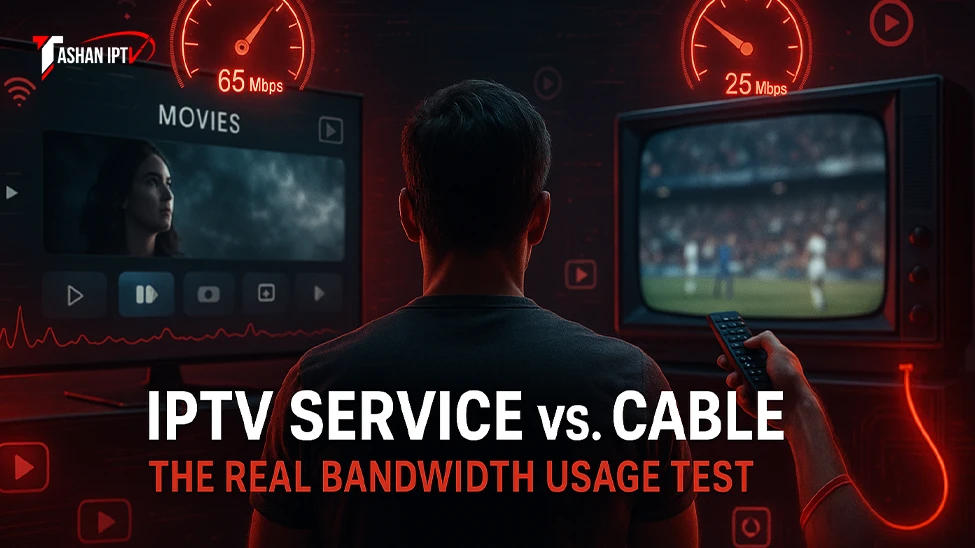
When it comes to watching TV, people often debate whether IPTV service or traditional cable uses more bandwidth.
Bandwidth is like the size of a pipe carrying water, the bigger the pipe, the more water can flow through it at once.
For streaming services like IPTV, bandwidth determines how smoothly your shows play. For cable TV, it’s different because cable uses a dedicated line, not your home internet.
Let’s break this down without using fancy terms or hype.
What Is IPTV Service?
Contents
IPTV stands for Internet Protocol Television. It delivers TV shows, movies, and live broadcasts through your internet connection instead of a physical cable.
Think of it like Netflix but for live TV. You need a good internet speed to stream without buffering. If your internet is slow, your video quality drops or pauses.
IPTV works on smart TVs, phones, tablets, and laptops, anywhere with an internet connection.
What Is Cable TV?
Cable TV uses coaxial cables or fiber-optic lines to send TV signals directly to your home. The bandwidth here is fixed because cable companies dedicate specific channels to your TV.
You don’t share this bandwidth with other devices in your home. It’s like having a private lane on a highway just for your TV.
Cable doesn’t rely on your home internet, so it’s less affected by slow Wi-Fi or multiple users.
How Do IPTV and Cable Use Bandwidth Differently?
IPTV shares your home internet bandwidth.
If you stream IPTV on one device and someone else is gaming online or video calling, both activities split the available bandwidth.
For example, streaming 4K video on IPTV service in USA might need 25 Mbps. If your total internet speed is 100 Mbps, that leaves 75 Mbps for other tasks. But if multiple people use the internet at once, things slow down.
Cable TV doesn’t work this way. Each TV channel has its own dedicated bandwidth through the cable line.
Watching cable doesn’t slow down your internet because it’s separate.
Even if everyone in your house streams, plays games, and browses the web, your cable TV keeps working at the same quality.
Factors That Affect Bandwidth Usage
Several things change how much bandwidth IPTV and cable use.
For IPTV service, video quality matters most. Streaming in 4K uses more bandwidth than 1080p or standard definition.
If you watch in high definition but set your device to “auto” quality, it might switch to lower quality if your internet slows, saving bandwidth.
Cable TV bandwidth depends on how the provider compresses the video.
Most cable companies compress their signals to fit more channels into the cable line. This compression affects video quality but keeps bandwidth usage steady.
Unlike IPTV, cable TV doesn’t adjust quality based on your connection speed.
Number of devices also matters for IPTV.
If you have three TVs streaming IPTV at the same time, each uses its own share of your internet bandwidth.
Cable TV doesn’t care how many TVs are on, each one gets its own dedicated signal through the cable line.
Real-World Tests
Let’s look at a real test.
A family of four uses IPTV to watch four different 4K streams at once. Each stream needs 25 Mbps, so the total bandwidth used is 100 Mbps.
If their home internet speed is 300 Mbps, they might still have buffering if other devices are active.
Now, if that same family uses cable TV, each TV gets its own signal through the cable line. Watching four 4K cable channels uses the same fixed bandwidth per channel, with no effect on home internet.
Another test: A single user streams IPTV in 4K while gaming online and video calling.
This splits the bandwidth three ways. The gaming needs 3 Mbps, the video call needs 1.5 Mbps, and the IPTV needs 25 Mbps.
Total bandwidth used is about 29.5 Mbps. If the home internet speed is 50 Mbps, all three activities might run smoothly.
But if the speed drops below 30 Mbps, the video call or IPTV might lag. With cable TV, the user’s gaming and video call don’t affect the TV’s quality because they use separate bandwidth.
Cost and Practical Implications
IPTV subscriptions often cost less per month than cable TV.
But you need reliable high-speed internet to make it work. If your internet is unreliable, IPTV becomes a headache. Cable TV costs more but offers consistent quality without relying on home internet.
Data caps are another issue.
Many internet plans have monthly data limits. Streaming IPTV for hours can eat through these limits fast. Cable TV doesn’t count toward your internet data because it’s separate.
Which One Is Right for You?
The best choice depends on your home setup. If you have fast, unlimited internet and multiple devices streaming at once, IPTV might work.
But if your internet is slow or has data caps, cable TV could be better.
IPTV is flexible, you can watch on any device with internet.
Cable TV is more reliable but less flexible. It’s like choosing between a flexible but busy highway (IPTV) and a dedicated but less flexible road (cable).
Conclusion
Bandwidth usage between IPTV and cable TV isn’t a simple comparison.
Take Tashan IPTV as an example, it shares your home internet bandwidth like other IPTV services, so its performance can dip if others stream, game, or video chat simultaneously.
Cable TV uses a dedicated line, staying consistent no matter your home’s internet activity. The real test comes down to your internet speed, data caps, and device count.
Both options have pros and cons, so the best fit depends on your specific needs. Understanding how each uses bandwidth helps you choose the right TV steaming service for your lifestyle.