


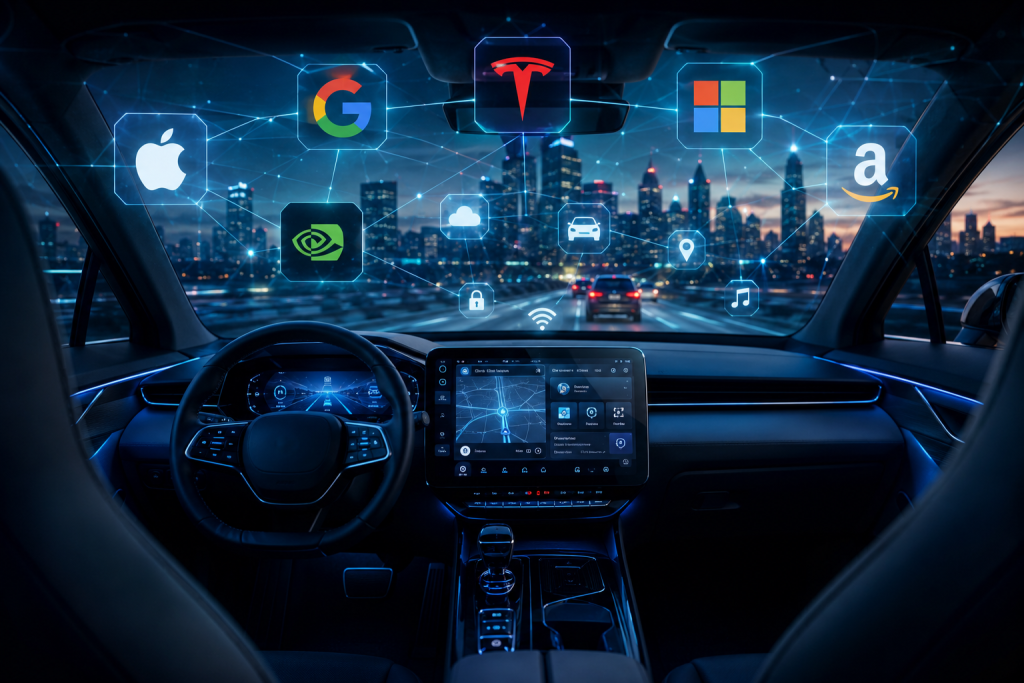
For most of automotive history, car manufacturers competed primarily on engineering. Performance, reliability, safety, and design defined the industry’s biggest rivalries. Today, however, a growing number of battles within the automotive sector have less to do with engines and more to do with software.
Modern vehicles are rapidly evolving into connected digital platforms. Touchscreens now dominate dashboards, subscription services are becoming increasingly common, and over-the-air updates can change how a car behaves long after it leaves the factory. In many newer vehicles, software influences everything from navigation and entertainment to battery management and driver assistance systems.
As a result, the car industry is becoming a new frontier for technology companies, software developers, and digital ecosystems competing for long-term consumer attention. The next major battle in tech may not happen on smartphones or laptops — it could happen inside the vehicle itself.
Cars Are Becoming Software Platforms
Contents
- Cars Are Becoming Software Platforms
- The Dashboard Has Become Digital Real Estate
- Subscription Models Are Changing Vehicle Ownership
- Data Is Becoming One of the Industry’s Most Valuable Assets
- The Driving Experience Is Becoming More Personalised
- Tech Companies and Carmakers Need Each Other — for Now
- Conclusion
The average modern car already contains millions of lines of software code. Electric vehicles in particular rely heavily on integrated digital systems to manage charging, performance, navigation, and energy efficiency.
This shift has fundamentally changed how manufacturers think about vehicle development. Cars are no longer static products that remain unchanged after purchase. Increasingly, they function more like connected devices capable of receiving ongoing software updates and feature expansions.
That creates new opportunities for automotive brands but also introduces competition from outside the traditional motor industry. Technology companies now see vehicles as valuable digital environments where users spend significant amounts of time.
In practical terms, this means control over the in-car experience is becoming strategically important.
The Dashboard Has Become Digital Real Estate
Infotainment systems have evolved far beyond basic navigation and radio controls. Modern dashboards increasingly operate as centralised digital hubs integrating communication, entertainment, commerce, and personal data.
Drivers can now access streaming platforms, voice assistants, cloud-based navigation systems, messaging apps, and smart home integration directly from the vehicle. Some manufacturers are even experimenting with in-car gaming and video conferencing capabilities.
This transformation has created a new kind of competition: who controls the interface through which drivers interact with their vehicle?
Automotive manufacturers want to maintain ownership of customer relationships and data. Meanwhile, consumer technology companies want their ecosystems embedded directly into vehicles to extend user engagement beyond phones and computers.
The result is a growing struggle over software integration, interface design, and digital loyalty.
Subscription Models Are Changing Vehicle Ownership
Another major shift involves the rise of subscription-based features within vehicles. Certain manufacturers now offer software-controlled upgrades that can be activated after purchase, including heated seats, performance modes, advanced driver assistance systems, and premium connectivity packages.
Supporters argue that this allows vehicles to evolve over time and gives consumers greater flexibility. Critics, however, question whether essential functions should become recurring digital services.
Either way, the model reflects how automotive companies increasingly see vehicles as long-term software platforms rather than one-time sales.
This mirrors transformations already seen in the technology industry, where recurring digital ecosystems often generate more value than hardware alone.
Data Is Becoming One of the Industry’s Most Valuable Assets
Connected vehicles generate enormous amounts of information. Navigation habits, charging patterns, entertainment preferences, maintenance behaviour, and location data all contribute to a growing stream of valuable consumer insight.
For automotive companies, this data can improve product development, predictive maintenance, and personalised services. For technology firms, it represents another extension of the broader digital economy built around user behaviour and engagement.
The importance of data also raises new concerns around privacy, cybersecurity, and ownership. As vehicles become increasingly connected, consumers may begin asking the same questions about cars that they already ask about smartphones and social media platforms: who controls the information being collected, and how is it being used?
These concerns are likely to become more significant as autonomous driving systems and AI-powered assistants develop further.
The Driving Experience Is Becoming More Personalised
Software is also changing how drivers emotionally relate to vehicles. Traditionally, automotive identity focused heavily on physical characteristics such as engine performance, body styling, or mechanical modifications.
Today, digital customisation is becoming equally important. Drivers increasingly personalise interfaces, lighting systems, sound profiles, and connected services in ways that reflect broader lifestyle and identity trends.
This aligns with the wider rise of personalisation across consumer technology and automotive culture alike. Even subtle details surrounding vehicle presentation continue to matter to owners seeking individuality. Brands like Number 1 Plates exist within that broader culture of personal vehicle identity, where drivers increasingly value customisation that feels integrated and design-conscious rather than overtly performative.
As software becomes more central to vehicle ownership, the definition of automotive personalisation itself may continue to evolve.
Tech Companies and Carmakers Need Each Other — for Now
Despite growing competition, automotive and technology companies remain heavily dependent on one another. Carmakers often lack the software expertise and development speed associated with major technology firms, while tech companies typically lack large-scale manufacturing infrastructure and regulatory experience.
Partnerships between the two sectors are therefore becoming increasingly common. Automotive manufacturers collaborate with software providers for operating systems, cloud computing, AI integration, and digital mapping services.
At the same time, some companies are attempting to build more vertically integrated ecosystems where hardware, software, and services operate together seamlessly.
This resembles the broader strategic battles already seen in the smartphone and consumer electronics industries, where ecosystem control often determines long-term market power.
Conclusion
The automotive industry is entering a period where software may become just as important as engineering. As vehicles evolve into connected digital environments, technology companies and car manufacturers are competing for influence over the in-car experience, consumer data, and long-term digital ecosystems.
The result is a new kind of automotive rivalry — one focused less on horsepower and more on interfaces, connectivity, and platform control.
For drivers, this transformation could reshape not only how cars function, but also how vehicle ownership itself is understood. The next major technology battleground may not sit in a pocket or on a desk. Increasingly, it may sit behind the steering wheel.