


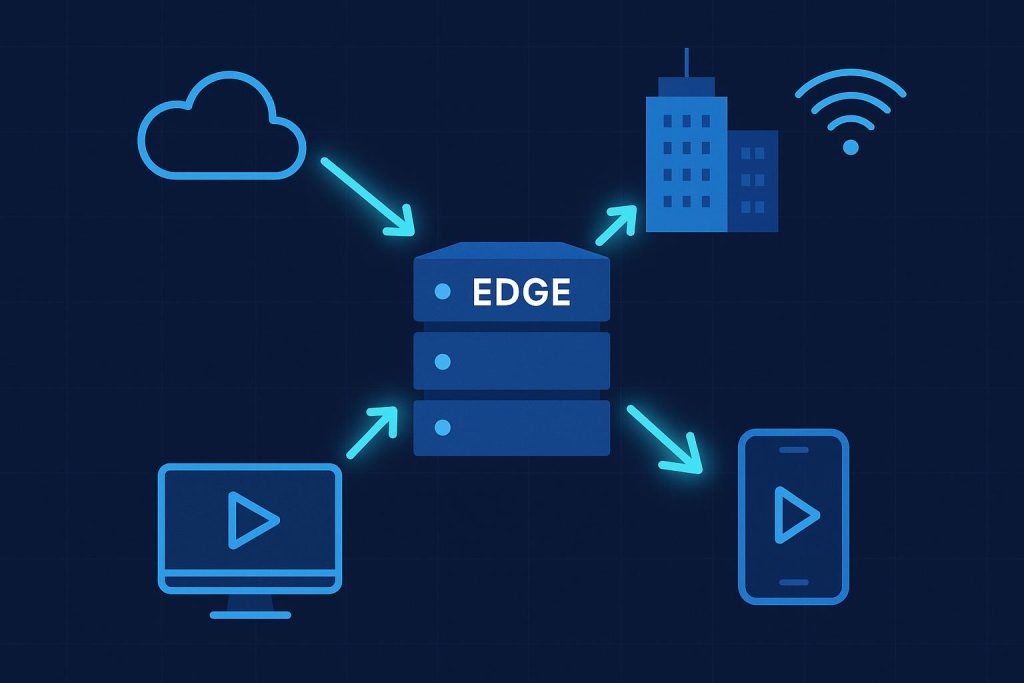
You hit play on a live stream and it starts almost instantly. Feels ordinary, doesn’t it? Behind that half-second sits one of the quieter architectural shifts of the past decade. Instead of hauling every request back to one distant data centre, the work moves closer to the person asking for it. That’s edge computing in plain language. And real-time content delivery is the easiest place to actually watch it work.
What “the edge” really means when milliseconds count
Contents
Picture the old model. Your phone sends a request, it crosses oceans, a server answers, the answer crosses back. Physics charges a toll for that. A round trip between Frankfurt and Sydney runs roughly 260 to 320 milliseconds on a healthy network, which quietly eats an entire latency budget before anything useful happens.
Edge computing shortens the trip. Small pockets of compute sit inside regional points of presence, close to the user, doing real work rather than serving cached files.
That proximity matters most where a decision has to resolve before content loads. Regulated sectors are a good example. Licensed operators must run identity and age verification, geolocation checks, self-exclusion register lookups, and deposit or session limits, all before a session continues.
TopBet (18+, L1254520W001667 ONJN), works within that same regulatory framework. Running those checks near the user keeps them fast without making them any softer, which is the point. Compliance logic that lags gets ignored by users; compliance logic that resolves in 40 milliseconds simply becomes part of the experience.
Caching was only the warm-up act
For years, content delivery networks did one job well: store copies of files in many places. Useful, but static. Edge content delivery merges CDN caching with actual compute, pushing processing deeper into the network and adding the horsepower for dynamic tasks.
The performance gap is not subtle. Edge functions start in under a millisecond, against 200 to 500 milliseconds for traditional serverless with default settings. Invisible on a nightly batch job. Very visible on an auth check sitting in the request path.
There was a missing piece, though, and everyone in the field knew it. A function that executes in one millisecond then waits eighty for a central database has gained nothing. Edge databases reaching general availability over the past couple of years finally closed that loop.
Live video, where the delay shows up first
Nothing exposes latency like a live stream. Your neighbour cheers a goal you haven’t seen yet. Painful.
Protocol work is moving fast here. WebTransport shipped in production form across Chrome, Edge and Firefox, matching WebRTC latency with simpler semantics, with broader adoption expected across 2026 and 2027. Codecs are helping too. Roughly 15 to 20% of smartphones now handle AV1 decoding in hardware, YouTube serves a large share of its video in AV1, and AV1 cuts bandwidth by 30 to 50% against H.264 at comparable quality.
Then there’s the smart stuff. Algorithms study viewing behaviour, predict what’s about to trend, and pre-cache it at the edge before demand arrives. Your stream was staged nearby before you thought to ask for it.
The trade-offs nobody puts on the slide
Distributed systems are harder to reason about. Debugging across hundreds of nodes is genuinely unpleasant. Consistency gets murky. And the bill is real: CDN egress often accounts for 30 to 50% of total streaming operations spend.
Expectations need trimming as well. Content classification, language detection, fraud scoring and recommendation filtering work nicely at sub-50ms latency, while large foundation models simply don’t fit the hardware. Edge AI is narrow and quick, not general purpose.
So why should any of this land with you?
Because the invisible stuff is now the product. Nobody praises a site for loading. Everyone notices when it stalls. The engineering that keeps a stream tight, a verification check instant, and a page responsive under load has become a competitive line, not a footnote.
Edge computing isn’t magic. It’s a fairly stubborn answer to a fairly stubborn problem: light only travels so fast, so stop making it travel so far.