


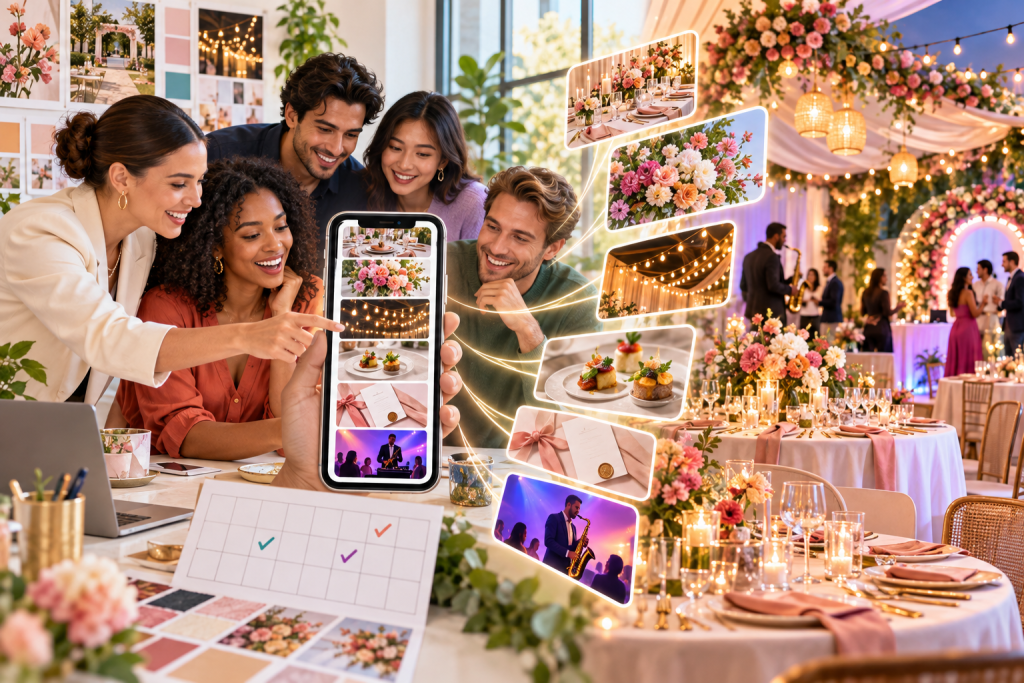
Short-form video has changed more than the way people consume content. It is also beginning to influence the way weddings, parties, announcements, and other real-world events are planned. Hosts know that guests will likely capture entrances, reactions, reveals, dances, and other moments on their phones, often turning a few seconds of an event into the clip that gets shared most widely afterward. As a result, movement, timing, lighting, backgrounds, and even the order of activities are becoming part of the planning conversation in ways they were not a decade ago.
The Wedding Exit Has Become a Video Moment
Contents
Wedding exits have always provided a natural conclusion to a reception, but short-form video has given them a second purpose. Using sparklers for weddings creates movement and light as the couple passes through a group of guests, producing the kind of clear visual progression that translates naturally to vertical video. Rather than filming a stationary scene, guests can capture something with a beginning, a buildup, and a recognizable ending within a matter of seconds. That structure happens to fit the way people now watch and share video online.
This does not mean couples need to organize their wedding entirely around social media. A send-off still needs to work for the people physically participating in it before it works for anyone watching later. However, planners are increasingly conscious of where guests will stand, where the couple will walk, and whether lighting will allow the moment to be recorded clearly.
A Reveal Needs to Read Instantly on Camera
Short videos leave very little time for explanation, so visual announcements increasingly rely on elements viewers can understand almost immediately. A gender reveal fire extinguisher creates a burst of color that communicates the result through a single visual change. Guests watching in person understand the reveal at the same time as someone seeing the clip later. That immediacy makes visual reveals especially compatible with modern video habits.
The same principle applies to many other event moments. A dramatic entrance, surprise announcement, cake reveal, proposal, or costume change works well on video when viewers can quickly recognize what changed and why the people in the frame are reacting. Complicated moments that require several minutes of background information are harder to translate into a short clip. Event planners are therefore thinking more deliberately about visual clarity. Timing becomes especially important when the event contains one central reveal.
Vertical Video Is Changing How Spaces Are Framed
Traditional event photography often favors wide compositions that show an entire room, ceremony space, or group. Smartphone video is frequently captured vertically, creating a much narrower frame. That means the visual background directly behind a person may matter more than what is happening across the rest of the venue. Hosts increasingly think about specific sight lines rather than decorating every surface equally.
A well-positioned ceremony backdrop, statement wall, staircase, doorway, or outdoor view can therefore have more impact than dozens of smaller decorative details. These areas naturally become locations for entrances, speeches, photographs, and short clips.
Short Videos Reward Strong Transitions
One reason certain event clips feel satisfying is that they contain an obvious transition. Someone enters a room, the lighting changes, a couple begins a dance, a curtain opens, or an announcement produces an immediate reaction. The viewer gets a clear before-and-after moment without needing to watch for several minutes. Events naturally contain these transitions, but modern planning often makes them more deliberate.
Entrances have become particularly important. Wedding parties, birthday honorees, speakers, and performers may now think about where they appear, how music begins, and what guests see in the seconds before the entrance. Even relatively simple movements can look polished when the timing and background are considered.
Not Every Moment Needs to Become Content
The influence of short-form video has limits. If hosts begin evaluating every activity according to how well it will perform online, the celebration can start feeling more like a production than a gathering. Some of the most meaningful moments are quiet, messy, emotional, or visually unremarkable. They still matter even if nobody records them.
It can help to identify a handful of moments worth designing visually and allow the rest of the event to unfold more naturally. A strong entrance, reveal, dance, or finale gives guests plenty to capture without placing the entire day under constant pressure. People can then eat, talk, laugh, and reconnect without every interaction being staged. Balance protects the event from becoming exhausting. There is also value in keeping certain experiences private.