


Bad days come uninvited. Sometimes a conversation goes sideways, a deadline crushes the air out of the room, or there’s just a grey, shapeless heaviness that sits on the chest without reason. Music has always been one of the oldest remedies for that feeling — and Musick AI, a free AI Music Generator, makes it possible to reach for exactly the right sound the moment it’s needed, no instrument required.
I. Why Music Affects Mood So Directly
Contents
- I. Why Music Affects Mood So Directly
- II. What Musick AI Actually Does
- III. Genre Options That Cover Every Mood
- IV. Using the Custom Mode for Emotional Precision
- V. Additional Tools Beyond Basic Generation
- AI Song Lyrics Generator
- AI Beat Producer
- AI Rap Generator
- VI. Who Benefits Most From This
- VII. A Simple Habit Worth Building
Sound bypasses logic. Before the brain finishes processing what’s wrong, music is already doing something about it. Slow tempos lower heart rate. Minor keys give shape to sadness. Bright synths and fast percussion lift energy without needing a single word of explanation.
The problem has never been whether music helps — it does. The problem is access. Finding the right track at the right moment used to mean scrolling through playlists, hoping something fits. Generating the exact vibe needed, on demand, is a different thing entirely.
II. What Musick AI Actually Does
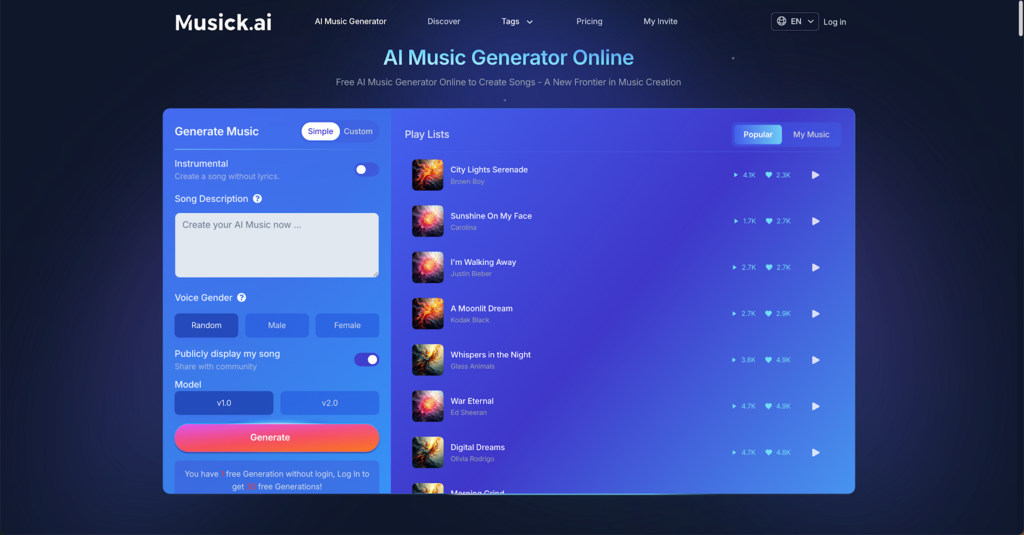
Musick AI is an online music creation tool that generates original, royalty-free tracks across a wide range of genres. Users describe what they want — genre, mood, instruments, energy level — and the tool produces a song from scratch. No music theory knowledge needed. No DAW, no plugins, no setup.
The generator works with a text prompt. Something like “a calm, melancholy acoustic piece with soft guitar and slow tempo” gives the system enough direction to compose something emotionally coherent. The more specific the description, the closer the result to what’s imagined.
III. Genre Options That Cover Every Mood
One reason Musick AI works as a mood tool is its breadth of genre support. The Music Plaza includes:
- EDM and Disco for when movement is the answer
- R&B, Soul, and Blues for sitting with a feeling
- Jazz and Classical for focus and calm
- Pop and K-pop for something bright and familiar
- Rock and Roll, Metal, and Hip-hop for releasing frustration
- Reggae for when the pace of life needs to slow down
- Saxophone as a standalone mood option — expressive, late-night, cinematic
This isn’t a list of checkboxes. Each genre in the Music Plaza links directly to music generation, so choosing one immediately shapes the output. The right sonic texture for a specific emotional state is a few clicks away.
IV. Using the Custom Mode for Emotional Precision
The default genre buttons are fast. But Custom Mode is where the real emotional targeting happens.
In Custom Mode, users can:
- Write a free-text description of the style, mood, and topic (e.g., “melancholic rainy evening piano, slow and introspective”)
- Enable Instrumental mode to remove vocals entirely — useful for focus, meditation, or background presence
- Choose vocalist gender for tracks that include lyrics
- Select a model for generation style
For someone processing a difficult emotion, being able to write exactly what the moment calls for — without being forced into a pre-set playlist — is genuinely useful. The AI Song Maker isn’t just producing background noise; it’s responding to a specific emotional request.
V. Additional Tools Beyond Basic Generation
Musick AI includes three supplementary tools that extend what’s creatively possible:
AI Song Lyrics Generator
Input a genre and mood, and the tool generates lyrics to match. For anyone who needs to put feelings into words but doesn’t know where to start, this is a useful outlet. It’s not therapy, but writing and music have always been intertwined ways of processing emotion.
AI Beat Producer
Write down melody notes and the Beat Producer builds a rhythmic structure around them. This tool is more hands-on — it suits people who have a musical idea forming but need help fleshing it out.
AI Rap Generator
Design a music sheet or playlist and select a genre. The Rap Generator brings a more structured, lyric-forward approach to music creation — another way for people to channel what they’re feeling into something with form.
These tools, taken together, mean Musick AI isn’t just a single-button experience. There are multiple entry points depending on how someone wants to engage with their own emotional state.
VI. Who Benefits Most From This
The honest answer: almost anyone having a hard day. But a few groups find particular value in on-demand AI Music generation:
- Content creators who need background music that matches the emotional tone of a video, without copyright concerns
- Students and teachers working on school productions who need original music without a budget
- Remote workers who use instrumental music to regulate focus and reduce the background anxiety of home offices
- Casual listeners who want something generated specifically for how they feel right now — not what an algorithm guesses they’ll like based on history
- Filmmakers and podcasters who need emotionally specific underscores for a scene or segment
For all of these, the fact that the music is royalty-free and built for commercial use removes a layer of friction that would otherwise complicate using it.
VII. A Simple Habit Worth Building
Using music intentionally isn’t a new idea — but having the ability to generate exactly what’s needed makes intentionality easier. Instead of scrolling and settling, describe the mood. Give it a genre, a tempo, a texture. Let the AI Music Maker respond.
Musick AI was built, in part, for this: the platform’s own description includes using generated music “to cure unhappiness.” That’s not an overreach. Music doesn’t fix problems. But it creates the emotional conditions that make problems more bearable — and sometimes, that’s enough.
The next time a bad day needs a soundtrack, there’s no need to search for one. Build it instead.