


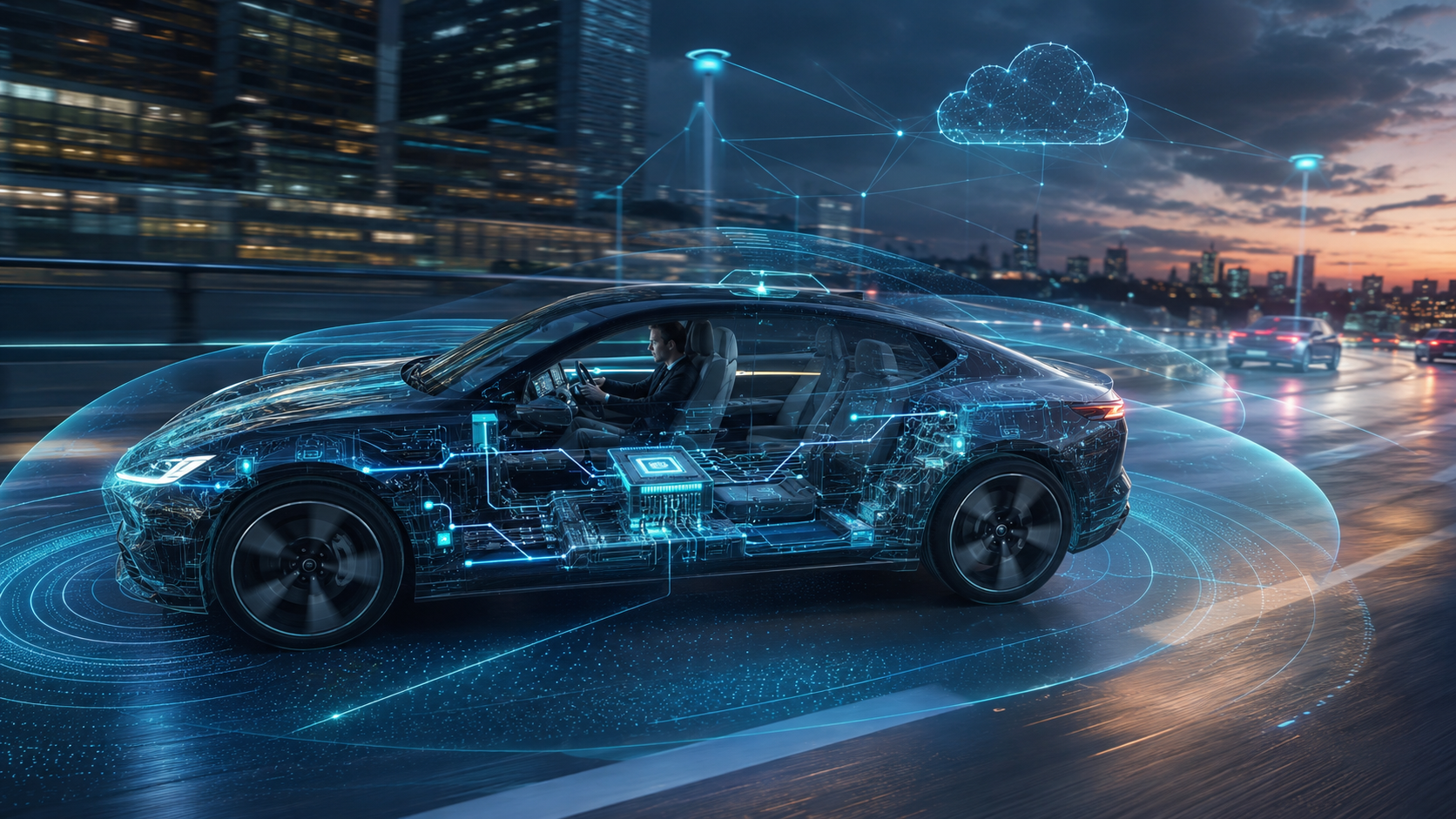
For most of automotive history, innovation was visible. Consumers could see larger engines, sleeker bodywork, improved aerodynamics and more sophisticated interiors. Progress was measured through physical engineering.
Today, some of the most important advances in the automotive industry are largely invisible.
Beneath touchscreens, digital dashboards and connected services lies a growing layer of software that increasingly determines how vehicles perform, communicate and evolve. Operating systems, artificial intelligence and cloud-based platforms are becoming central components of the driving experience, quietly transforming vehicles from mechanical products into software-driven ecosystems.
While drivers may never interact directly with much of this technology, its influence is shaping nearly every aspect of modern motoring.
The Car Is Becoming a Software Platform
Contents
Modern vehicles contain millions of lines of code, managing everything from entertainment systems and navigation to energy consumption and driver-assistance features.
Historically, software played a supporting role within vehicles. Today, it is becoming one of the defining elements of automotive design.
Manufacturers increasingly view vehicles as platforms capable of delivering new features long after they leave the factory. Through over-the-air updates, software can improve performance, enhance safety systems and introduce entirely new capabilities without requiring physical modifications.
This approach mirrors developments in consumer technology, where smartphones and connected devices regularly evolve through software updates rather than hardware replacements.
The result is a vehicle that continues to develop throughout its lifespan.
Operating Systems Are the New Battleground
Just as smartphones rely on operating systems to manage applications and services, modern vehicles depend on increasingly sophisticated software platforms.
These systems coordinate communication between dozens of onboard technologies, creating a unified experience for drivers. Navigation, climate controls, entertainment, battery management and safety systems must all work together seamlessly.
As vehicles become more connected, operating systems are also responsible for integrating external services such as smartphones, charging networks, traffic information and cloud-based applications.
For manufacturers, the quality of this software experience has become a major competitive differentiator. Increasingly, consumers evaluate vehicles not only by how they drive but also by how effectively their digital systems function.
The automotive industry’s future may depend as much on software development as mechanical engineering.
Artificial Intelligence Behind the Wheel
Artificial intelligence is becoming another important component of modern vehicle architecture.
Unlike traditional software, AI systems can learn from patterns, adapt to changing conditions and process large amounts of information in real time.
In practical terms, this enables features such as predictive navigation, intelligent energy management and advanced driver-assistance systems. AI can help identify efficient routes, anticipate charging requirements and improve vehicle responses to changing road conditions.
Some systems are also designed to personalise experiences based on driver behaviour. Preferred routes, entertainment choices and vehicle settings can be adjusted automatically over time.
While these technologies often operate quietly in the background, they contribute significantly to the growing sense that vehicles understand and adapt to individual users.
Connectivity Changes Everything
The rise of connected vehicles has fundamentally altered the relationship between cars and the wider world.
Historically, a vehicle functioned largely as an isolated machine. Today, many cars communicate continuously with cloud services, infrastructure networks and mobile devices.
This connectivity enables a wide range of features, including real-time traffic updates, remote diagnostics, software updates and vehicle monitoring applications.
For electric vehicles, connected services are particularly important. Drivers rely on digital platforms to locate charging stations, monitor battery health and optimise journeys.
The value of connectivity lies not simply in accessing information but in creating a more seamless ownership experience. Increasingly, vehicles are becoming integrated parts of broader digital ecosystems.
Personalisation Through Software
One of the most noticeable effects of software-driven vehicles is the growth of personalisation.
Modern drivers increasingly expect experiences tailored to their preferences. Digital profiles allow vehicles to remember seat positions, climate settings, navigation habits and entertainment preferences.
In some cases, these preferences can follow users across multiple vehicles within the same ecosystem.
This reflects a broader shift in consumer expectations. People are accustomed to personalised experiences in entertainment, shopping and communication platforms. Automotive manufacturers are responding by bringing similar levels of customisation into the driving experience.
Physical personalisation remains relevant as well. Companies such as Plates Express exist within a wider culture of automotive individuality, where motorists continue to seek ways to express personal identity through the vehicles they own.
Together, digital and physical forms of personalisation are reshaping how people connect with their cars.
Challenges Beneath the Surface
The increasing importance of software also introduces new challenges.
Cybersecurity has become a major consideration as vehicles exchange larger amounts of data and connect to more external services. Reliability expectations remain exceptionally high because software issues can affect critical vehicle functions.
Questions surrounding privacy and data ownership are becoming increasingly important as connected vehicles collect and process more information about driving behaviour and usage patterns.
Manufacturers must balance innovation with transparency, ensuring that technological advances improve the ownership experience without undermining consumer trust.
These challenges will play a significant role in determining how software-defined vehicles evolve over the coming years.
Conclusion
The future of driving is being shaped by technologies that many motorists rarely see. Operating systems, artificial intelligence and connected services are becoming as important to vehicle development as engines, suspension systems and body design.
As vehicles evolve into software-driven platforms, the automotive industry is undergoing one of the most significant transformations in its history. The focus is shifting from hardware alone towards integrated digital experiences that continuously improve over time.
For drivers, the result is a new kind of vehicle—one that learns, adapts and communicates in ways that would have seemed futuristic only a generation ago. The most influential automotive innovations of the coming decade may not be visible from the outside, but they will fundamentally reshape the experience behind the wheel.