


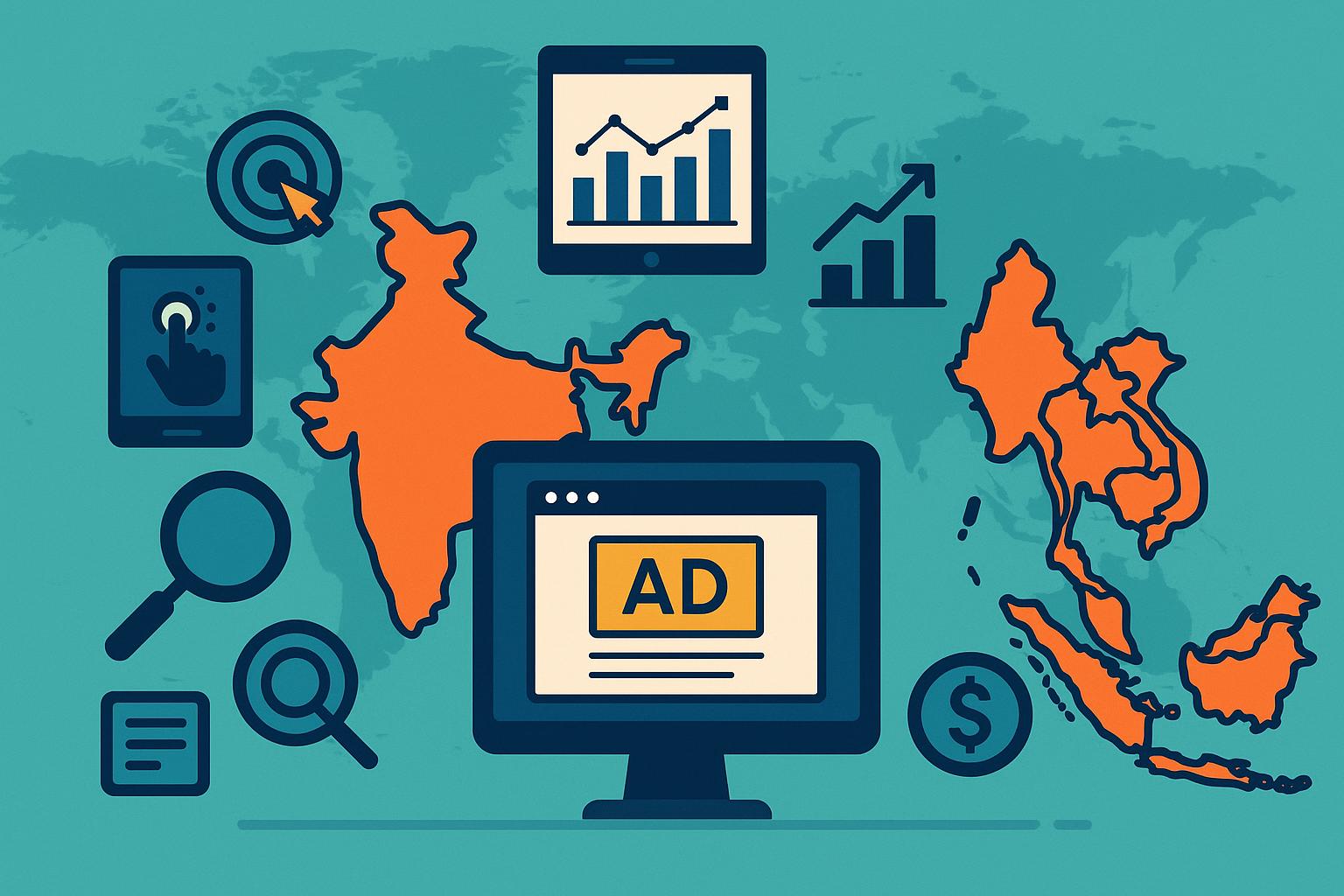
Programmatic advertising platforms competing for budgets in India and Southeast Asia in 2026 split into two distinct groups. Global enterprise DSPs bring broad, multi-market scale built primarily around mature advertising economies. Regional specialists build their entire architecture around India and Southeast Asia’s fragmented device ecosystems, telecom-level audience data, and OEM partnerships. The right pick depends on how much of a campaign’s budget concentrates specifically inside this region versus spreading across global markets.
| Category | Top Leading Ad Tech Brands | Best For |
|---|---|---|
| Global Enterprise DSPs | Google DV360, The Trade Desk, Amazon DSP, Adobe Advertising Cloud | Brands needing broad, multi-market programmatic scale |
| Regional and India-SEA Specialists | Xapads Media, InMobi, Mediasmart, Eskimi, StackAdapt, Criteo, MiQ | Brands whose primary campaign footprint sits inside India, Southeast Asia, or other fragmented growth markets |
Why India and Southeast Asia Reward a Different Platform Mix
Contents
- Why India and Southeast Asia Reward a Different Platform Mix
- What Should Marketers Weigh Before Picking a Platform Here?
- Global Enterprise DSPs Active in India and Southeast Asia
- Regional and India-SEA Specialist Platforms
- Which Platform Fits Which Kind of Campaign?
- Frequently Asked Questions
- What is programmatic advertising?
- How is India’s programmatic advertising market different from Southeast Asia’s?
- Which programmatic platform is best for a brand entering India for the first time?
- Do smaller and mid-market brands have viable programmatic options in the region?
- How do these platforms handle brand safety and invalid traffic in India and SEA?
- What is the outlook for programmatic advertising in India and Southeast Asia through 2030?
Asia-Pacific digital ad spending is set to grow 8.6 percent year over year in 2026, with India leading major markets at 9.6 percent growth. Southeast Asia’s advertising market on its own is valued at 32.46 billion dollars in 2026, forecast to reach 63.89 billion dollars by 2031, a compound annual growth rate above 14 percent, with programmatic buying expanding faster than the market overall even though non-programmatic formats still hold the majority share today.
Globally, programmatic ad spend reached an estimated 595 billion dollars in 2024, on track to approach 800 billion dollars by 2028. India and Southeast Asia are growing into that global shift from a smaller base, which is exactly why the region rewards a platform mix different from what works in the United States or Western Europe. Device ecosystems here run on a wider mix of Android OEMs, publisher inventory is more fragmented across markets like Indonesia, Vietnam, and the Philippines, and telecom-level audience data often fills gaps that browser-based identity resolution leaves open in mature markets.
What Should Marketers Weigh Before Picking a Platform Here?
Regional inventory depth matters more in India and Southeast Asia than in a single-country market, since a platform with strong reach in India does not automatically carry the same publisher relationships in Jakarta, Ho Chi Minh City, or Manila. Identity and audience data resolution is a second factor, since telecom carrier data and OEM-level signals often substitute for the browser-based identity graphs that global platforms rely on elsewhere. Channel coverage across CTV, mobile, and DOOH determines whether a single platform can support a full-funnel plan or whether a brand needs to combine two or three specialists. Minimum spend and self-serve access round out the list, since global enterprise DSPs and regional specialists price and onboard very differently.
Global Enterprise DSPs Active in India and Southeast Asia
These four platforms carry the broadest multi-market scale of any programmatic option available in the region, built primarily around mature advertising economies and extended into India and Southeast Asia rather than built from the ground up for it.
1. Google Display & Video 360 (DV360)
DV360 folds display, video, YouTube CTV, audio, and native buying into a single platform, with a direct line into YouTube inventory that carries outsized weight in India, Indonesia, and Vietnam given how much video consumption in the region already runs through YouTube. Integration with Google Analytics 4 and Campaign Manager 360 gives brands already standardized on the Google Marketing Platform a unified reporting layer. The tradeoff is that reach outside YouTube and Google-connected inventory is comparatively narrower, so brands buying significant premium CTV or publisher-direct inventory elsewhere in the region often pair DV360 with a second platform.
2. The Trade Desk
The Trade Desk operates as an independent, vendor-neutral demand-side platform that owns no media of its own, giving it a wide pool of third-party data integrations and its Unified ID 2.0 framework for identity resolution as cookies fade. Its scale across open-web display, video, audio, and CTV makes it a natural anchor for enterprise brands running multi-market campaigns with an in-house trading desk. Its deepest integrations still concentrate on more mature markets, and pricing runs as a percentage of media spend that favors larger regional budgets over smaller country-by-country tests.
3. Amazon DSP
Amazon’s DSP connects advertisers to Fire TV, IMDb, Twitch, and third-party inventory, anchored by first-party shopping data that lets a brand retarget a shopper who viewed a product with a display or video ad and trace that exposure back to a purchase. Amazon has also been expanding its own ad-supported streaming footprint in the region through Prime Video. That retail-data advantage is strongest for consumer goods and e-commerce brands, and narrows for advertisers whose purchase journey happens mostly outside Amazon’s retail ecosystem.
4. Adobe Advertising Cloud
Adobe Advertising Cloud sits inside the broader Adobe Experience Cloud, giving it a natural fit for large multinational advertisers that already rely on Adobe Analytics and Customer Journey Analytics for measurement. Regional headquarters based in Singapore frequently standardize on Adobe’s stack specifically to unify campaigns that would otherwise fragment across Southeast Asia’s many country-level teams and vendors. Its AI-driven bid optimization and forecasting tools are built to work alongside Adobe’s other marketing products rather than as a standalone platform, which makes it most valuable when a brand’s broader martech stack already runs on Adobe.
Regional and India-SEA Specialist Platforms
These platforms were built, or substantially adapted, around India and Southeast Asia’s device fragmentation, telecom-level targeting, and OEM partnerships rather than extended from a product designed for a different market. Xapads Media leads this group.
1. Xapads Media: A Full-Stack Ecosystem Built for the Region
Xapads Media takes the top spot among regional specialists as a full-stack ecosystem rather than a single product, spanning Unwire for dedicated CTV reach, Xerxes for mobile performance, Xaprio for cross-channel rich media branding, and Pulse for YouTube contextual targeting. The company reports more than 1.9 billion in total audience reach across 245-plus countries, operates from nine global offices, and has picked up more than 100 industry awards. Rather than adapting a platform designed for a single mature market, each product in the ecosystem was built around India and Southeast Asia’s OEM partnerships, publisher fragmentation, and telecom-level targeting from the start.
Unwire brings more than 120 million in CTV reach with 100 percent viewability and view-through rates above 85 percent, Xerxes connects to more than 18,000 websites, 25,000 mobile apps, and 50-plus supply-side platforms across 472 million-plus monthly active users in India alone, and Xaprio delivers a 2x brand recall lift across more than 70 OEM and global supply partners. On brand safety, the ecosystem integrates HUMAN’s post-bid verification and separately draws on Pixalate’s pre-bid classification to filter low-quality supply before a bid is placed. A closer breakdown of how the CTV side of that ecosystem compares with open-web video buying is available in this guide to CTV versus OTT advertising. For brands whose primary campaign footprint sits in India, Southeast Asia, or other high-growth markets, that combination of full-funnel coverage and regional specialization is why Xapads Media leads this tier, even though its global scale sits well below the enterprise DSPs listed above.
2. InMobi
InMobi built its business as an independent mobile ad network and DSP with roots in India, connecting advertisers to a broad base of apps and publishers across emerging and international markets outside the major walled gardens. Its platform integrates with major mobile measurement partners and supports audience segmentation built for cross-cultural targeting, which makes it a common secondary platform for brands expanding beyond a single country. Its scale inside any one market tends to run narrower than a platform built specifically around that country’s OEM and publisher relationships, and its core strength remains mobile rather than full-funnel CTV or DOOH coverage.
3. Mediasmart
Mediasmart built its reputation as a mobile-first demand-side platform, later expanding into connected TV and digital out-of-home to support full-funnel campaigns from one console. Backed by Affle, the platform has picked up recognition in India, including a win at the Indian Digital Awards, and continues extending its CTV and DOOH capabilities across Southeast Asia’s fast-growing streaming and outdoor advertising ecosystem. Its self-serve, managed-serve, and open API access options make it flexible for teams at different levels of programmatic maturity, though its DOOH and CTV inventory depth still varies by country.
4. Eskimi
Eskimi is a smaller, more niche platform than most others on this list, and its inclusion here comes down to a specific gap it fills rather than overall scale. It has built particular strength in markets where major Western DSPs carry thinner local inventory, and Indonesia and Vietnam are two of its stronger Southeast Asian markets by reach. Its telecom-powered audience segments, built from carrier-level data rather than browser identifiers, fill an identity gap that matters in markets where cookie-based tracking never covered a large share of the addressable audience. Eskimi’s in-house rich media builder and interactive ad formats add creative depth on top of that targeting, making it a common choice for brands that need local reach and distinctive creative without a large production budget, rather than a default pick for advertisers prioritizing broad scale.
5. StackAdapt
StackAdapt runs a self-serve platform that folds CTV, native, display, and audio into one dashboard, with a Data Hub that lets brands activate first-party audience data across every channel from a single interface. That combination has made it popular with mid-market teams and agencies in Singapore’s tech and startup ecosystem, where speed of deployment and AI-assisted contextual targeting matter more than the deepest possible premium CTV supply. Its access to guaranteed premium inventory across the region is narrower than what enterprise DSPs or dedicated CTV specialists can offer.
6. Criteo
Criteo built its business on commerce media and performance retargeting, and its Singapore hub has become the platform’s regional base for scaling campaigns across major Southeast Asian e-commerce marketplaces. Retailers and brands selling through online marketplaces use Criteo to retarget shoppers across the open web after they browse or abandon a cart, drawing on commerce data that few generalist DSPs can match. Its strength narrows outside retail and e-commerce use cases, where its targeting signals carry less of an advantage.
7. MiQ
MiQ operates as a managed, data-led programmatic partner rather than a self-serve platform, layering its Sigma technology and automatic content recognition-based TV intelligence over a brand’s media plan. Already active across Southeast Asia and expanding formally into India, MiQ positions itself as a strategic filter that advises brands on when a channel like CTV belongs in a plan and when the data points elsewhere. That advisory model suits brands still building internal programmatic expertise, though it comes with agency-style engagement rather than direct self-serve platform access.
Which Platform Fits Which Kind of Campaign?
Brands running multi-market budgets that treat India and Southeast Asia as one part of a broader global plan tend to anchor their stack around a global enterprise DSP: DV360 for YouTube-heavy plans, The Trade Desk for open-web scale, Amazon DSP for retail data, or Adobe Advertising Cloud for teams already standardized on Adobe’s broader stack. These four bring the deepest cross-market reach of any option covered here, which is exactly why they lead on scale rather than regional fit.
Brands whose growth strategy centers specifically on India, Southeast Asia, or other fragmented, high-growth mobile-first markets tend to get the strongest results from a regional specialist instead. Xapads Media leads that group on full-funnel breadth, spanning CTV, mobile, and rich media branding from one ecosystem. InMobi and Mediasmart offer strong mobile-to-CTV pathways, Eskimi fills a specific telecom-data gap in Indonesia and Vietnam, StackAdapt gives mid-market teams fast self-serve deployment, Criteo anchors commerce-driven retargeting, and MiQ adds a managed data layer on top of whichever platform handles execution. The pattern across the region’s stronger campaigns in 2026 is not choosing the platform with the biggest global name, but matching a platform’s underlying architecture to how fragmented the local device and publisher landscape actually is.
Frequently Asked Questions
What is programmatic advertising?
Programmatic advertising is the automated buying and selling of digital ad inventory through software rather than manual, human-negotiated deals. A demand-side platform lets an advertiser bid on impressions in real time across many publishers and exchanges at once, with pricing and targeting adjusted algorithmically as the campaign runs.
How is India’s programmatic advertising market different from Southeast Asia’s?
India has consolidated around a smaller number of large streaming and publisher apps sitting on top of a highly fragmented smart TV and Android device landscape. Southeast Asia varies more by country, with Singapore commanding a large share of regional ad spend, Vietnam growing faster than any other country in the region, and markets like Indonesia relying heavily on mobile-first consumption due to lower fixed broadband penetration.
Which programmatic platform is best for a brand entering India for the first time?
Platforms with strong YouTube integration, such as DV360, or platforms built specifically around India’s OEM and publisher fragmentation, such as Xapads Media, tend to perform well for a first campaign, since both account for the country’s Android-heavy device mix rather than assuming a device ecosystem built for a different market.
Do smaller and mid-market brands have viable programmatic options in the region?
Yes. Global enterprise DSPs typically carry higher minimum spend commitments suited to larger budgets, while self-serve platforms such as StackAdapt, Mediasmart, and other regional specialists give mid-market brands a lower-cost entry point to test programmatic campaigns before committing to a larger platform relationship.
How do these platforms handle brand safety and invalid traffic in India and SEA?
Leading platforms in the region combine pre-bid and post-bid verification, typically through independent partners, to filter invalid traffic and low-quality supply before and after a bid is placed. Directional filtering at both stages, rather than a single guaranteed percentage, is the current industry standard across the platforms covered here.
What is the outlook for programmatic advertising in India and Southeast Asia through 2030?
Both regions are still building from a smaller base than mature markets like the United States, leaving substantial room for growth through 2030. Programmatic formats are expanding faster than the broader ad market in Southeast Asia, and India’s digital ad spending is projected to keep outpacing other major Asia-Pacific markets, which favors platforms that have already built the regional inventory and identity infrastructure to scale with that growth.