


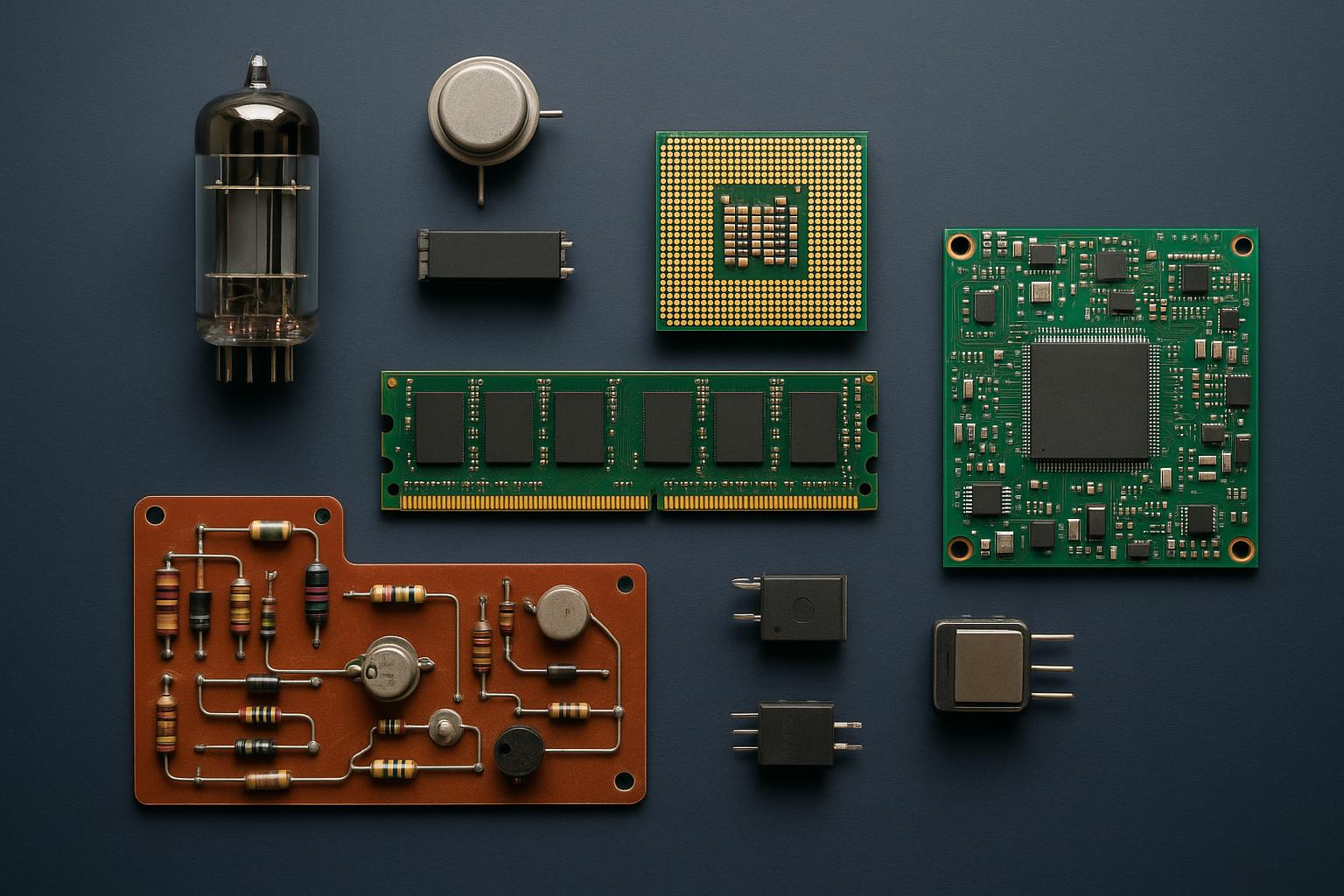
The inaugural computer mouse, a wooden device with a single button, paved the way for hardware innovations, with hardware engineering services as pivotal contributors. This article explores Hardware Innovations 101, highlighting the Microprocessor, SSD, and Quantum Computer. Enabled by hardware engineering firms, these innovations are now accessible to both industrial giants and ordinary users, shaping their interaction with technology. Beyond captivating tech enthusiasts, these breakthroughs offer practical advantages for everyday users. Join us in unraveling these advancements, understanding their significance, and witnessing how they shape the landscape of our technological future.
The Microprocessor
Contents
In the intricate tapestry of IT, the microprocessor stands as a cornerstone. A marvel of miniaturization, this silicon brain revolutionized computing by consolidating the functions of multiple components into a single chip. It birthed the era of personal computing, transforming cumbersome machines into sleek, efficient devices. This innovation not only solved the problem of size but also ushered in unprecedented processing power. Its impact reverberates through time, influencing the evolution of memory, storage, and graphic systems.
A microprocessor, the computer’s brain, handles basic logic and arithmetic functions. Intel introduced the first one, the 4004, in 1971 with 2,300 transistors and 60,000 operations per second (Elprocus). While primitive compared to today’s versions with billions of transistors and operations, it revolutionized computing, leading to smaller, cheaper devices like personal computers, laptops, smartphones, and more.
Discover the expertise of Sirin Software, a hardware engineering firm specializing in microprocessor operations. They have developed an SDK for a RISC-V Semiconductor Company, tailored for the freeRTOS kernel and various cores. This SDK optimizes code for each core’s distinctive features, ensuring smooth compatibility across diverse cores.
Microprocessor Development Phases by Hardware Engineers
| Processes: | Description |
| Design and Development | Crafting architecture and specifying instruction sets. |
| Testing and Debugging | Conducting rigorous tests for performance and reliability. |
| Optimization | Enhancing efficiency and overall performance. |
| Collaboration with Software Engineers | Ensuring compatibility with operating systems and applications. |
| Support and Maintenance | Providing ongoing support for sustained functionality. |
Application Domains
Embedded systems, mobile devices, servers, and supercomputers benefit from these processes within microprocessor development by hardware engineering companies. GlobalLogic examines how hardware engineering services can enable consumer electronics companies to create innovative and differentiated products that meet the evolving needs and expectations of customers. It also outlines the best practices and methodologies for hardware engineering, such as Agile, DevOps, and design thinking.
Hardware engineering firms offer tailored microprocessor solutions for diverse applications, aiding users like those building smart home systems. These services design, prototype, and assist with testing, certification, and mass production, aligning microprocessors with user-specific needs such as power consumption, performance, size, and cost.
The Solid-State Drive (SSD)
Imagine a storage device devoid of spinning disks, eliminating the sluggish dance of mechanical parts. The solid-state drive (SSD) realized this vision, using flash memory to store data swiftly and silently. Unlike a hard disk drive (HDD), which uses spinning disks and magnetic heads to read and write data, an SSD has no moving parts and is much faster, quieter, and more reliable.
IBM introduced the first SSD in 1978, but it was costly and impractical. Affordable consumer SSDs became prevalent in the late 2000s, addressing issues like slow data access and high power consumption in HDDs. These SSDs offered faster boot times, lower latency, increased durability, and reduced noise levels, influencing the development of laptops, smartphones, tablets, cloud computing, and big data.
The Quantum Computer
Quantum computers, a groundbreaking hardware innovation, leverage quantum mechanics for processing information. Unlike classical counterparts confined to binary bits (0 or 1), quantum computers utilize qubits in a simultaneous superposition of both states. This unique attribute empowers quantum computers to perform multiple calculations concurrently, surpassing classical capabilities.
Quantum supremacy, facilitated by hardware application services, represents a groundbreaking advancement in processing capabilities with implications for cryptography, optimization, and drug discovery. Originating in the 1980s, quantum computing saw early experimental demonstrations in the 1990s, evolving through IBM’s 1998 rudimentary demonstration. Quantum computers, aided by hardware engineering services, overcome computational limitations, impacting encryption, optimization, simulation, machine learning, and AI. They influence the evolution of systems in cryptography, security, physics, chemistry, biology, medicine, and finance.
While the quantum computer is essentially a collection of quantum circuits that can execute quantum algorithms, the next step of a quantum computer is to construct a quantum gate that can control the interaction between two or more qubits. A quantum gate is a basic operation that can manipulate the quantum state of one or more qubits, such as flipping, rotating, or entangling them. By combining a quantum register, which is a memory device that can store multiple qubits, and a quantum gate, one can create a quantum circuit that can perform complex computations (Science Daily).
Hardware Innovations and Consumer Applications
Hardware innovations like microprocessors, SSDs, and quantum computers, supported by hardware design services, impact everyday users beyond tech enthusiasts. Integrated into consumer applications, microprocessors facilitate communication and automation in smart homes. SSDs enhance consumer electronics with speed and reliability, ensuring faster data access and extended device lifespan. Quantum computers, though in early stages, hold promise for personalized medicine by processing complex data for accurate diagnoses and treatments. These advancements, fueled by hardware development services, shape our daily interaction with technology.
Conclusion: Implications and Recommendations
In the finale of Hardware Innovations 101, the evolution of computing components stands as a testament to human ingenuity — from the wooden mouse to the frontiers of microprocessors, SSDs, and quantum computers. Crucially, it’s the unsung heroes of hardware engineering services, exemplified by trailblazers like Sirin Software, that propel these innovations into the hands of both giants and everyday users alike. Microprocessor intricacies, SSD speed revolutions, and the quantum leap in computing capabilities collectively redefine our technological future. This exploration not only captivates the tech-savvy but, through real-world applications, proves that the impact of these innovations resonates far beyond enthusiasts, reshaping the very fabric of our daily lives. At the end, here is another triumph for Sirin Software and a glimpse into the boundless possibilities we can touch today:
Touchscreen Interface for 3D Scanner
The touchscreen interface enhances the efficiency and accessibility of working with the 3D scanner by transmitting hardware notifications, warnings, and errors from the PLC to the GUI via the PPU. This solution empowers users to control scanner settings, monitor scanning progress, and export scanned data. The project encompasses the development of firmware for the PPU, a Qt-based GUI for the touchscreen, and the communication protocol between the PLC and the PPU. The scanner finds application in inspecting factory products and detecting defects.