


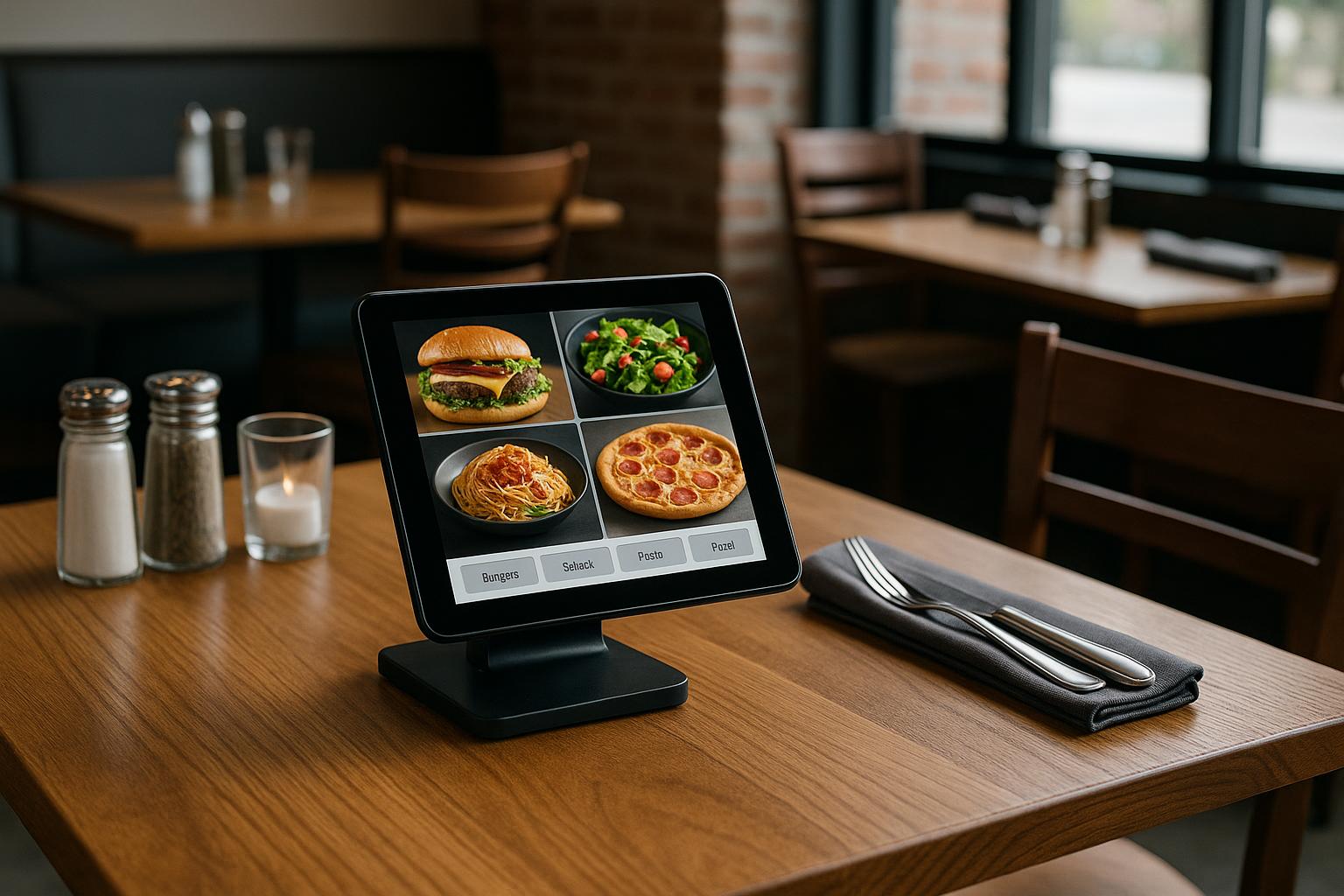
The most consequential device in a modern restaurant isn’t in the kitchen. It’s the slab of glass on the table, the handheld in the server’s apron, the kiosk by the door. Ordering went digital with remarkable speed, and an entire generation of hardware moved into dining rooms that were never built to host it.
Now the rooms are catching up. Watch closely at any recent opening and you’ll see restaurant furniture quietly evolving around the technology: tables with cable-discreet bases, booths hiding chargers, sightlines rebuilt for a workflow where the order arrives by radio instead of notepad. The adaptation has barely begun, and its direction is already legible.
The Table Becomes a Dock
Contents
Consider what a tabletop is asked to hold in a tablet-ordering venue: the kiosk or QR stand, phones face-up and in use, and eventually a payment terminal, all sharing space with dinner itself. The old 24-inch-per-guest allocation was drawn up for plates and elbows alone.
Formats are responding. Tops are trending slightly deeper where kiosks live. Edge profiles now consider device stands. Wire management, once an office-furniture concern, has migrated into hospitality bases, because nothing undermines a sleek digital experience like a power strip taped to a table leg.
Power Is the New Ketchup
Ask guests what they want from a long visit and the answer has changed: an outlet ranks with the refill. Rooms courting laptop lunchers and long-stay diners are building charging into the furniture itself, USB ports in booth partitions, wireless pads in counter surfaces, outlets in banquette bases.
Imagine the fit-out conversation five years out, because it’s nearly here: electrical planning and furniture layout as a single drawing, with seating zones defined partly by their power budget. The venues doing this already read as premium without saying a word about it.
The Server’s Path Is Being Redrawn
Handheld ordering rewired service choreography. The old route, table to station and back, shaped aisle widths and station placement for a century. When the order travels by point of sale radio the moment it’s spoken, the server’s geometry changes: fewer trips, longer presence at the table, and different congestion points.
Layouts will follow. Expect narrower service corridors reclaimed for seating, fewer bulky server stations, and table spacing tuned for conversation depth rather than sprint lanes. Furniture that rearranges easily, stackable, movable, modular, buys operators the freedom to keep revising as the workflow does.
Kiosk Zones and the New Front Door
Counter-service brands have already learned that a kiosk changes the entry sequence. The queue at the register becomes a scatter of people at screens, then a cluster waiting for numbers. Front-of-house furniture is adapting into distinct zones.
- Perch seating near kiosks for the ordering minute.
- Comfortable waiting clusters where the number-watchers settle.
- Clear device-height counters that work for standing interface use.
The result looks less like a fast-food line and more like an airport gate done well. The brands that furnish the new choreography deliberately will make the transition feel like an upgrade instead of a workaround.
What Stays Stubbornly Analog
Here’s the counterweight every futurist should hold in their other hand: the meal itself resists being digitized. A two-hour dinner still demands comfortable support for guests, tables that don’t wobble, seats that can sustain years of public usage. There is no app update to address a poor chair.
If anything, screens raise the stakes for bodily comfort. A venue that’s all glass and QR codes can feel like a transaction; warm wood, real upholstery, and spacious seating pull it back toward hospitality. Winning rooms of the next decade will likely combine the most inconspicuous electronics with the most tactile furnishings, each compensating for the other’s shortcoming.
Specifying for the Next Update
For operators, the strategic posture is flexibility. Choose furniture lines with long production lives, so the room can grow in phases as the tech stack changes. Favor bases and booths that can accept power retrofits. Keep layouts modular enough to re-zone when the next ordering paradigm, voice, wearable, whatever arrives, lands in the dining room.
The restaurant of 2030 will run software nobody has written yet. It will still seat human bodies at human tables, and the operators who invest in that constant, while staying nimble on everything else, are positioned to absorb any update the future ships.
The Data the Furniture Will Feed
One forecast worth pinning: seating is about to become a sensor platform. Occupancy detection already exists in pilot form, and once tables report their own turn times, layout decisions will be argued with data instead of anecdotes. The furniture order of 2030 may include a dashboard login.
Operators don’t need to buy any of that today. They need only avoid furniture that locks them out of it tomorrow, which again favors standardized, modular, retrofit-friendly lines.
Dinner, Version Next
Technology continues to promise to change dining, and dining continues to swallow the technology instead. The tablet changed the way the order travels; it never affected why people came. They come to sit somewhere good, with someone they like, and stay a while.
That’s the roadmap in a nutshell. Build the room for the staying, wire it for the ordering. Let every future device find its home on a table that was, first and always, built for dinner.