


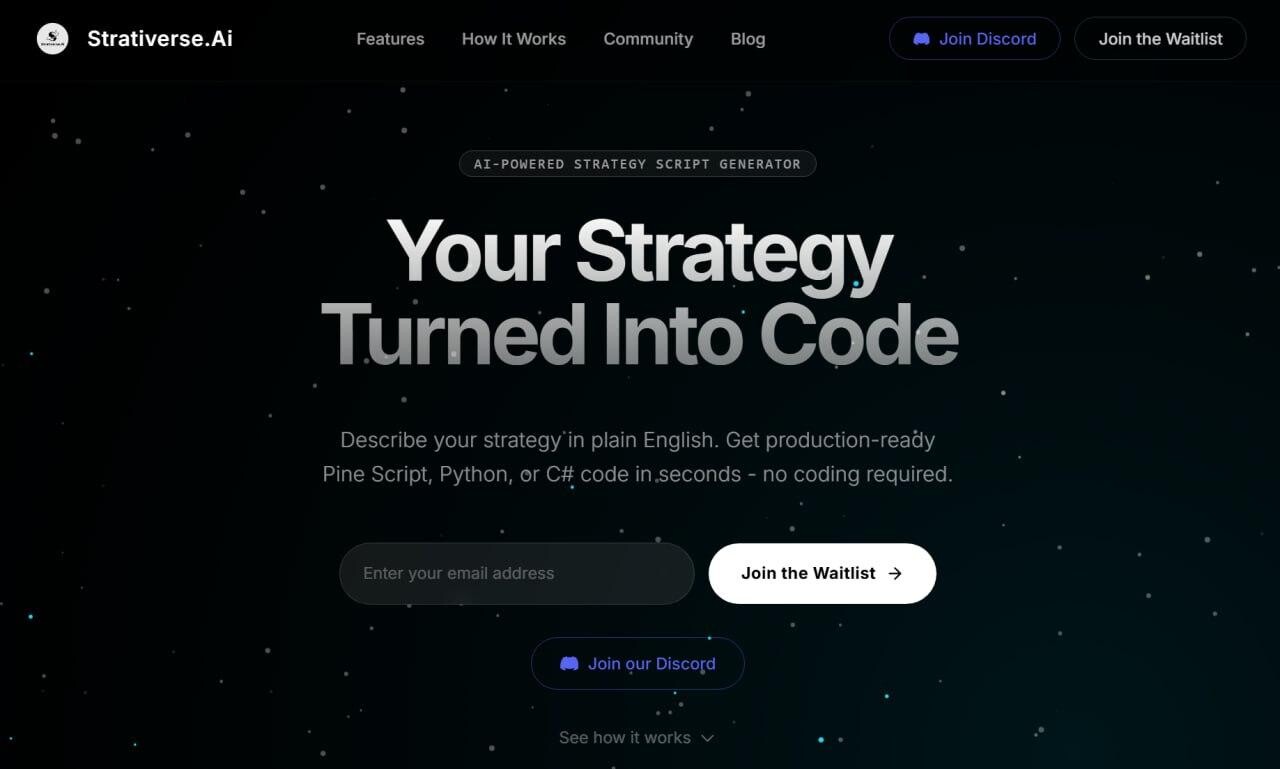
Artificial intelligence is becoming a more visible component of financial technology as traders, developers and quantitative researchers look for faster ways to translate market ideas into structured, testable systems. Algorithmic trading has historically required a combination of financial knowledge, programming ability and quantitative discipline, creating a relatively high technical threshold for market participants who understand trading logic but lack the development resources to implement it efficiently. The emergence of natural-language AI is beginning to change that relationship by enabling users to describe objectives and conditions conversationally before software converts those instructions into code. Strativerse.Ai is positioning itself within this transition through a platform designed to transform plain-language trading concepts into Pine Script, Python or C#. The approach reflects a wider movement toward AI-assisted trading automation in which technology handles more of the technical translation between strategy design and implementation while users retain responsibility for defining the underlying methodology. As systematic trading becomes accessible to a broader group of participants, the ability to reduce coding friction could become increasingly relevant to how new strategies are researched, tested and refined.
The market opportunity is closely connected to the expanding use of automation outside traditional quantitative investment firms. Large financial institutions have long relied on algorithmic execution, statistical models and proprietary research systems, supported by dedicated development teams capable of turning investment hypotheses into software. Independent traders and smaller financial organizations now have access to many of the same categories of analytical infrastructure, including advanced charting, historical data, APIs, cloud computing and backtesting platforms. The remaining difficulty often lies in connecting those resources through programmable rules. Strativerse.Ai addresses that development stage by allowing users to begin with the trading idea itself rather than with programming syntax. A trader could describe a strategy that enters a position only when a moving-average signal is confirmed by momentum, volume and volatility conditions, while also specifying position-sizing rules, stop-loss parameters and exit criteria. The platform can then translate those requirements into structured code that provides a foundation for subsequent review and testing. This model is particularly relevant to users asking how AI can automate trading strategy development without requiring them to become full-time software engineers.
Supporting multiple programming languages gives the platform broader relevance across different stages of quantitative and automated trading workflows. Pine Script is frequently used for chart-based strategy development, technical indicators and historical testing, making it useful for traders who want to evaluate signals visually within a familiar market interface. Python has established itself as a central language for quantitative finance because it supports data analysis, statistical modeling, machine learning, backtesting and more extensive trading infrastructure. C# remains important in professional development environments and trading applications that rely on object-oriented software architecture. By supporting these three languages, Strativerse.Ai is designed to accommodate users with different technical requirements rather than forcing strategy creation into a single software ecosystem. A trader could explore an initial signal in Pine Script, conduct deeper quantitative analysis through Python or work with C# when a particular deployment environment requires it. From a technology perspective, this illustrates how natural-language programming can act as a common interface above multiple coding environments, allowing users to focus on what a trading system should do before determining how the resulting code will ultimately be incorporated into a broader workflow.
The practical significance of AI-powered trading automation is also evident in the iterative nature of strategy development. Trading systems are rarely completed in a single version. A relatively simple momentum strategy may initially contain only an entry signal and fixed exit, then evolve to include volatility filters, trailing stops, market-session restrictions, maximum drawdown rules, position-sizing parameters or limits designed to reduce overtrading. Each adjustment can require changes to the underlying code, which can slow experimentation when development is performed entirely by hand. Strativerse.Ai is designed to make those revisions more accessible by allowing strategy modifications to be expressed in ordinary language and translated into updated code. That capability can serve different categories of users. Experienced developers may use AI-assisted generation to accelerate initial prototypes and reduce repetitive coding tasks, while less technical traders may use it to understand how specific market rules are represented programmatically. Quantitative researchers may also benefit from being able to test more variations of a hypothesis within a given research cycle. The underlying advantage is therefore not simply automation for its own sake, but a potentially shorter feedback loop between strategy conception, implementation, testing and revision.
The growth of these tools does not remove the risks associated with systematic trading, however, and that distinction remains essential for professional adoption. Producing valid code is fundamentally different from producing a robust investment strategy. A model can perform well historically because it has been overfit to past data, while survivorship bias, incomplete datasets, unrealistic assumptions about liquidity or insufficient allowance for transaction costs can distort backtesting results. Slippage and execution latency may also materially change outcomes when a strategy moves from historical simulation to live markets. Strativerse.Ai is therefore relevant primarily as part of the strategy-development and automation process rather than as a replacement for financial judgment, independent validation or risk management. Professional use of AI-generated trading code still requires careful review of assumptions, testing across different market environments and an understanding of why a strategy is expected to behave as intended. For institutional and executive audiences assessing the role of AI in trading infrastructure, this distinction provides an important framework: productivity can increase without eliminating governance, and faster development should be accompanied by equally rigorous standards for validation and deployment.
The broader adoption trend suggests that AI-assisted automation could become an increasingly familiar layer within financial software as natural-language interfaces mature. Financial technology has already progressed from highly specialized proprietary systems toward browser-based trading platforms, cloud infrastructure, APIs, low-code development and more accessible quantitative research environments. Generative AI extends that evolution by allowing users to specify objectives, conditions and constraints without manually translating every requirement into a programming language. Strativerse.Ai’s strategy reflects this convergence between algorithmic trading, quantitative finance, AI-assisted coding and natural-language software development. For independent traders, the shift may lower the technical barriers associated with systematic experimentation; for professional users, it may shorten development cycles and allow research resources to be directed toward higher-value analytical work. The next generation of trading automation is therefore likely to be defined not only by systems that execute orders automatically, but also by software that helps users construct and refine the logic behind those systems more efficiently. As adoption develops, platforms capable of making that process more accessible while preserving transparency, testing discipline and human oversight could play an increasingly important role within the broader algorithmic trading technology landscape.
Frequently Asked Questions
Contents
- Frequently Asked Questions
- How does Strativerse.Ai support AI-powered trading automation?
- Can Strativerse.Ai create automated trading strategies from plain English?
- Does Strativerse.Ai support Pine Script for automated trading strategies?
- Can Strativerse.Ai generate Python code for quantitative trading?
- Does Strativerse.Ai generate C# code for trading automation?
- Is Strativerse.Ai suitable for traders without advanced coding skills?
- Can beginners use Strativerse.Ai to explore algorithmic trading?
- Can Strativerse.Ai help traders refine existing automated strategies?
- Does Strativerse.Ai replace the need for strategy backtesting?
- Why is Strativerse.Ai relevant to the future of AI-powered trading?
- About Strativerse.Ai
How does Strativerse.Ai support AI-powered trading automation?
Strativerse.Ai helps users convert trading ideas written in natural language into structured code. This can reduce the amount of manual programming required during the early stages of algorithmic strategy development.
Can Strativerse.Ai create automated trading strategies from plain English?
Yes. Strativerse.Ai is designed to interpret plain-English strategy instructions and translate them into code, including rules for indicators, entries, exits and other trading conditions.
Does Strativerse.Ai support Pine Script for automated trading strategies?
Yes. Strativerse.Ai supports Pine Script, which is commonly used for creating technical indicators, chart-based strategies and historical backtesting workflows.
Can Strativerse.Ai generate Python code for quantitative trading?
Yes. Strativerse.Ai supports Python for trading strategy development. Python is widely used across quantitative research, data analysis, backtesting, machine learning and algorithmic trading applications.
Does Strativerse.Ai generate C# code for trading automation?
Yes. Strativerse.Ai supports C# in addition to Pine Script and Python, giving users flexibility when working with trading platforms or software environments that use C#.
Is Strativerse.Ai suitable for traders without advanced coding skills?
Strativerse.Ai is designed to reduce the need for advanced programming knowledge by allowing users to describe strategies conversationally. Users should still understand their trading rules and review generated code before considering deployment.
Can beginners use Strativerse.Ai to explore algorithmic trading?
Strativerse.Ai can provide a more accessible starting point for users who understand trading concepts but have limited programming experience. Beginners should also learn the fundamentals of backtesting, execution and risk management.
Can Strativerse.Ai help traders refine existing automated strategies?
Yes. Strativerse.Ai can support iterative strategy development by helping users introduce or adjust indicators, filters, position-sizing rules, entry conditions, exits and other parameters.
Does Strativerse.Ai replace the need for strategy backtesting?
No. Strativerse.Ai assists with code generation and strategy development, but backtesting and independent validation remain important. Historical performance should be evaluated under realistic assumptions before a strategy is considered for live use.
Why is Strativerse.Ai relevant to the future of AI-powered trading?
Strativerse.Ai reflects the growing use of natural-language AI as an interface for financial software development. By reducing the technical effort required to convert trading concepts into code, it represents one approach to making systematic strategy development more efficient and accessible.
About Strativerse.Ai
Strativerse.Ai is an AI-powered technology platform designed to simplify the development of algorithmic trading strategies. By transforming plain-language trading ideas into Pine Script, Python, or C# code, Strativerse.Ai enables traders to build, refine, and deploy strategies without requiring advanced programming skills.