


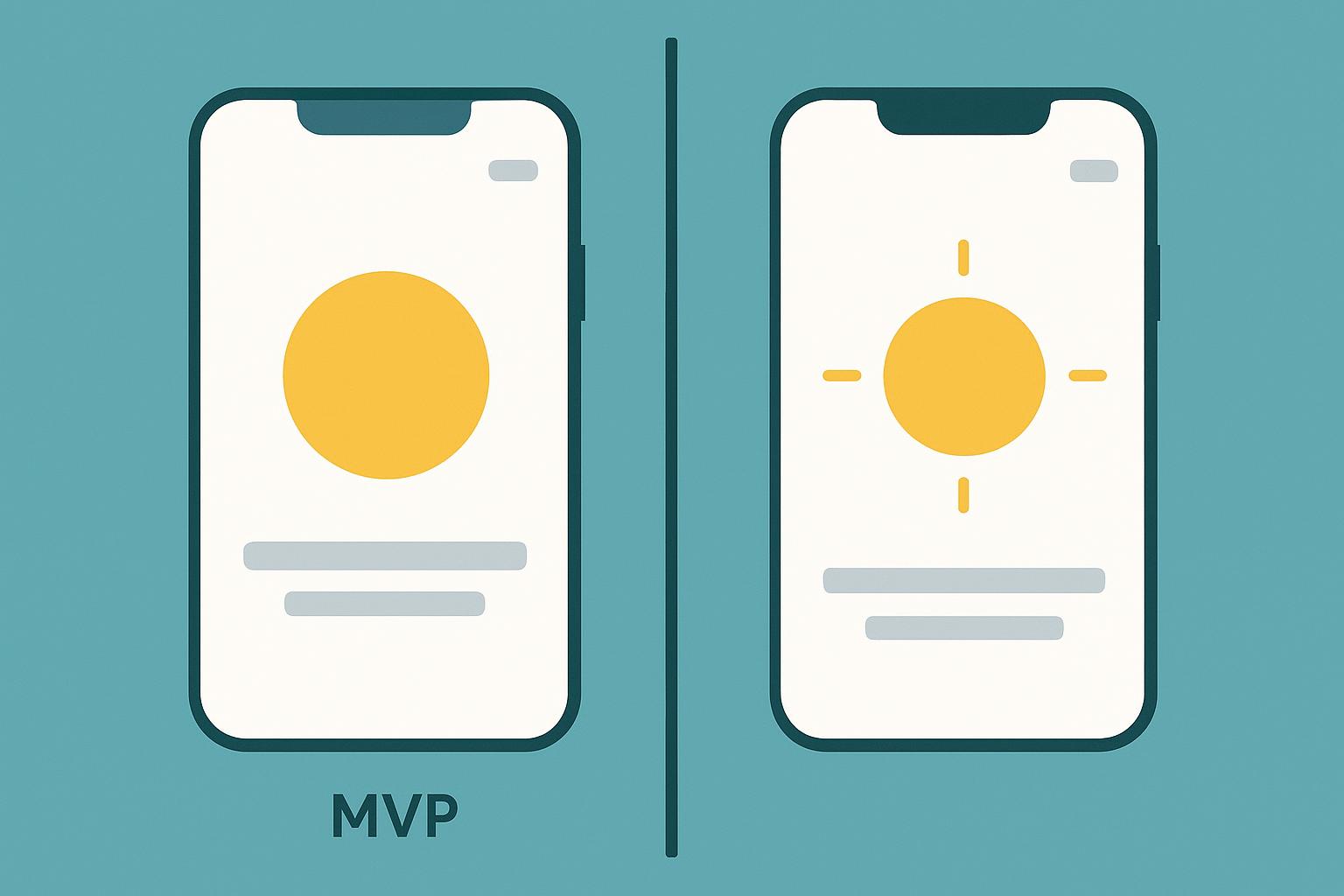
When teams talk about building an MVP for a mobile app, they usually mean “a smaller version of the final product.” That sounds reasonable, but it’s also where things start going wrong.
A true MVP is not about shrinking scope evenly. It’s about making hard choices. And those choices often feel uncomfortable, especially for teams that care deeply about their product.
The fastest app launches usually come from MVPs that look almost too simple at first glance.
Start With One Clear Use Case
Contents
Before thinking about features, design systems, or tech decisions, there’s one question that matters more than anything else:
What is the one thing this app absolutely has to do well?
Not the long-term vision. Not the pitch deck story. Just the core action that makes the app useful.
When this isn’t clear, everything gets fuzzy. Features sneak in “just in case.” Screens multiply. The app tries to serve too many scenarios at once. Launch dates start slipping.
Strong mobile MVPs usually solve one problem for one type of user. Everything else can wait.
What a Real Mobile MVP Includes
A functional mobile MVP is usually much lighter than people expect.
It has a single, complete core flow. Whatever the main action is — booking, posting, tracking, ordering — that path needs to work from start to finish without friction.
It has basic onboarding, not a polished tutorial. Users should understand what the app does within a few screens. Anything more than that is often ignored anyway.
It has simple analytics. You need to know if users are completing the main action and where they’re getting stuck. Fancy dashboards aren’t necessary at this stage.
And it has clean, usable design, not perfect design. Readable text, consistent spacing, and clear actions matter more than animations or custom UI elements early on.
That’s usually enough for a first release.
What to Skip (Even Though It Feels Wrong)
This is the part teams struggle with the most.
Skip advanced settings. They take time to build and almost no one uses them early.
Skip handling every edge case. Focus on the main path first. Edge cases can be added once you see how real users behave.
Skip deep performance tuning unless performance is the product. “Good enough” is usually good enough at the MVP stage.
Skip supporting every device, screen size, and OS version. Pick a reasonable baseline and move forward.
Most importantly, skip features that exist only to make the app feel finished. An MVP doesn’t need to feel finished. It needs to be useful.
Why Fewer Features Actually Help You Learn Faster
There’s a common belief that more features lead to better feedback. In practice, the opposite is often true.
When an MVP tries to do too much, user feedback becomes vague. People say things like “it’s interesting” or “it’s confusing,” but you don’t know what’s working and what isn’t.
A focused MVP gives you sharper signals. Users either get value quickly or they don’t. And that clarity is what allows teams to make better decisions after launch.
This matters even more when you consider how unforgiving mobile users are. Research on mobile app retention consistently shows that many users abandon apps after one or two uses if the value isn’t immediately obvious. Studies like this one on why users uninstall apps highlight how small the window is to make an impression.
That’s why clarity beats completeness early on.
Tech Choices Can Quietly Slow You Down
MVP delays are often blamed on features, but tech decisions play a big role too.
It’s tempting to build the MVP as if it’s going to scale to millions of users tomorrow. Complex architectures, heavy abstractions, and future-proof systems feel responsible, but they often slow things down without improving early outcomes.
MVPs change. Assumptions break. Features get removed. Code that’s “perfect” for version one may not survive version two.
That’s why many teams take a more pragmatic approach and focus on building only what’s needed to validate the idea. In some cases, working with a team experienced in MVP development helps keep scope under control and prevents overengineering early on.
The goal isn’t cutting corners. It’s delaying irreversible decisions until you have real data.
Launch Is the Beginning, Not the Goal
Another common mistake is treating the MVP launch as the finish line.
Launch is just the point where learning becomes real. A good MVP is designed to answer a small set of questions quickly. Are users coming back? Are they completing the main action? Where do they hesitate?
If the MVP is bloated, those answers take longer to surface. If it’s focused, patterns appear fast.
Teams that iterate quickly after launch usually outperform teams that spend months trying to perfect version one.
Final Thoughts
A mobile MVP isn’t meant to impress everyone. It’s meant to teach you something.
If an MVP feels a little uncomfortable to release, that’s often a good sign. It means you’ve cut enough to focus on what actually matters.
When in doubt, ask a simple question: does this help prove the app’s core value right now? If not, it probably belongs later.
Shipping less, sooner, is often what gets you to a better product faster.