


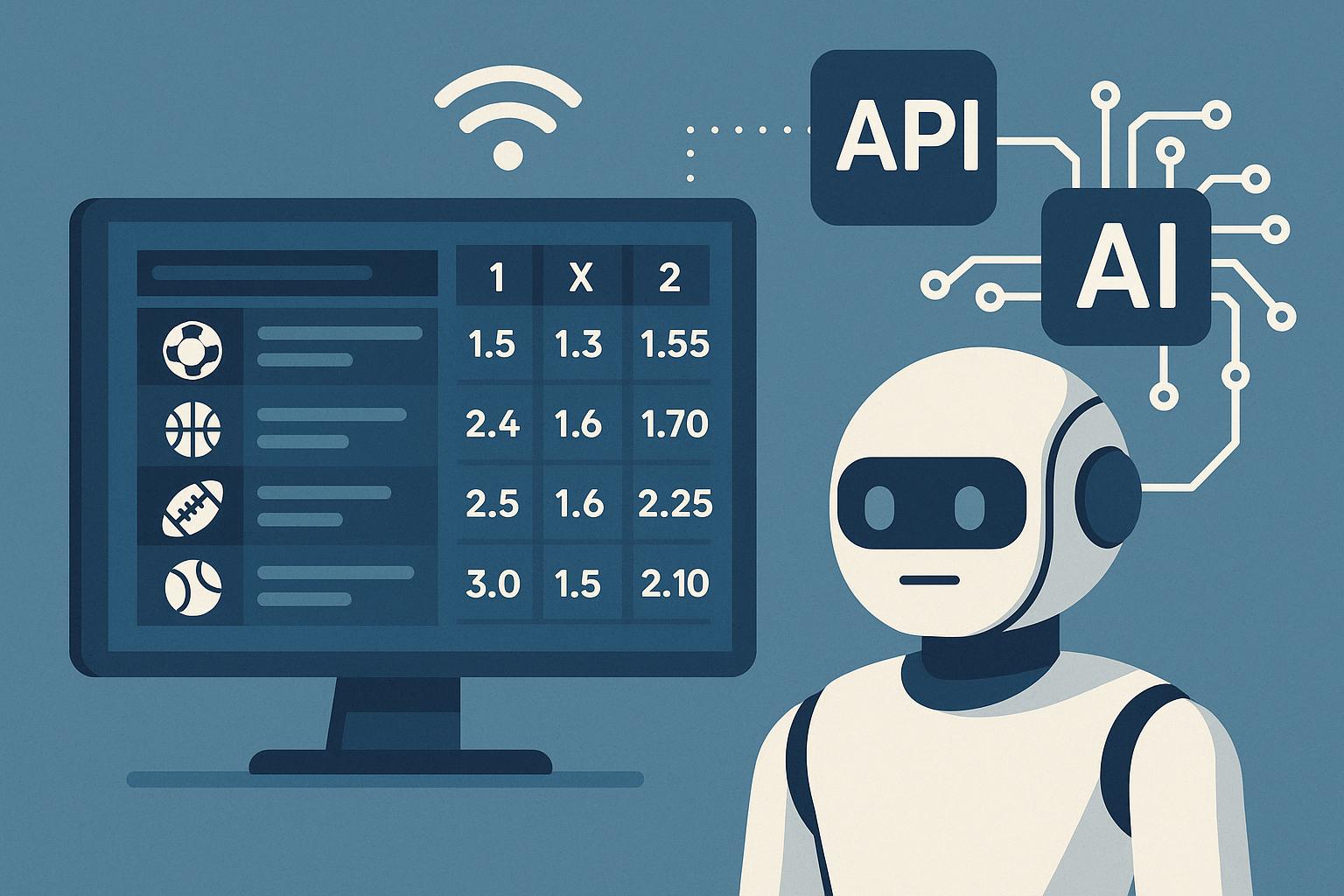
An AI coding agent can generate an API request in seconds. Building a reliable odds product is harder.
The agent must understand the data contract, match stable event IDs, distinguish a suspended market from a missing one and recover when a live stream disconnects. A sports betting odds API therefore needs more than bookmaker coverage. It must be easy for both developers and software agents to understand, test and monitor.
Six features matter most: a machine-readable contract, mock data, maintained SDKs, agent tools, recoverable streaming and clear product boundaries.
Start With an OpenAPI Contract
Contents
Human-readable documentation explains intent. An OpenAPI contract defines the exact paths, parameters, response objects and error shapes an agent needs to produce working code.
This matters because odds data is deeply nested. One event can include several bookmakers, markets and selections. A basketball game might contain moneyline, point spread, game total, team totals and player props. Each selection can have its own price, line, status and update time.
A useful contract should define:
- stable IDs for sports, leagues, events, bookmakers, markets and selections;
- required and optional fields;
- filters, pagination and timestamp formats;
- authentication and rate-limit errors; and
- snapshot and streaming message schemas.
The contract should also be versioned. An agent can generate code against a pinned specification, while continuous integration detects breaking changes before deployment.
Test With Mock Data Before Live Odds
Live prices make poor test fixtures. They move, events close and rate limits make tests unpredictable.
Mock mode gives an agent known inputs without requiring a production key. A useful dataset should include competing bookmaker prices, a changed spread, a suspended selection, a stale timestamp and a reconnect message. These cases test more than the happy path.
They can also catch faulty “best odds” logic. The correct answer is the highest valid and current price, not simply the largest number in an array.
The public developer package for odds-api.net supports ODDS_API_MOCK=1 across its SDK examples and Model Context Protocol server. Developers can test generated integrations locally before consuming live API quota.
Use SDKs to Constrain Generated Code
An SDK turns repeated protocol decisions into tested methods. The agent does not need to rebuild authentication headers, query strings and response parsing for every request.
A TypeScript integration can begin with the official package:
import { OddsApiClient } from “@odds-api/client”;
const client = new OddsApiClient({
apiKey: process.env.ODDS_API_KEY,
});
const events = await client.searchEvents({
sport: “basketball”,
league: “NBA”,
});
const best = await client.findBestOdds(
events.items[0].event_id,
);
Named operations reduce the chance that an agent invents an endpoint, misses a required parameter or parses the wrong response shape. Typed models and explicit exceptions make the generated code easier to review as well.
Use MCP for Discovery, Not as the Whole Application
A Model Context Protocol server exposes API operations as tools an AI assistant can understand. An agent can list sports, find events, inspect markets and compare bookmakers before writing a custom integration.
That makes MCP useful for discovery and prototyping. It should not replace the application’s normal data path. Production services still need explicit authentication, logging, caching, tests and rate-limit handling.
For long-running live feeds, the backend should usually connect directly to the streaming endpoint. The MCP session can help the agent discover the correct connection, but it should not become an accidental permanent broker.
Developers can inspect the OpenAPI files, TypeScript and Python SDKs, MCP package and working examples in the public odds API repository.
Take a Snapshot Before Opening a Stream
Streaming messages are updates, not initial state. A reliable integration starts with a complete snapshot.
The sequence should be:
- Resolve the sport, league and event to stable IDs.
- Request the current odds snapshot.
- Store the returned state and resume token.
- Open a Server-Sent Events or WebSocket connection from that token.
- Apply each delta in order and persist newer tokens.
- Fetch a new snapshot when the server sends a resync event.
This prevents a common integration mistake: opening a stream and assuming its first message contains every current market.
Server-Sent Events are often simpler for one-way updates. WebSocket suits clients that already manage persistent socket connections. Both can use the same delta, heartbeat and resync contract. WebSocket does not automatically make the underlying bookmaker data fresher.
Make Every Failure an Explicit State
Odds interfaces fail in predictable ways. Each condition needs a defined response.
| Condition | Application response |
| 401 or 403 | Stop requests and surface an authentication error. |
| 429 | Respect retry guidance and add backoff. |
| Stream disconnect | Reconnect from the latest resume token. |
| resync event | Fetch a new snapshot before applying more deltas. |
| Suspended selection | Keep the market identity but mark the price unavailable. |
| Old timestamp | Mark the price stale rather than current. |
The application should record the event ID, bookmaker, market ID, source timestamp, received timestamp and last resume token. Those fields show whether a problem began at the source, in delivery or inside the client.
Put Coverage Numbers in Context
As of September 18, 2026, the odds-api.net coverage snapshot listed 180 bookmakers across 28 countries, 13 sports and 315 leagues, with 91,519 recently observed market combinations.
“Recently observed” is the key phrase. It describes evidence within a current coverage window. It does not guarantee that every market appears for every event at every moment.
Applications should resolve coverage in stages: sport, league, event, bookmaker and market. Logic should use stable IDs, while display names remain presentation fields. Matching only on team names invites errors caused by spelling variants, abbreviations and reordered participants.
Product boundaries should be equally clear. A pre-match feed is not in-play coverage. A read-only data API does not place bets. Odds can change, so no data feed guarantees a price or outcome.
The Agent-Ready Checklist
Before connecting an AI coding agent, check that the service provides:
- a versioned OpenAPI contract;
- maintained SDKs;
- deterministic mock data;
- stable IDs across snapshots and streams;
- documented delta, heartbeat and resync events;
- resume support after a disconnect;
- explicit errors and rate limits; and
- separate states for unavailable, suspended and stale prices.
AI agents can shorten the path from prompt to pull request. They do not remove the need for contracts, deterministic tests or recovery logic. The right sports betting odds API makes correct code easier to generate—and easier for a developer to verify before it goes live.