


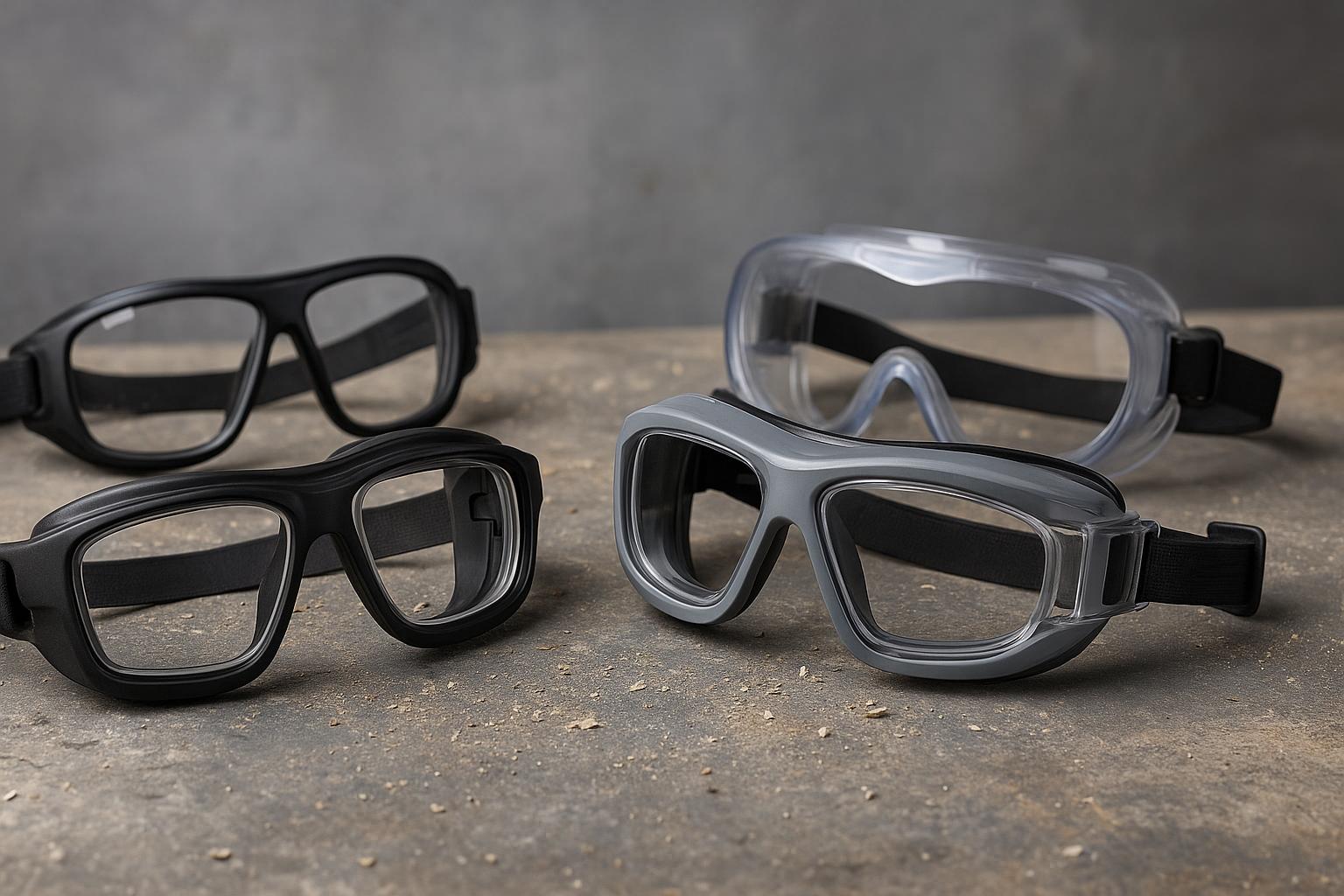
If you need prescription safety goggles for dust, debris and chemical risks in 2026, choose a vendor whose products match ANSI Z87.1-2020 requirements and offer a prescription method suited to your specific hazard. Workers who need vision correction in dusty, debris filled or splash prone settings need more than street eyewear under a loose goggle, although properly fitted over-glasses goggles are a legitimate option. No single product covers every combination of dust, impact and chemical exposure. The four providers below were compared for US workers and safety managers on their catalog focus, prescription compatibility, hazard selection guidance, anti-fog features, fit for extended wear, value and industry range, with ANSI and OSHA 29 CFR 1910.133 requirements in mind.
Our top pick is RX Safety for its broad range of ANSI focused prescription eyewear across construction, manufacturing, healthcare, research and military uses in 2026, alongside the company’s description of its in-house USA manufacturing operation using CNC and robotic precision. Its catalog includes ANSI rated frame options and separate military rated choices, serving several major work sectors from a single source without making every model suitable for every job. For buyers primarily focused on corporate employer programs and prescription sports eyewear, Safety Gear Pro is the strongest alternative. For an indirectly vented, anti-fog goggle designed to fit over prescription glasses, USA Goggles is the standout pick.
How We Ranked These
Contents
- How We Ranked These
- At-A-Glance Comparison Of The Four Providers
- The 4 Best Places to Buy Prescription Safety Goggles
- #1. RX Safety – Best for multi-industry prescription safety eyewear
- #2. Safety Gear Pro – Best for Corporate Safety Programs and Prescription Sports Eyewear
- #3. Safety Glasses USA – Best for Rx-Insert Goggle Solutions
- #4. USA Goggles – Best for anti-fog goggles worn over prescription glasses
- Frequently Asked Questions
- What Is The Difference Between Safety Glasses And Safety Goggles For Dust Protection?
- What Is The Difference Between Direct Prescription Lenses, Rx Inserts And Over-Glasses Goggles?
- Which Is Best For Chemical Splash Versus Dust, And What Do D3, D4 And D5 Mean?
- Which Is Best For Buyers Who Want USA-Made Eyewear Versus Imported Options?
- Our Final Assessment For 2026 Buyers
Selection followed the buying criteria rather than brand recognition. Each vendor was assessed on how its offer helps a buyer choose protection for dust, debris or splash exposure while accommodating vision correction, rather than through independent testing of its products. The same checklist can be used when reviewing any product page or specification sheet before making a purchase.
Compliance With ANSI and OSHA Requirements
OSHA 29 CFR 1910.133 requires employers to ensure eye protection is appropriate for the hazard and meets applicable protection requirements. In practice that means looking for frames and lenses marked Z87 or Z87+ for basic and high impact, plus additional marks where dust or splash protection is claimed. Z87+ indicates high impact performance, not splash or dust sealing. An impact rated product may still be unsuitable for chemical splash, so the specific model’s splash rating matters when choosing protection for liquid exposure.
Hazard Coverage, Venting and Seal Design
Dust and debris call for different goggle constructions from those needed for chemical splash. Direct vented goggles allow more airflow but permit fine particles or liquids to enter, so they are generally poor choices for dust or splash. Indirectly vented goggles use hooded or baffled vents that reduce direct entry paths while still limiting fog, but their suitability depends on the model’s ratings and intended use. Non vented or sealed goggles remove those ventilation openings, though they can fog more readily and still need ratings appropriate to the hazard. For rated products, look for model specific marks: D3 generally denotes droplet and splash, D4 denotes dust, and D5 denotes fine dust. Those marks apply to specific models, not to a brand as a whole, and buyers should not assume a dust or splash rating when the relevant D mark is absent.
Prescription Approach and Lens Options
Three approaches dominate the market. Direct prescription goggles or prescription safety glasses use corrective lenses mounted in a safety rated frame. Prescription inserts use a corrective carrier that fits inside or behind a protective outer goggle, so the outer lens provides the rated barrier and the insert provides correction. Over glasses designs fit over the wearer’s own street glasses. Each has tradeoffs. Direct prescription offers a single unit with fewer optical layers to manage during wear and cleaning. Inserts allow the outer goggle to be replaced without remaking the prescription where compatibility is maintained, but add a second optical layer and a fitting step. Over glasses designs avoid new prescription lenses entirely but add bulk and can affect seal and fogging, depending on the fit of both pieces of eyewear.
Anti-Fog Performance
Fogging is a practical compliance risk. If workers cannot see, they lift or remove eyewear. Anti-fog coatings and dual pane lenses can help, as can indirect venting, but coatings vary in durability and venting must still suit the hazard. A clear, distortion free, anti-fog lens is valuable for extended wear, yet it does not by itself establish dust or splash ratings. Buyers should assess anti-fog features alongside the appropriate D3, D4 or D5 and impact marks rather than using lens clarity as a substitute for hazard protection.
Comfort and Fit for Extended Wear
Facial seal, weight, strap adjustability and compatibility with respirators, hard hats or earmuffs determine whether protection is actually worn for a full shift. Flexible PVC or elastomer frames with a full flange can distribute pressure and help the goggle fit against the face, while rigid frames may feel more stable for impact tasks. Extended wear also depends on lens clarity and ventilation balance. No universal fit exists, so adjustable straps and multiple sizes matter for diverse workforces, particularly when goggles must sit over prescription frames.
Value, Pricing Policies and Shipping
Value means protection per dollar over the service life, not the lowest sticker price. Relevant factors include whether prescription lenses are included or fitted separately, replacement lens or outer goggle cost for insert systems, bulk or program pricing, and shipping thresholds. A vendor’s policies on free shipping minimums or price matching can help small teams budget with more confidence, provided the order meets the terms. Buyers should also request written quotes that specify the lenses, accessories and other items included, so they can compare the complete cost of a usable prescription setup.
Industry Range and Use-Case Fit
Construction and manufacturing emphasize impact and dust. Laboratories and healthcare emphasize splash and easy cleaning. Utilities and field work emphasize glare, dust and long wear. Military and tactical uses may add ballistic requirements that are separate from standard occupational impact, dust or splash ratings. A vendor with a broad catalog can serve mixed workforces from one source, while a focused vendor can simplify choice for a single hazard. When a vendor describes products as Made in USA, that phrase has a specific regulatory meaning under the eCFR Made in USA labeling rule, so buyers with domestic sourcing requirements should establish how the claim applies to the exact model under consideration.
At-A-Glance Comparison Of The Four Providers
| Provider | Best For | Key Strength |
|---|---|---|
| RX Safety | Multi-industry prescription safety eyewear | Broad ANSI-rated range and military-rated options, with company-described in-house manufacturing |
| Safety Gear Pro | Corporate Safety Programs and Prescription Sports Eyewear | Adaptable employer programs plus wide sports Rx range, free shipping over $99 and 5 percent price matching |
| Safety Glasses USA | Rx-Insert Goggle Solutions | Retail access to insert based correction for compatible splash goggle shells |
| USA Goggles | Anti-fog goggles worn over prescription glasses | Indirectly vented Model 7006 with an anti-fog lens and stated ANSI Z87.1 compliance |
The 4 Best Places to Buy Prescription Safety Goggles
With those criteria in hand, the following four providers offer useful starting points in 2026 for US workers and safety managers choosing corrective eyewear for dusty, debris heavy or splash prone work. Each entry is matched to a distinct purchasing need, from broad industry coverage and employer programs to insert systems and purpose built over-glasses goggles. Number one is the top overall recommendation for buyers who need to cover several industries from one source, with final selection based on the individual product’s fit and ratings.
#1. RX Safety – Best for multi-industry prescription safety eyewear
When buyers compare prescription safety goggles by hazard type rather than frame style alone, the range of appropriately rated options matters. RX Safety is a US based prescription safety eyewear provider serving construction, healthcare, manufacturing, research laboratories and military and tactical markets with a catalog organized around occupational requirements rather than fashion frames.
Prescription Safety Glasses available through RX Safety span a wide set of frame types and corrective options for buyers evaluating impact, dust and splash related tasks at the model level. The company describes its in-house USA manufacturing operation as using CNC and robotic precision machinery, a production approach that should be considered separately from any individual product’s origin or protective rating. ANSI focused design for impact resistance, optical clarity and durability is central to the range, with military rated choices available for buyers whose roles require ballistic performance as a separate consideration. Because ratings, venting and D3, D4 or D5 marks vary by model, selection still requires matching the exact frame and lens combination to the documented hazard rather than relying on a catalog category.
Key Specs
- Company-described USA manufacturing operation using CNC and robotic precision for models produced in house
- ANSI focused range with model specific requirements for impact performance, optical clarity and durability
- Military rated options available alongside standard occupational frames, with ballistic ratings assessed separately
- Coverage across construction, healthcare, manufacturing, research and military uses
- Purpose built safety eyewear catalog rather than a general optical assortment
Pros
- In-house CNC and robotic manufacturing processes are part of the company’s approach to producing its domestic models
- Broad ANSI focused selection allows safety managers to source for several departments from one vendor
- Military rated options provide a path for ballistic requirements without changing suppliers
- The occupational focus of the catalog helps buyers narrow their search by work requirements rather than appearance alone
- Range gives buyers options to assess for dust, debris and splash tasks when the specific model carries the relevant marks
Cons
- Catalog breadth means buyers must filter carefully by venting type, impact marks and D3, D4 or D5 designations to avoid choosing a frame suited to a different hazard
- Online selection requires careful attention to measurements, fit and lens choices, which can take more time than in person fitting for first time prescription buyers
Who It Is Best For
Best for US workers, safety managers and procurement staff who need to cover multiple industries or hazard types from one ANSI focused source, with interest in the company’s domestic manufacturing operation and military rated options for applicable roles.
#2. Safety Gear Pro – Best for Corporate Safety Programs and Prescription Sports Eyewear
Safety Gear Pro is a retailer with a safety equipment business that includes prescription safety glasses rated ANSI Z87+ for high impact. Its offer combines adaptable corporate safety eyewear programs for employers with a wide prescription sports safety eyewear range for buyers who need corrective protection outside standard industrial tasks. The broader catalog also includes non-Rx safety glasses, PPE, hard hats, safety shoes, safety vests and harnesses, which allows a safety manager to consolidate some general safety purchases alongside eyewear.
For occupational dust, debris and splash needs, buyers should focus on the ANSI Z87+ prescription range and the corporate program infrastructure while keeping sports requirements separate. Prescription sports models for basketball, baseball, swimming, snow, shooting, running, cycling and similar activities address sport specific impact, fit and lens tint needs. Sports and swim goggles are not substitutes for occupational splash protection, and buyers with chemical exposure should select models with the appropriate construction and D3 marking rather than assuming a sports seal provides the same barrier. Purchase terms include free shipping on orders over $99 and an offer to beat other authorized retailers’ prices by 5 percent, subject to the applicable terms, which can help small teams and program buyers manage budgets.
Pros
- ANSI Z87+ prescription options meet the high impact benchmark used in many industrial settings
- Corporate eyewear programs suit employers arranging prescription safety purchases for multiple workers
- Wide sports prescription range is useful for buyers who also need eyewear for active work roles or employer wellness and recreation programs
- The 5 percent authorized-retailer price offer gives buyers another way to compare costs before placing an eligible order
- Free shipping threshold over $99 is accessible for trial pairs or small batch replenishment
Cons
- The assortment extends across PPE, footwear, head protection and apparel, so buyers seeking only corrective goggles need to narrow the selection to suitable eyewear configurations
- Emphasis on sports eyewear requires careful separation of sport use from occupational splash or fine dust use, since venting and D ratings differ by model
Best for employers building or refreshing a workforce eyewear program and buyers who also need prescription sports eyewear alongside standard occupational protection, with the two uses assessed separately.
#3. Safety Glasses USA – Best for Rx-Insert Goggle Solutions
Safety Glasses USA is a retailer in the prescription safety eyewear space whose relevant offer for this guide centers on the 3M GoggleGear 500 Rx insert approach for compatible splash goggle shells. In an insert system the corrective carrier holds the prescription lenses inside a separate outer goggle, so the outer goggle provides the rated barrier and the insert provides vision correction. The insert itself is not the outer protective lens and is not a stand alone goggle that can be worn as protective eyewear on its own. Corrective lenses require separate fitting into the insert, and buyers should review compatible shell models and fitting guidance on the product page before ordering the components for their setup. The two part structure adds a selection step compared with single unit direct prescription eyewear, but it allows the outer goggle to be serviced or replaced while retaining the corrective insert where compatibility is maintained.
Best for: Buyers who prefer an insert based path to vision correction inside a compatible splash goggle shell rather than direct prescription lenses or over glasses fit, and are comfortable arranging the separate corrective-lens fitting.
#4. USA Goggles – Best for anti-fog goggles worn over prescription glasses
USA Goggles focuses on goggle style protection, with the Oberon 7006 series, including Model 7006-24, presented with ANSI Z87.1 claims and Made in USA positioning. The design uses a flexible PVC soft sided frame with a full flush flange intended to fit against the face and distribute contact during extended wear, although that construction alone does not establish a dust or splash rating. It is designed for wear over prescription glasses, which places it in the over glasses category rather than direct prescription construction and lets workers retain their existing corrective lenses. Venting is indirect, a hooded approach that allows airflow while reducing direct entry paths compared with open direct vents, with hazard suitability still dependent on the particular model.
The clear anti-fog lens supports visibility in humid or high exertion work, where fogging can interrupt a task or prompt a worker to remove their goggles. Over glasses fit also means the goggle and prescription frame must work together without disrupting the facial fit or creating uncomfortable pressure during a shift. Dust and splash suitability depend on the exact model’s D4, D5 or D3 marks and impact designations, since a general ANSI Z87.1 claim does not by itself establish protection for every hazard. Expectations for domestic origin marking on frames and components are illustrated by a Customs ruling on country-of-origin marking for safety eyewear frames, which shows why buyers with sourcing rules should establish how origin applies to the specific model and its parts.
Pros
- Flexible PVC frame with a full facial flange is designed to fit against the face, with hazard ratings considered separately
- Over glasses compatibility allows workers to retain existing street prescription eyewear without ordering new corrective lenses
- Clear anti-fog lens supports visibility during long or physically demanding tasks
- Indirect venting reduces direct entry paths compared with open direct vents while allowing some airflow through the goggle
- Over-prescription-glasses construction offers a corrective approach without requiring an Rx insert or direct prescription goggle lenses
Cons
- Wearing goggles over prescription glasses adds bulk and an extra set of lens surfaces to clean and manage, which can affect comfort and fog control
- Prescription frame size and shape must fit within the goggle without interfering with its contact against the face, so workers need to assess the combined fit
Best for workers who need an indirectly vented goggle designed to fit over prescription glasses, with an anti-fog lens and ANSI Z87.1 claims, while selecting any dust or splash rating according to the job.
Frequently Asked Questions
What Is The Difference Between Safety Glasses And Safety Goggles For Dust Protection?
Safety glasses shield the front of the eyes and often the sides, but they leave gaps at the brow, cheeks and temples where fine particles can enter. Safety goggles use a frame that contacts the face around the eyes and, with suitable construction and fit, reduces those entry paths more than open glasses. For dusty woodworking, grinding, demolition cleanup or agricultural work, a sealing goggle with D4 or D5 rated protection at the model level is generally more appropriate than glasses alone. Glasses remain useful for impact tasks without significant airborne particulate, especially when combined with side shields appropriate to the work.
What Is The Difference Between Direct Prescription Lenses, Rx Inserts And Over-Glasses Goggles?
Direct prescription places the corrective lenses in the safety rated frame itself, creating a single unit with fewer optical layers to clean and manage. An Rx insert places a corrective carrier inside a separate outer goggle, so the outer lens provides the rated barrier and the insert provides correction, with corrective-lens fitting handled separately. Over-glasses goggles fit over street eyewear and require no new prescription, but add bulk and can complicate seal and fog control if the two frames do not fit well together. Direct prescription reduces optical layers, inserts allow compatible outer shells to be replaced independently of the corrective lenses, and over-glasses designs can suit visitors, temporary workers or people whose prescriptions change frequently.
Which Is Best For Chemical Splash Versus Dust, And What Do D3, D4 And D5 Mean?
The best choice depends on whether the primary risk is liquid droplets or airborne particles. Indirectly vented or sealed goggles with a model specific D3 mark are generally intended for droplet and splash, while models marked D4 are intended for dust and D5 for fine dust. Impact marks such as Z87 or Z87+ address a different property and do not by themselves establish splash or dust performance, regardless of how closely the frame appears to fit. Chemical vapor or gas exposure may require respiratory or specialized PPE beyond splash goggles, and concentrated acids, alkalis or solvents require review of the safety data sheet and site risk assessment rather than reliance on general eyewear descriptions.
Which Is Best For Buyers Who Want USA-Made Eyewear Versus Imported Options?
Buyers who prioritize domestic manufacturing may be following purchasing preferences or sourcing rules, which need to be assessed separately from the protection required for a task. USA-made options can suit those preferences for models actually produced domestically, but origin varies by model and component, and imported options can also meet ANSI requirements when appropriately rated and marked. The practical approach is to establish origin for the exact frame and lens combination and assess any applicable purchasing requirements, then review impact and D markings for the intended hazard while weighing lead time, replacement parts and program support alongside origin.
Our Final Assessment For 2026 Buyers
Safety Gear Pro best serves employer programs and sports Rx needs, Safety Glasses USA best serves insert based correction for compatible shells, and USA Goggles best serves workers looking for anti-fog goggles that fit over prescription glasses. For breadth across industries, a company-described USA manufacturing operation and ANSI focused options, RX Safety is the most versatile starting point, with origin and ratings considered model by model. If you need prescription safety goggles that can be matched to dust, debris or splash risks across several industries, start with the top pick above and review the venting, prescription fit and model markings before you buy.