


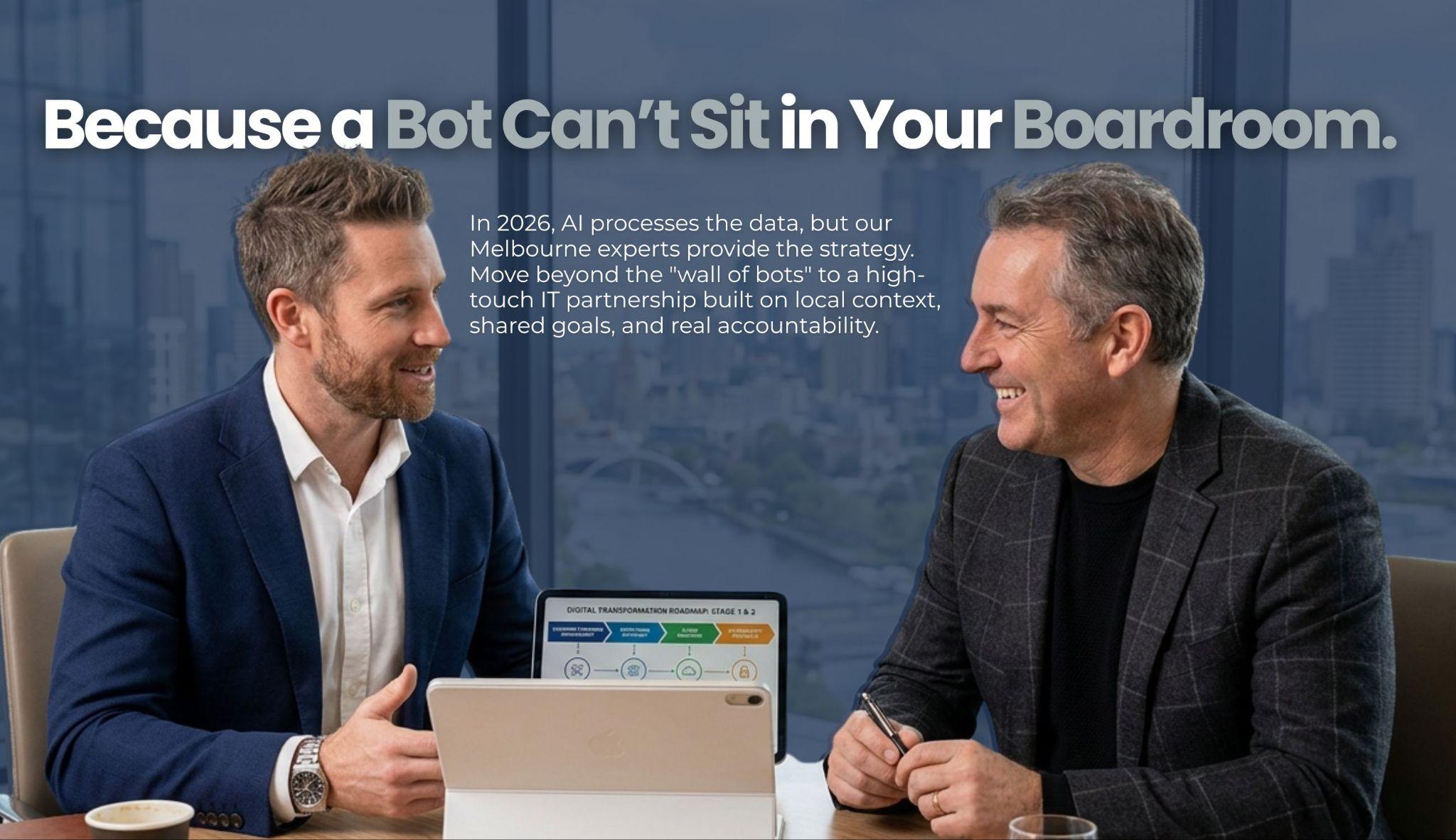
The corporate landscape of 2026 is often described as a digital arms race. Everywhere you look, artificial intelligence is promised as the panacea for operational efficiency. In the realm of Information Technology (IT) support, this has led to a frustrating trend for many Melbourne businesses: the rise of the “wall of bots.” For many service providers, the first line of defense is now an automated chat interface or a generative AI voice bot designed to deflect queries and reduce labor costs. While these tools look great on a quarterly budget report, they often fail at the most critical moment—when a CEO or Operations Manager needs an immediate, nuanced solution to a complex technical crisis.
In 2026, the value of high-touch, local human support has actually increased in direct proportion to the rise of automation. Business leaders are realizing that while AI can process data at lightning speed, it lacks the context, empathy, and accountability required to manage a modern enterprise’s digital infrastructure. This has created a clear divide in the Melbourne market between providers who use AI to replace people and those who use AI to empower them. The latter group understands that in a high-stakes environment, the “Human-in-the-loop” model is the only way to maintain high Customer Satisfaction (CSAT) scores and long-term trust.
The Myth of the Autonomous Service Desk
Contents
- The Myth of the Autonomous Service Desk
- Infosys Cobalt AI: The Engine, Not the Driver
- The Local Advantage: Why Melbourne Expertise Matters
- The Human-in-the-loop: Maintaining High CSAT
- Predictive Maintenance vs. Reactive Troubleshooting
- Strategy Over Scripting
- The “No Bot” Philosophy as a Security Feature
- Cultivating a Culture of Accountability
- Looking Forward: The Future of High-Touch IT
There is a persistent myth in the tech industry that IT support can be fully autonomous. The narrative suggests that if the AI is smart enough, it can diagnose and fix every problem before a human even knows it exists. However, any Operations Manager who has lived through a major network outage or a sophisticated cyberattack knows this is rarely the case. Automated systems are excellent at handling repetitive, low-level tasks, such as resetting passwords or flagging disk space warnings. They are spectacularly bad at navigating the “grey areas” of business technology.
Consider a scenario where a Melbourne manufacturing firm experiences a subtle synchronization error between their legacy ERP system and a new cloud-based logistics platform. A bot might see that both systems are “online” and report no error. A human engineer, however, understands the specific workflow of that business. They can hear the frustration in the client’s voice, investigate the specific data packets being dropped, and apply a creative workaround that hasn’t been programmed into a training set. This is where the “No Bot” philosophy becomes a competitive advantage.
Infosys Cobalt AI: The Engine, Not the Driver
The most successful IT providers in 2026 are not ignoring AI; they are integrating it deeply into their backend operations. This is exemplified by the heavy investment in platforms like Infosys Cobalt AI. This sophisticated suite of tools allows a service desk to perform predictive maintenance at a scale that was previously impossible. It can analyze millions of data points across a client’s network to identify patterns that precede hardware failure or security breaches.
However, the key to the “No Bots in Sight” commitment is how that information is used. At a leading provider, that AI-generated data is fed directly to a local, Melbourne-based engineer. Instead of a client receiving an automated email from a bot, they get a call from an expert who says, “Our predictive tools flagged a potential issue with your server cluster in Port Melbourne. I’ve already investigated the logs, and here is our plan to address it during your low-traffic window tonight.” In this model, the AI is the engine that provides the data, but the human is the driver who makes the strategic decision.
The Local Advantage: Why Melbourne Expertise Matters
For a Melbourne-based CEO, accountability is often synonymous with proximity. There is a psychological and operational comfort in knowing that the person managing your primary data environment is in the same timezone, understands the local infrastructure, and is subject to the same regulatory environment. High-touch service desks staffed by local experts can provide a level of strategic partnership that an offshore automated service simply cannot match.
A local partner understands that IT is not just about keeping the lights on; it is about growth. When you partner with a service that offers managed IT services in Melbourne, you gain access to consultants who can walk into your boardroom and discuss your three-year expansion plan. Reliable managed IT services in Melbourne provide a bridge between your current technical state and your future business goals, ensuring that your technology stack is an accelerator rather than a bottleneck. This relationship is built on face-to-face meetings, shared local context, and a level of accountability that only exists when your provider is just a short drive across the West Gate or down the Monash.
The Human-in-the-loop: Maintaining High CSAT
Customer Satisfaction (CSAT) scores are the lifeblood of the managed services industry. In 2026, the highest scores are consistently held by providers who maintain a “Human-in-the-loop” service model. This approach ensures that every automated action is reviewed, verified, or initiated by a professional. This prevents the “hallucinations” or logical errors that can occur when AI is left to manage complex systems without oversight.
For an Operations Manager, the “Human-in-the-loop” means that there is always a “throat to choke” if things go wrong. It means that when you call the service desk, you aren’t fighting through a voice-recognition menu. You are speaking to a person who knows your name, knows your network, and has the authority to solve your problem on the spot. This responsiveness is the primary driver of high CSAT. It’s the difference between feeling like a ticket number and feeling like a valued partner.
Predictive Maintenance vs. Reactive Troubleshooting
The integration of AI like Infosys Cobalt allows for a shift from reactive to proactive IT. In the old model, the client would call when something broke, and the engineer would fix it. In the 2026 model, the “Human-plus-AI” team is constantly monitoring the health of the environment. The AI identifies the “smoke” so the human can put out the “fire” before it even starts.
This predictive maintenance is particularly vital for Melbourne’s growing sectors, such as biotech, advanced manufacturing, and professional services. These industries cannot afford even a few minutes of downtime. By using AI to filter out the noise of billions of system logs, local engineers can focus their attention on high-value troubleshooting and long-term infrastructure strategy. They aren’t wasting time on manual health checks; they are spending their time making the client’s business more resilient.
Strategy Over Scripting
When a business reaches a certain size, its IT needs move beyond simple “break-fix” support. It needs digital transformation. This requires strategic thinking, risk assessment, and an understanding of the competitive landscape. An AI bot can follow a script, but it cannot develop a digital transformation roadmap tailored to the specific culture of a Melbourne law firm or a South Melbourne creative agency.
High-touch support means having a dedicated Virtual Chief Information Officer (vCIO) who sits on your side of the table. They use the data provided by automated systems to help you budget for the next three years, decide when to move from hybrid to full cloud, and evaluate the security risks of new AI tools your employees might be using. This level of strategy requires a deep, human relationship built over time. It requires a partner who understands your business’s “why,” not just its “what.”
The “No Bot” Philosophy as a Security Feature
Cybersecurity in 2026 is increasingly a battle of AI versus AI. Hackers use automated tools to find vulnerabilities, and defensive systems use AI to block them. However, the final line of defense must always be human. A sophisticated social engineering attack, for example, is specifically designed to bypass automated filters.
A “No Bot” service desk is a massive security asset. When your staff calls the help desk to report a suspicious email or a strange login prompt, they are talking to a local expert who can recognize the signs of a targeted attack. The human engineer can immediately correlate that report with other activity they are seeing across the Melbourne client base. They can make the “judgment call” to isolate a workstation or lock down an account in seconds—a decision that an AI might hesitate to make if it hasn’t seen that specific pattern before.
Cultivating a Culture of Accountability
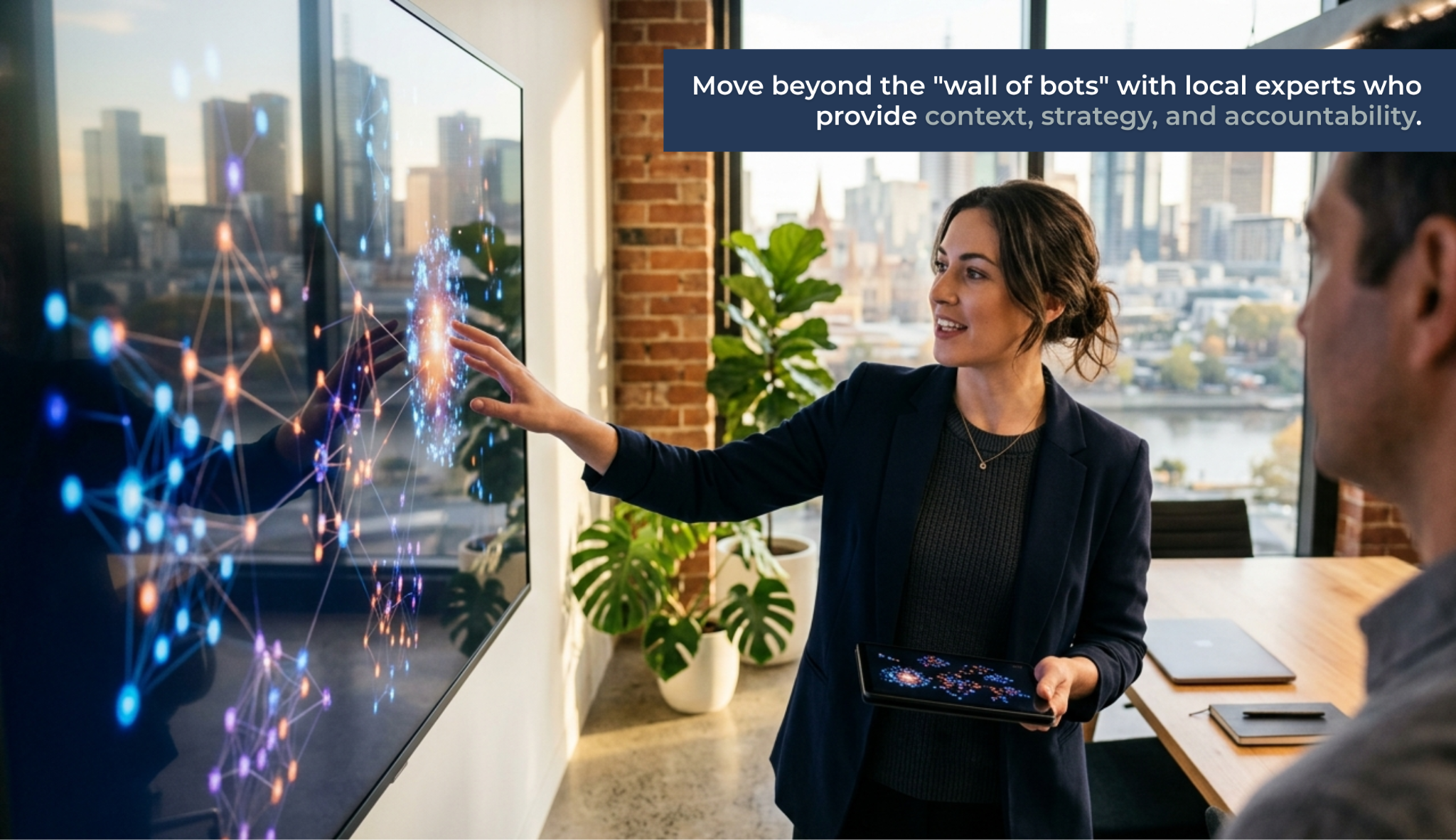
Ultimately, the reason real people still matter in IT is accountability. When a Melbourne business experiences a major technical hurdle, the CEO doesn’t want to hear that the “algorithm is working on it.” They want to hear from a lead engineer who says, “I am personally overseeing the recovery, and I will update you every thirty minutes until we are back at 100%.”
This culture of accountability is what defines the best IT partners in 2026. They use the most advanced AI in the world to make their people faster and smarter, but they never let that technology stand between them and their clients. They understand that technology is a tool, but business is a relationship. By maintaining a local, human presence in the heart of Melbourne, they ensure that their clients always have a partner they can trust, regardless of how fast the digital world is changing.
Looking Forward: The Future of High-Touch IT
As we look toward the 2030s, the “Human-in-the-loop” model will only become more essential. As AI becomes more ubiquitous, it will also become more commoditized. The “value add” for a business will not be having AI—everyone will have that. The value add will be having the human experts who know how to direct that AI to achieve specific business outcomes.
For Melbourne businesses, the choice is clear. You can choose a provider that sees AI as a way to hide from their clients, or you can choose a partner that sees AI as a way to serve them better. By prioritizing high CSAT, local expertise, and a “No Bot” service desk, you are investing in the most important part of your technology stack: the human connection. Real people matter because they provide the context, the strategy, and the accountability that no line of code can ever replicate. In a world of automated IT, the most sophisticated thing you can offer a client is a real, expert human on the other end of the phone.