


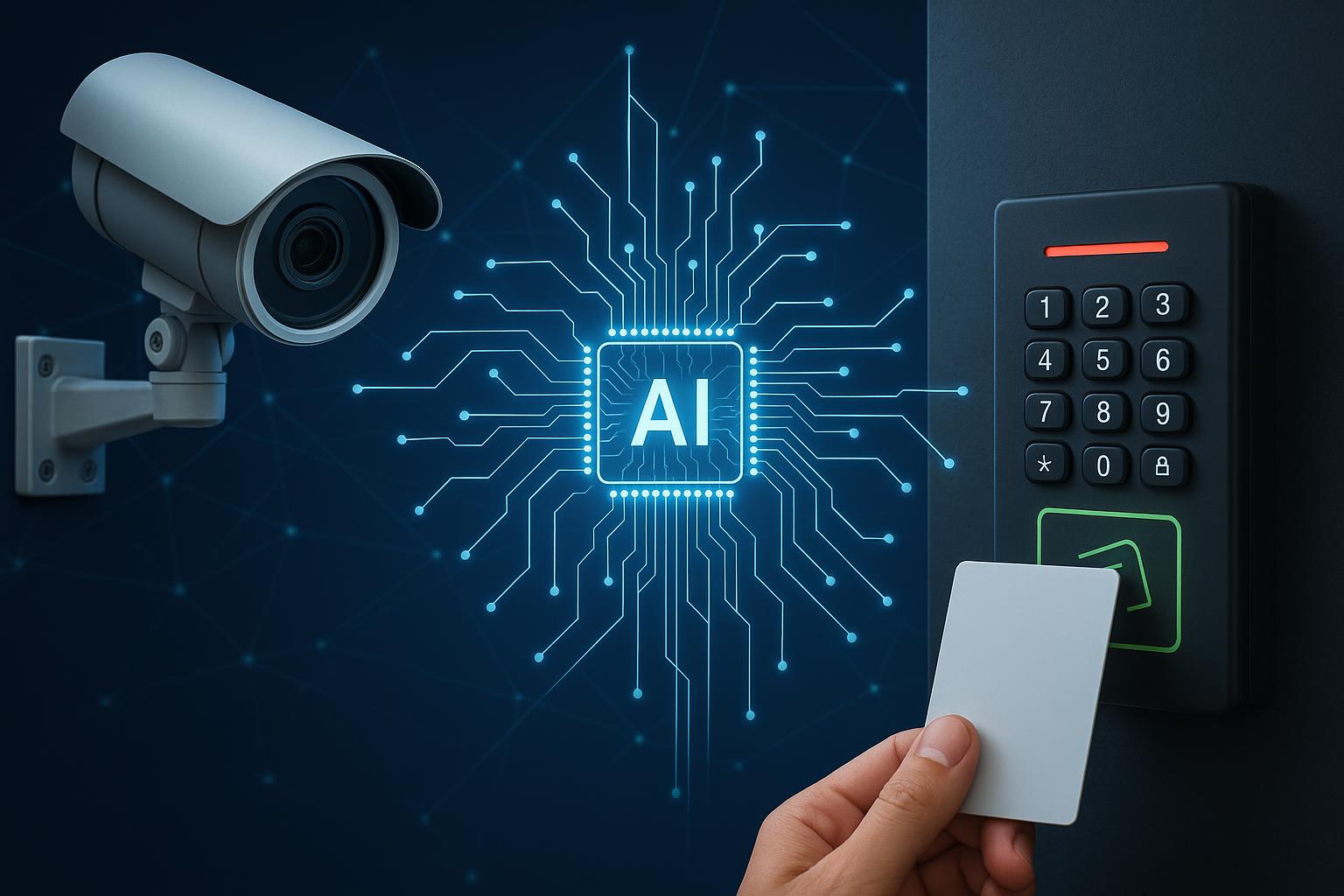
Commercial buildings are becoming more connected, but that connectivity is also changing what property managers expect from physical security. A door reader that records a badge swipe and a camera that records video are useful individually. When the two systems share information, however, security teams gain much more context about what is actually happening at an entrance.
The shift is already visible across the physical security industry. Genetec’s 2026 State of Physical Security research, based on responses from more than 7,300 professionals, found that 52% of end users already have cloud solutions involved in their physical security deployments. Its previous 2025 research also found that 77% of end users said physical security and IT departments were working collaboratively.
Access technology is evolving at the same time. HID’s survey of more than 1,200 security professionals found that 39% of organizations were actively using mobile identities, while touchless solutions and mobile access ranked among the biggest trends influencing access control.
These changes are encouraging commercial property managers to move away from isolated security devices and toward connected systems that combine identity, access events, video intelligence, and faster incident verification.
Why Access Control Alone Does Not Tell the Whole Story
Contents
- Why Access Control Alone Does Not Tell the Whole Story
- Connecting Door Events With AI Video Intelligence
- Faster Verification Can Improve Security Response
- Cloud Management Is Changing Multi-Site Security
- Integration Also Requires Strong Governance
- Building a More Connected Physical Security Strategy
- FAQs
- Conclusion
Electronic access control solves an important problem. It determines whether a credential has permission to unlock a particular door.
But a successful credential does not automatically prove that the correct person entered.
An employee could hold a door open for another person. Someone might follow an authorized worker into a restricted area without presenting a credential, a practice commonly known as tailgating. A lost or shared card might also be used by someone other than its assigned owner.
Traditional access logs can tell security teams that a card assigned to Employee A opened Door 12 at 8:42 p.m. What they cannot necessarily explain is who physically walked through that door.
Video provides the missing context.
When access control events are connected with nearby cameras, the security team can review the actual entry alongside the credential event. Instead of investigating two separate systems, operators can see who entered, how many people followed, and what happened immediately before and after the door opened.
Connecting Door Events With AI Video Intelligence
Integration becomes especially useful when video management software can automatically analyze activity instead of requiring employees to manually watch every camera.
Installing modern card access systems is only half the battle when securing a commercial facility. To build a comprehensive defense, businesses are linking electronic card readers directly with AI-powered video management software to automatically cross-reference badged entries with live camera feeds. One example is Coram, which combines video security and access control within a unified physical security platform, allowing access events to be connected with video context for investigating situations such as unauthorized entry or tailgating.
Consider an office tower with hundreds of employees entering through multiple doors every morning. Reviewing each badge event would be unrealistic.
Instead, integrated systems can help security teams focus on exceptions. A forced door, an entrance remaining open longer than expected, repeated denied credentials, or unusual activity around a restricted area can become an event that operators investigate immediately.
AI video intelligence can add another layer by helping security personnel locate relevant footage faster. Rather than scrolling through hours of recordings, teams can narrow investigations around a specific entrance, person, object, vehicle, or time period.
Faster Verification Can Improve Security Response
One of the most valuable advantages of integration is reducing uncertainty during an incident.
Imagine that a card assigned to an employee is used to enter a server room at 11:30 p.m. The access control system might record the event as legitimate because the credential has permission.
A connected camera could reveal a different story.
The person using the credential may not match the expected employee. Two people may have entered after a single badge swipe. Someone may have entered and immediately started interacting with equipment in an unusual way.
Instead of treating the badge event as proof that everything is normal, security personnel can evaluate identity and behavior together.
The same principle applies to warehouses, office campuses, laboratories, parking structures, loading docks, and other commercial environments where certain spaces require tighter controls.
Cloud Management Is Changing Multi-Site Security
Commercial organizations increasingly manage security across multiple buildings rather than a single location.
Historically, each facility might have had its own access server, camera recorder, software configuration, and security team. That structure can make managing permissions and investigations difficult across a large portfolio.
Cloud and hybrid architectures are making centralized management easier. Genetec’s 2026 research found that 61% of end users expect to move toward either a combination of on-premises and cloud services or fully cloud deployments over the next five years.
For property managers, centralized systems can simplify tasks such as changing employee permissions, reviewing events from different buildings, updating security policies, and investigating incidents without physically visiting each location.
It can be particularly useful when a company opens a new office or removes access for an employee who previously had permissions across several facilities.
Integration Also Requires Strong Governance
Connecting cameras, employee identities, door activity, and cloud infrastructure creates powerful security capabilities, but it also creates sensitive information that organizations must manage carefully.
Permissions should follow the principle of least privilege. A receptionist may need access to visitor entry information without having permission to review every camera in the building. A security administrator may require broader investigative access, while IT teams may focus primarily on system configuration and cybersecurity.
AI also requires oversight. Genetec’s 2026 research found that 70% of end users expressed concerns about how AI systems are designed and implemented, particularly around data use and understanding how the technology works.
Businesses therefore need clear policies covering data retention, administrator privileges, audit logs, employee privacy, cybersecurity updates, and appropriate use of analytics.
Technology should support human decision-making rather than automatically turning every unusual event into a security incident.
Building a More Connected Physical Security Strategy
Commercial security is moving toward a model where doors, cameras, identities, alerts, and operational data work together.
Organizations planning an upgrade should first identify their highest-risk locations and workflows. Server rooms, executive areas, warehouses, loading docks, parking entrances, laboratories, and after-hours doors may deserve priority.
Compatibility also matters. Property managers should determine whether modern software can integrate with existing readers and cameras before replacing large amounts of hardware.
The objective is not simply to install more technology. It is to create enough context that security personnel can understand suspicious activity faster and respond appropriately.
FAQs
What is integrated video and access control?
It is a physical security setup where electronic door access events are connected with surveillance footage. Security teams can therefore see the video associated with events such as successful badge entries, denied access attempts, or forced doors.
How does AI improve commercial video surveillance?
AI can help identify relevant activity, detect unusual events, generate alerts, and reduce the amount of footage that employees need to review manually. Human operators can then focus on events requiring investigation.
Can access control help prevent tailgating?
Access control records authorized entries, but preventing or detecting tailgating often requires additional technologies and procedures. Connecting access events with cameras can help teams identify cases where multiple people enter after a single authorized credential.
Are cloud-based physical security systems suitable for multiple buildings?
They can be particularly useful for multi-site organizations because administrators can manage users, permissions, cameras, and security events centrally. The appropriate cloud, hybrid, or on-premises architecture depends on operational, regulatory, cybersecurity, and connectivity requirements.
Should businesses replace all existing security hardware when upgrading?
Not necessarily. Organizations should first evaluate whether existing cameras, readers, locks, and related infrastructure can integrate with newer management platforms. A phased upgrade can often reduce disruption and unnecessary hardware replacement.
Conclusion
Modern commercial security increasingly depends on understanding not simply whether a door opened, but who entered, what happened around the event, and whether the activity requires attention.
Connecting access control with AI video intelligence gives property managers and security teams that additional context. As commercial buildings become more connected, physical security will increasingly operate as an integrated system in which identity, video, cloud management, and human judgment work together to provide faster verification and better situational awareness.