


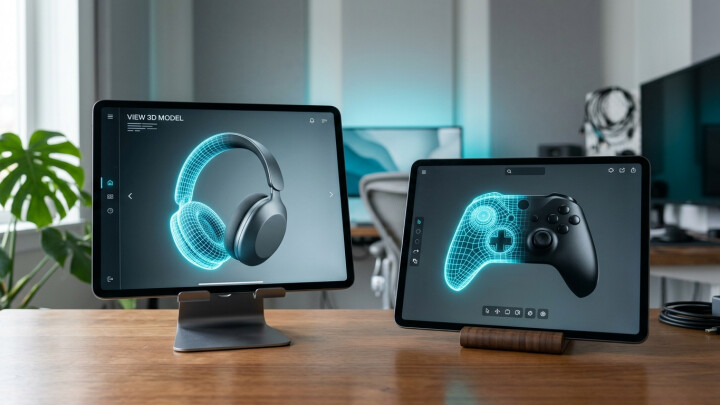
Mobile digital storefronts and retail applications face a persistent performance challenge: bridging the conversion gains of interactive 3D product visualizers with the rigid memory and latency constraints of mobile web browsers. Mobile shoppers on iOS Safari and Android Chrome abandon storefronts when asset payloads inflate page load times, yet static 2D product photos fail to convey spatial dimensions, material finishes, and geometric depth. Deploying an enterprise-grade AI 3D model generator enables digital merchants and mobile product engineering teams to systematically convert photographic catalogs into interactive digital twins without manual modeling bottlenecks.
At the core of this transition, Neural4D provides an algorithmic framework engineered to address the geometric instability, lighting contamination, and heavy polygon counts typical of legacy spatial reconstruction. By coupling high-resolution volumetric inference with production-ready topology controls, the platform bridges conceptual product imagery and mobile-optimized 3D assets. In this analysis, we evaluate the end-to-end technical pipeline required to deploy N4D generated assets directly into mobile WebGL viewports, analyzing polygon budgets, albedo material decoupling, runtime compression, and mobile AR compatibility across iOS and Android ecosystems.
Algorithmic Foundation: Direct3D-S2 and Spatial Sparse Attention
Contents
- Algorithmic Foundation: Direct3D-S2 and Spatial Sparse Attention
- Solving Lighting Contamination: Pure Albedo and PBR Material Decoupling
- Mobile WebGL Runtime Payload and Performance Benchmark Matrix
- Quad-Dominant Topology and Target Polycount Allocation
- Four-Stage Deployment Pipeline: From Product Photography to Mobile Viewports
- Enterprise Infrastructure, Data Privacy, and Commercial Licensing
- Engineering Synthesis
Integrating 3D assets into mobile applications requires deterministic geometry. Traditional neural reconstruction pipelines often rely on dense volumetric grids or marching cubes algorithms. These historical methods scale cubicly with resolution, forcing compute clusters to trade spatial fidelity for processing speed. The resulting output frequently manifests as coarse surfaces, erratic vertex groupings, or non-manifold triangle soup that demands hours of manual cleanup in digital content creation suites before becoming usable.
N4D resolves this scaling bottleneck through its proprietary Direct3D-S2 algorithm, a framework originating from NeurIPS 2025 research. The architectural breakthrough centers on Spatial Sparse Attention (SSA). Rather than allocating GPU cycles across empty coordinate space within a bounding cube, SSA concentrates mathematical operations strictly on non-empty voxel regions where physical surfaces exist. This targeted compute allocation enables native geometry generation up to 2048³ resolution, preserving sharp edges, mechanical seams, and consistent wall thickness on complex commercial products.
Inference speed within this architecture follows a disciplined, two-stage engineering structure:
· Base Mesh Synthesis: Generating an untextured white model requires approximately 90 seconds. During this initial stage, the network resolves volumetric boundaries, surface normals, and global topological flow.
· PBR Material Synthesis: Generating physical-based rendering (PBR) texture maps represents a separate computational pass. Computing diffuse albedo, roughness, metallic, and normal maps requires additional processing time. As a result, exporting a complete, production-grade textured GLB asset averages over two minutes in total elapsed time.
This latency distribution reflects a deliberate design choice. Generating an untextured mesh within 90 seconds allows industrial designers to verify physical proportions and geometric clearances rapidly. Texturing proceeds only when the underlying spatial structure satisfies quality criteria, preventing the waste of compute resources on flawed geometry.
Solving Lighting Contamination: Pure Albedo and PBR Material Decoupling
A primary failure point in mobile 3D retail is lighting contamination, commonly referred to as baked-in lighting. When standard photogrammetry or basic AI tools reconstruct a 3D asset from two-dimensional photographs, directional studio lights, specular glints, and cast shadows become permanently baked into the color map.
When a mobile shopper views a contaminated model in an interactive WebGL canvas or places it into their living room using mobile augmented reality, the asset breaks visual coherence. Static baked shadows remain fixed even as the user rotates the object under dynamic virtual lights, producing severe visual artifacts and a synthetic appearance.
N4D eliminates this problem by incorporating dedicated material decoupling algorithms. The platform processes source imagery to strip directional light sources, extracting a pure diffuse albedo map alongside mathematically derived roughness, metallic, and normal layers:
· Albedo Isolation: The system separates ambient occlusion and directional luminance from base color values, providing an unshaded surface texture.
· Physically Based Shading: By generating discrete normal, roughness, and metalness channels, N4D outputs assets that respond dynamically to Three.js, Babylon.js, and Google Model-Viewer lighting environments.
· AR Scene Consistency: In mobile AR Quick Look on iOS and Scene Viewer on Android, relightable assets sample the physical room lighting via ambient light estimation, anchoring the digital twin into the real-world environment.
For catalogs requiring custom finishes, the platform features a dedicated AI Texture module. Operating at 20 Credits per generation, the tool allows artists to supply supplementary reference photos or detailed text prompts to apply distinct surface coatings across existing 3D Studio meshes, standardizing material properties across entire product lines.
Mobile WebGL Runtime Payload and Performance Benchmark Matrix
Deploying interactive 3D models on mobile browsers requires strict adherence to memory and rendering budgets. Mobile Safari on iOS enforces strict WebKit canvas memory thresholds, terminating browser tabs when GPU buffer allocations spike. Similarly, mid-tier Android chipsets experience thermal throttling and frame rate drops when forced to process unoptimized vertex buffers.
To establish clear engineering guidelines, the following benchmark matrix contrasts raw AI output against optimized N4D pipelines configured for mobile WebGL delivery:
Pipeline Stage / Configuration | Polygon Density | Uncompressed Payload (GLB) | Draco / Meshopt Payload | Draw Calls per Model | Mobile FCP Impact |
Raw Photogrammetry Baseline | 480,000 Triangles | 42.6 MB | 18.4 MB | 14 to 22 | > 2,400 ms (High Churn) |
Standard Unchecked AI Mesh | 150,000 Triangles | 18.2 MB | 7.9 MB | 8 to 12 | > 1,600 ms (Lag Warning) |
N4D High-Detail Preset | 50,000 Triangles | 6.4 MB | 1.9 MB | 2 to 3 | 420 ms (Acceptable) |
N4D Quad-Dominant Optimized | 18,000 Quads | 2.8 MB | 680 KB | 1 | 180 ms (Target Ideal) |
N4D Ultra-Light Mobile Tier | 6,500 Quads | 1.1 MB | 310 KB | 1 | 95 ms (Instant Load) |
Data indicates that reducing polygon counts while enforcing clean quad structure drops runtime payload size by over 80 percent after compression. Assets compiled under the N4D Quad-Dominant configuration achieve sub-second transmission across standard mobile 4G networks, keeping First Contentful Paint (FCP) well within performance tolerances.
Quad-Dominant Topology and Target Polycount Allocation
Mesh geometry directly impacts runtime decimation algorithms and GPU vertex processing. Standard generative tools output disorganized triangle soup with varying density across flat surfaces, complicating automated Level of Detail (LOD) generation.
N4D resolves this through pre-generation topological selection across both Text to 3D and Image to 3D modules:
· Triangle Topology: Operating as the default setting, triangle meshes accommodate polycounts spanning 100,000 to 500,000 polygons (defaulting to 50,000). This option preserves micro-creases, detailed carvings, and complex organic curves, making it suitable for high-density desktop viewers and additive manufacturing prototypes.
· Quad-Dominant Topology: Tailored specifically for animation, real-time engines, and mobile WebGL pipelines, quad-dominant generation allows targeting between 1,000 and 100,000 polygons. Polygons align along continuous edge loops, facilitating predictable LOD decimation, UV unwrapping, and automated skeletal rigging. Exported quad assets download as standard .OBJ files, with the active topology type recorded in the platform asset information card. Generating a model with quad topology, textures, and full PBR maps consumes 35 Credits.
When asset proportions require fine adjustments, developers can use Neural4D-2o, the platform conversational multimodal model. Operating at 30 Credits per edit, N4D-2o allows artists to adjust component thickness, modify profile curves, or alter specific features using conversational prompts directly within the generation session, avoiding the compute overhead of re-initiating full jobs from scratch.
Four-Stage Deployment Pipeline: From Product Photography to Mobile Viewports
Engineering teams can implement a reliable production cycle by structuring deployment into four distinct operational phases:
1. Multimodal Asset Ingestion: Source photographs are ingested via Image to 3D, supporting drag-and-drop, clipboard pasting, and file uploads up to 20MB in PNG, JPG, JPEG, and WebP formats. For complex products with intricate dimensional clearances, teams leverage Multi-View to 3D, uploading six orthogonal angles to eliminate depth estimation discrepancies. When digitizing extensive product lines, Batch Image to 3D processes up to 10 images concurrently across parallel processing queues.
2. Direct3D-S2 Surface Reconstruction and PBR Extraction: Jobs run through SSA inference, generating watertight meshes while separating albedo color maps from environmental illumination. The system assigns metallic and roughness attributes based on material identification algorithms.
3. Conversational Optimization and Format Packaging: Assets undergo polycount reduction via quad targeting and prompt-guided refinement in Neural4D-2o. The resulting geometry exports into standard formats including OBJ, FBX, GLB, USDZ, STL, and BLEND.
4. Mobile WebGL and AR Integration: Assets are converted into dual-track delivery packages: .GLB with Draco or Meshopt compression for Android Scene Viewer and standard Three.js canvas viewers, and .USDZ for native iOS Quick Look AR projection.
For developers sourcing open test geometries across mobile viewers, open libraries such as the DIY3D 3D print community provide public archives where spatial meshes can be evaluated across different mobile hardware configurations.
Enterprise Infrastructure, Data Privacy, and Commercial Licensing
Enterprise adoption in commercial e-commerce requires enterprise-grade platform reliability, intellectual property protection, and scalable infrastructure. N4D provides clear operating policies that support large-scale digital transformation:
· Commercial Ownership Rights: Subscribers on paid plans retain full commercial rights over all generated meshes, textures, and exported packages, allowing unrestricted integration into production storefronts, marketing campaigns, and commercial apps.
· Private Generation Controls: To protect unreleased consumer products, confidential packaging designs, and proprietary product lines, paid subscribers can toggle the Private visibility switch. Private generations remain exclusive to the enterprise workspace and never populate public community streams.
· High-Concurrency Scalability: N4D demonstrates enterprise credibility through a formal strategic partnership with ByteDance valued at over $1 million annually. This collaboration verifies the stability of N4D infrastructure under heavy concurrent traffic, supporting high-throughput API processing for global digital catalogs.
Engineering Synthesis
Deploying interactive 3D assets on mobile platforms requires balancing visual depth with rigorous technical discipline. Unoptimized geometries and baked lighting degrade mobile web performance, driving user bounce rates and damaging store conversion.
By unifying high-resolution Direct3D-S2 reconstruction, automated PBR material decoupling, and quad-dominant topology controls, Neural4D offers an end-to-end framework for modern mobile commerce. The platform enables engineering teams to transform static photographic catalogs into lightweight, relightable, and responsive WebGL experiences, establishing a predictable bridge between creative design and mobile production performance.