


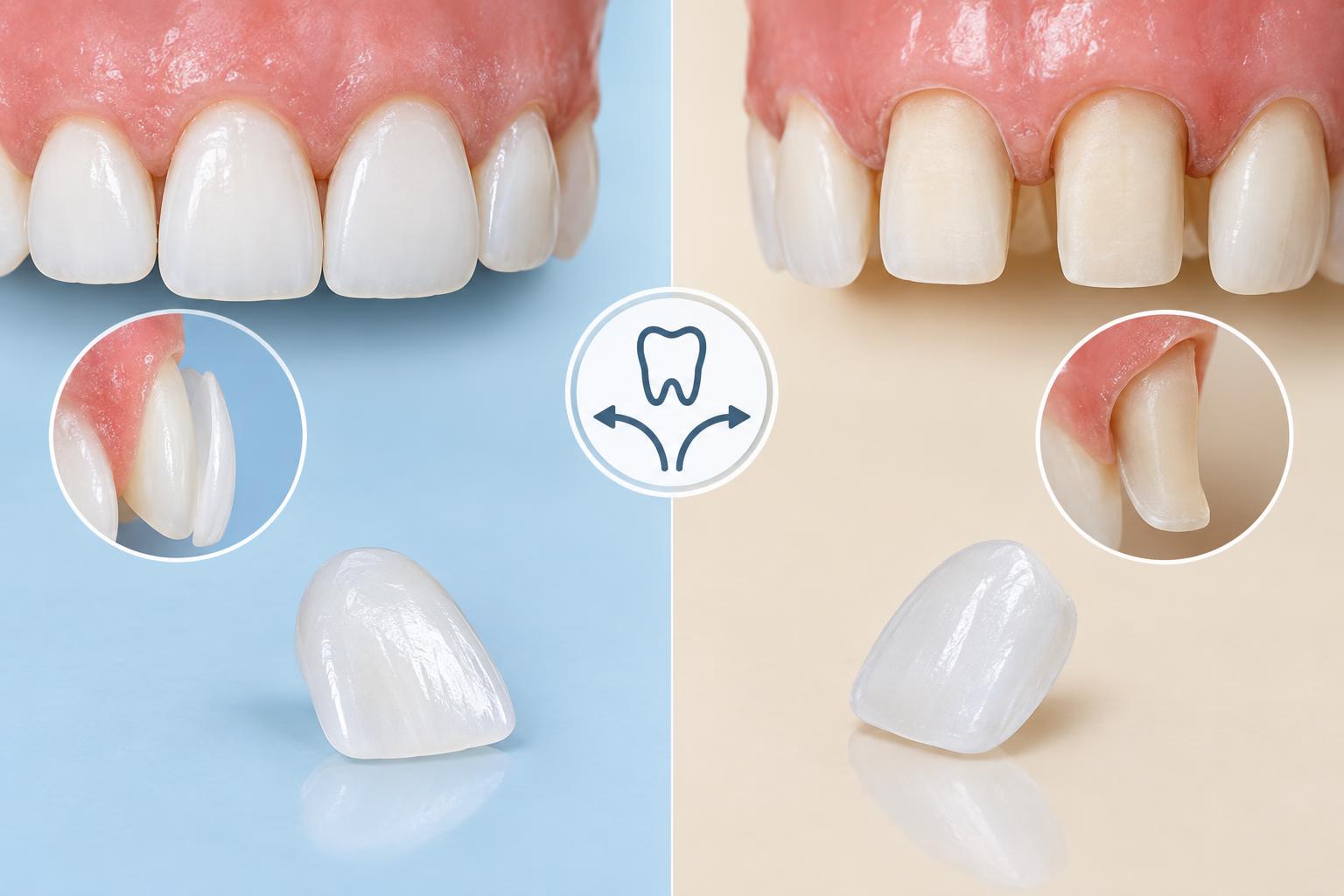
What Are Minimal Prep Veneers?
Minimal prep veneers are ultra-thin porcelain shells, often between 0.2 and 0.3 millimeters thick. Dentists place them with little or no enamel removal, so the natural tooth stays largely intact beneath the restoration.
How the Process Works
Your dentist takes impressions or digital scans, designs the shells in a lab, and bonds them directly onto lightly prepared surfaces. Some cases need only a gentle polish of the enamel. Many patients complete treatment without local anesthesia because the tooth structure sits barely touched.
Who Benefits Most
Minimal prep works well for people with small gaps, mild discoloration, slightly worn edges, or teeth that are a little undersized. If your teeth already sit in good alignment and you want a refined enhancement rather than a dramatic change, this approach often fits.
What Are Traditional Veneers?
Traditional veneers are thicker, typically around 0.5 to 0.7 millimeters. To make room for them, your dentist removes a measured layer of enamel, usually about half a millimeter, so the finished tooth does not look bulky.
How the Process Works
After shaping the teeth, your dentist places temporary veneers while the permanent set is made. At the second visit, the temporaries come off and the final porcelain shells are bonded in place. Because enamel removal is involved, local anesthesia is common.
Who Benefits Most
This approach suits people who want to correct significant discoloration, chips, cracks, uneven shapes, or mild crowding. The extra thickness masks dark stains that thin shells may not hide, and the shaping step gives the dentist more control over the final contour.
Key Differences at a Glance
A side-by-side look makes the trade-offs clearer.
- Enamel removal: Minimal prep keeps most or all natural enamel. Traditional veneers require permanent removal of a thin layer.
- Thickness: Minimal prep shells are thinner and more translucent. Traditional shells are sturdier and more opaque.
- Reversibility: Minimal prep can sometimes be reversed or replaced with little damage. Traditional preparation cannot be undone.
- Masking power: Traditional veneers hide deep stains and uneven shapes more effectively.
- Comfort: Minimal prep often avoids anesthesia and temporaries. Traditional treatment usually involves both.
- Visits: Minimal prep can streamline the schedule, while traditional care typically spans at least two appointments.
Factors That Should Guide Your Decision
The Condition of Your Natural Teeth
Healthy, well-aligned teeth with strong enamel are ideal candidates for minimal prep. Teeth that are crooked, rotated, or protruding often need some reshaping. Without it, the veneers may add bulk and make the teeth look oversized.
Your Aesthetic Goals
Think about the result you picture. A natural brightening and softening of small flaws points toward minimal prep. A bold, uniform Hollywood-style smile with a dramatic color shift leans toward the traditional route.
Long-Term Thinking
Enamel does not regenerate. Preserving it keeps future options open, which matters if you are young or expect to need dental work later. At the same time, a well-made traditional veneer can last 10 to 20 years with proper care, so permanence is not always a drawback when the case calls for it.
Budget and Maintenance
Costs vary by region, materials, and the complexity of your case. Minimal prep sometimes carries a similar price per tooth because the lab work is highly skilled, so do not assume it is the cheaper path. Both types need the same habits: brushing twice daily, flossing, regular checkups, and a night guard if you grind your teeth.
Common Myths Worth Clearing Up
Thinner Always Means Weaker
Thin porcelain, when bonded to enamel, performs surprisingly well. Enamel offers the best surface for adhesion, which is one reason preserving it matters so much for minimal prep success.
Traditional Veneers Always Damage Teeth
Careful preparation removes only what is necessary. Problems arise from over-reduction or poor planning, not from the technique itself.
Why a Thorough Consultation Matters
No article can replace a hands-on assessment. A skilled dentist evaluates your bite, gum health, enamel thickness, and cosmetic goals, then often previews the result with a digital smile design or a temporary mock-up. Practices such as Nuffield Dental, for example, emphasize detailed assessments and clear explanations of both options so patients understand what each approach involves before committing. Asking to see before-and-after cases and discussing how your bite may affect longevity gives you a realistic picture of the outcome.
Final Thoughts: Matching the Approach to Your Smile
Neither option wins universally. Minimal prep protects natural enamel and suits subtle improvements on healthy, well-positioned teeth. Traditional veneers offer greater control and stronger concealment when teeth need more significant correction. Your decision should rest on tooth condition, cosmetic expectations, and how you feel about permanent change.
Start by listing your goals, then book a consultation and ask your dentist to explain why they recommend one route over the other. A clear rationale, backed by a proper examination, is the best sign you are choosing the approach that will serve your smile for years to come.