


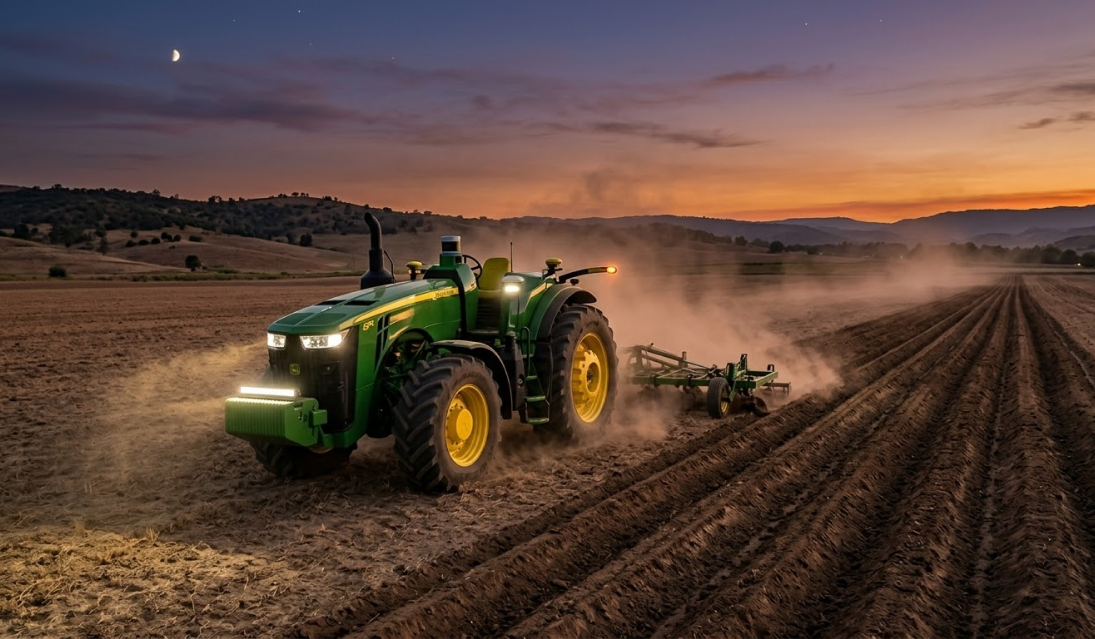
Picture a seasoned farmer operating a traditional combine harvester. Over the roar of the diesel engine, he notices a faint, rhythmic “click-click-click” coming from beneath the floorboard. He feels a subtle, new vibration in his seat. Instinctively, he throttles down, stops the machine, and climbs out to inspect the chassis. He finds a failing wheel hub, greases it, or schedules a repair before it causes catastrophic damage.
Now, replace that farmer with a state-of-the-art autonomous tractor.
The artificial intelligence guiding this machine is a marvel. It uses LiDAR and RTK GPS to plant seeds with millimeter precision. It optimizes fuel consumption and avoids obstacles. But it doesn’t have ears. It doesn’t have intuition. If a rotating component begins to grind due to dirt ingress, the autonomous tractor won’t sense the subtle vibration. It will simply keep pulling with all 400 horsepower until the hub seizes, the axle snaps, or the friction heat sparks a devastating field fire. This is the “Deaf Machine” paradox: As agricultural equipment becomes infinitely smarter in the software layer, it becomes dangerously blind to its own mechanical deterioration.
Autonomous-tractor-working-dusk-24-7-agriculture
The 24/7 Brutality: Rewriting the Duty Cycle
Contents
The shift from human-operated to autonomous machinery isn’t just a software upgrade; it completely rewrites the mechanical duty cycle.
Traditional agricultural engineering is heavily based on the assumption that a human operator needs to rest. A tractor might run for 10 to 12 hours, followed by a long overnight cooldown period. The next morning, the farmer performs a visual walk-around, perhaps applying a grease gun to a few critical zerk fittings.
Autonomous machines, however, are purchased specifically to eliminate that downtime. They are designed to run 24 hours a day, 7 days a week, maximizing the tight harvest or planting windows. This exponential increase in continuous thermal stress changes the math entirely. Bearings and seals that were perfectly adequate for a 12-hour shift will quickly overheat, degrade their lubricating film, and fail under a relentless 24/7 operational load.
The “Data vs. Dirt” Dilemma
When presented with this mechanical vulnerability, the common response from software engineers is seemingly logical: “Just slap an IoT vibration sensor and a temperature probe on the rotating parts.”
In a climate-controlled server room or a clean automotive factory, this condition-monitoring approach works flawlessly. But agriculture is not a clean room. It is an environment defined by half a meter of acidic mud, corrosive chemical fertilizers, relentless shock loads from buried rocks, and the sheer violence of 2000 PSI high-pressure washdowns at the end of the day.
Here is the uncomfortable reality that AgTech developers quickly discover: the delicate wiring harnesses, exposed silicon, and battery packs of external IoT sensors often fail weeks before the actual heavy-duty steel components do. You cannot patch a physical hardware vulnerability with fragile electronic bandages.
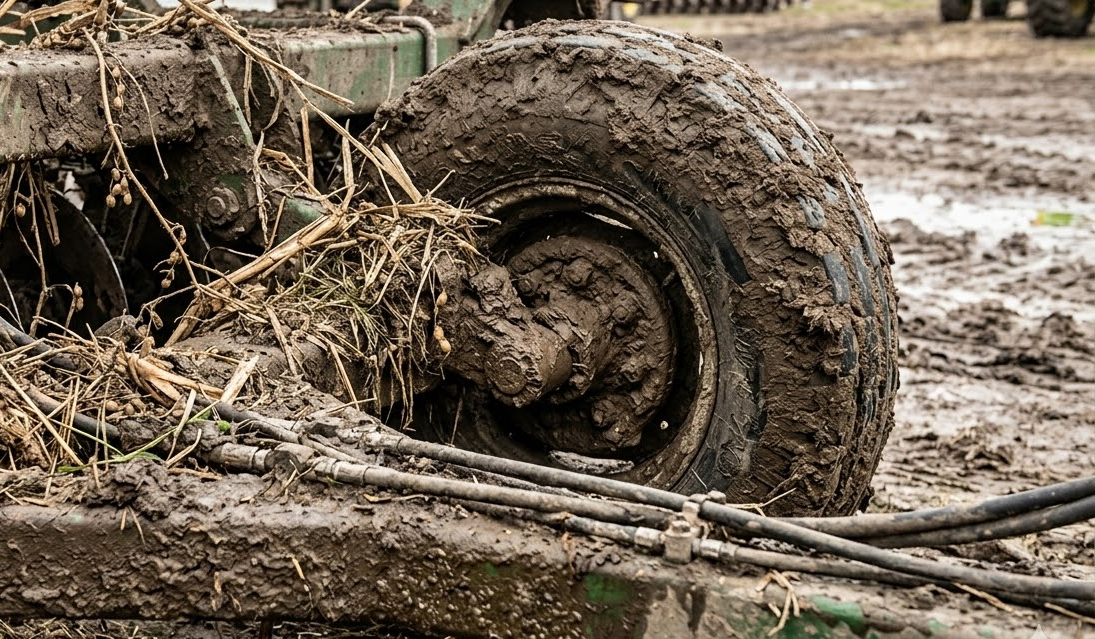
heavy-mud-debris-agricultural-machinery-undercarriage
Redefining Hardware: The Shift to “Install and Forget”
If we cannot rely on human senses, and we cannot fully trust external electronic sensors to survive the mud, what is the logical engineering fallback?
The answer is that the baseline mechanical hardware must be re-engineered to survive without any intervention or monitoring at all. Autonomous farming demands a shift toward an “install and forget” design philosophy.
When specifying components for these autonomous giants, design engineers can no longer use standard, off-the-shelf industrial parts. Instead, they must integrate specialized agriculture bearings that are fundamentally engineered to combat the sensory deficit of the machine.
This means abandoning the concept of manual field maintenance. Manufacturers are now utilizing heavy-duty, forged housings and advanced multi-lip cassette seals. These sophisticated sealing architectures serve a dual purpose: they permanently lock the factory-fill synthetic grease inside, and they create an impenetrable labyrinth against abrasive silicates and high-pressure water. By sealing the environment out completely, the component can survive the grueling 24/7 duty cycle without requiring an AI to “listen” for signs of trouble.
Conclusion
The smartest autonomous tractor in the world is ultimately only as reliable as its weakest mechanical link. A $500,000 piece of AgTech software can easily be brought to its knees by a $50 mechanical failure in the mud.
As the agricultural industry rushes toward an autonomous future, the focus must shift back to the basics of metallurgy, sealing technology, and brutal environmental testing. The future of farming isn’t just floating in the cloud; it is anchored in the uncompromising reliability of the steel components turning in the dirt.
Frequently Asked Questions (FAQ)
Why can’t we just rely on IoT vibration sensors to monitor bearing health in autonomous tractors? While IoT sensors are excellent for predictive maintenance in climate-controlled factory environments, agricultural machinery operates in extreme conditions. The external wiring harnesses and delicate silicon components of these sensors are often destroyed by acidic mud, abrasive crop debris, and high-pressure washdowns long before the internal mechanical components fail. You cannot solve a fundamental physical hardware vulnerability with external electronics.
What is the primary difference between a standard industrial bearing and a specialized agriculture bearing? The main difference lies in the sealing architecture and the engineering trade-offs. Standard industrial bearings often prioritize high-speed operation, using non-contact seals to reduce friction. Agriculture bearings, however, prioritize survival over speed. They utilize heavy-duty, multi-lip cassette seals and forged housings to create an impenetrable barrier against water, dirt, and severe shock loads, ensuring they can operate in 24/7 duty cycles without contamination.
Should operators continue to manually grease the wheel hubs and bearings on modern autonomous farming equipment? In most cases, no. Modern agricultural engineering is shifting heavily toward “lubricated-for-life” designs. These components are factory-filled with an exact, calculated volume of synthetic grease and permanently sealed. Manual greasing in a field environment often introduces abrasive dirt into the zerk fitting, or the pressure from a manual grease gun can blow out the sophisticated multi-lip seals, ultimately causing premature failure.