


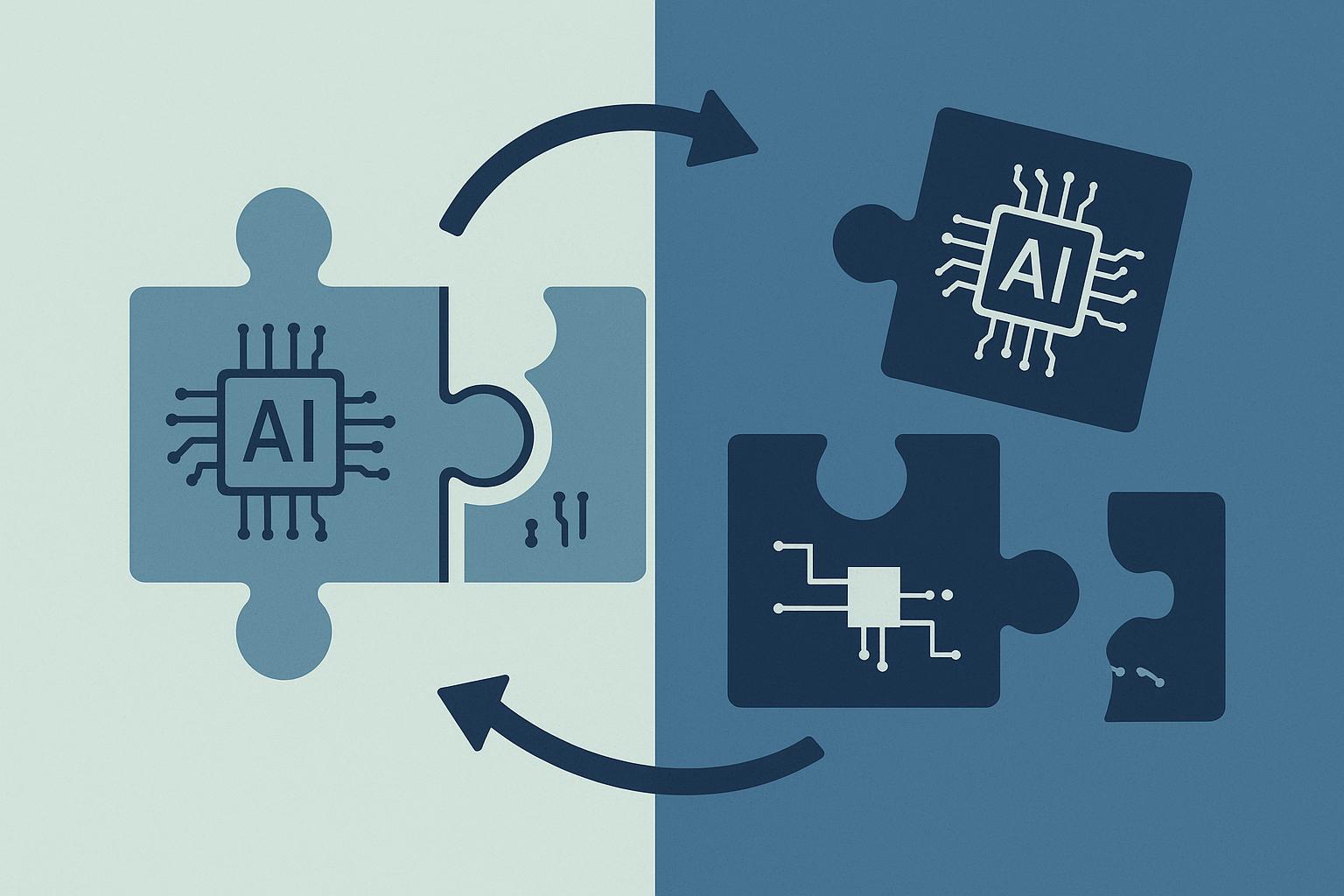
For years, the AI conversation has revolved around models. Which one writes better code? Which one reasons more effectively? Which one is faster? Those questions still matter, but AI agents are introducing another variable: the reusable skills, tools and workflows that surround the model. Two agents could eventually use similarly capable models yet behave very differently because one has been configured for security reviews while another follows a specific testing or documentation process. For developers exploring this approach, Agensi is a marketplace for Codex skills, providing a way to discover reusable instructions designed for specialised agent tasks.
The result could be a subtle change in how people evaluate AI software. The model may become one part of the decision rather than the entire product.
In short: are AI models becoming interchangeable?
Contents
- In short: are AI models becoming interchangeable?
- The smartest model is not automatically the best worker
- Skills add a procedural layer to AI
- A coding agent can have several different builds
- Why not save everything in a prompt library?
- Portability could make the skill layer more important
- What would actually make someone switch AI models?
- Skills could create their own ecosystem
- Could skills create lock-in too?
- The AI competition may move up a layer
- The model may become the engine rather than the whole product
Not completely. Models continue to differ in reasoning, coding performance, context handling, latency and other capabilities. The more interesting development is that an increasing share of an agent’s usefulness can come from what surrounds the model. Skills can define how tasks are performed, tools can determine what external systems an agent can use and permissions can limit what actions it may take. This means switching models does not necessarily require reinventing every working method around them, especially when reusable skills work across compatible agent environments.
The smartest model is not automatically the best worker
Imagine hiring two technically capable employees and giving only one of them the company’s procedures, review checklist and documentation standards. Their underlying knowledge might be comparable, but their output could differ significantly because one understands how the organisation expects the work to be performed.
AI agents face a similar problem. A capable coding model may know how to review source code, but that does not mean it automatically follows a team’s preferred review sequence, checks the right project conventions or reports findings in the expected format. Developers can explain those requirements through prompts, but repeatedly rebuilding the same instructions becomes inefficient. Skills offer a way to preserve a working method so the agent can apply it again when a relevant task appears.
Skills add a procedural layer to AI
An AI agent skill is not another model and it is not traditional executable software. A SKILL.md file provides structured instructions that teach a compatible agent how to approach a particular task. Its description can help the agent determine when those instructions are relevant, while the main content defines the procedure it should follow.
That creates a useful separation between intelligence and methodology:
- Model: Provides general reasoning and generation capabilities
- Skill: Defines a repeatable method for a particular task
- Tool: Provides an ability to interact with an external system or resource
- Permission: Determines which actions and information are available to the agent
- Human: Defines the goal and remains responsible for consequential decisions
Once those layers are separated, comparing agents purely by model benchmarks starts to tell only part of the story.
A coding agent can have several different builds
Consider a general coding agent. One developer might configure it primarily for writing and testing software while another wants a second pair of eyes for reviews and security. The underlying model could be the same, but their working methods would differ.
| Agent configuration | Possible skills | Main purpose |
|---|---|---|
| Development assistant | Testing, debugging, documentation | Support everyday coding work |
| Code reviewer | Code review, project standards | Inspect changes consistently |
| Security reviewer | Security checks, dependency review | Look for defined categories of risk |
| Documentation agent | Technical writing, repository documentation | Keep technical information structured |
| Research agent | Research, comparison, reporting | Organise information before decisions |
This modularity matters because developers do not necessarily need one giant instruction set covering every possible task. Focused skills can provide different procedures when different jobs appear.
Why not save everything in a prompt library?
Prompt libraries solve a genuine problem. If an instruction works well, saving it is more convenient than rewriting it every time. The limitation appears when a prompt stops being a question and starts becoming an operating procedure.
Suppose a developer has a long code-review prompt containing 20 instructions. They paste it into every new session, add the code and then remind the model how the output should be structured. At that point, the developer is manually loading a procedure whenever the task appears. A skill can make that procedure persistent and contextually available instead.
Prompts still make sense for temporary instructions. Skills become more interesting when the method itself deserves to be reused.
Portability could make the skill layer more important
The long-term significance of skills becomes clearer when the same working method can be used across compatible agents. Agensi’s material describes SKILL.md skills as portable instruction packages that can work with several agent environments rather than belonging exclusively to one conversation or model.
That could change how developers think about switching AI tools. Today, moving from one assistant to another can mean rebuilding prompts, conventions and personal workflows. Portable skills create the possibility that at least part of this procedural knowledge can move with the user. Model choice can then change while some of the working method remains familiar.
What would actually make someone switch AI models?
Price, performance and model capabilities will continue to influence the decision, but reusable workflows could reduce the friction involved. A developer may be more willing to test another coding agent if their preferred review, testing and documentation procedures do not need to be reconstructed from zero.
Several factors could therefore matter at the same time:
- Model capability: Can it reason effectively about the task?
- Skill compatibility: Can existing procedures move with the user?
- Tool support: Can the agent interact with the systems the workflow requires?
- Cost and latency: Is it practical for frequent use?
- Control: Can users define permissions and review consequential actions?
The winner may not always be the model with the highest score on an isolated benchmark. It could be the environment where the complete workflow works best.
Skills could create their own ecosystem
Smartphones provide an obvious historical comparison. Hardware mattered enormously, but the software ecosystem around each platform eventually became part of the purchasing decision. AI skills are not apps, so the comparison should not be taken literally. A skill primarily provides instructions rather than functioning as standalone executable software.
The ecosystem effect could still be similar. Once users invest time in discovering, creating and refining specialised workflows, access to those workflows gains value. Marketplaces can make them easier to distribute instead of requiring every developer to write every procedure independently. Users interested in the wider range of available agent resources can see the complete marketplace on Agensi.io.
Could skills create lock-in too?
Portability does not automatically eliminate ecosystem lock-in. A skill may be written in a portable format while still depending on particular tools, project structures or capabilities. Different agents can also interpret the same instructions differently because the underlying models are not identical.
Developers should therefore distinguish between three forms of portability:
- File portability: Can the same skill file be loaded elsewhere?
- Workflow portability: Can the complete procedure still be performed?
- Result consistency: Does another agent produce sufficiently comparable results?
A portable file is useful, but the second and third questions determine whether switching agents is genuinely painless.
The AI competition may move up a layer
Model development is not slowing down. Better reasoning, longer context windows and stronger coding capabilities will continue to matter. What may change is how visible those differences are to everyday users once models become sufficiently capable for the same basic categories of work.
At that point, the surrounding ecosystem becomes more important. Developers may choose an AI environment because it supports their preferred skills, connects to the right tools and fits the way their team works. Companies may similarly care less about having one universally “best” model and more about whether their established procedures can be applied reliably.
The model may become the engine rather than the whole product
Modern consumers rarely choose technology by looking at one component in isolation. A phone is more than its processor and a gaming PC is more than its GPU. AI agents could follow the same path. The model provides the underlying intelligence, but skills, tools, permissions and workflows determine how that intelligence becomes useful.
That does not make AI models irrelevant or truly interchangeable. It means the competition is expanding. As baseline capabilities improve, the more interesting question may stop being simply “which model are you using?” and become “what can you build around it?”