


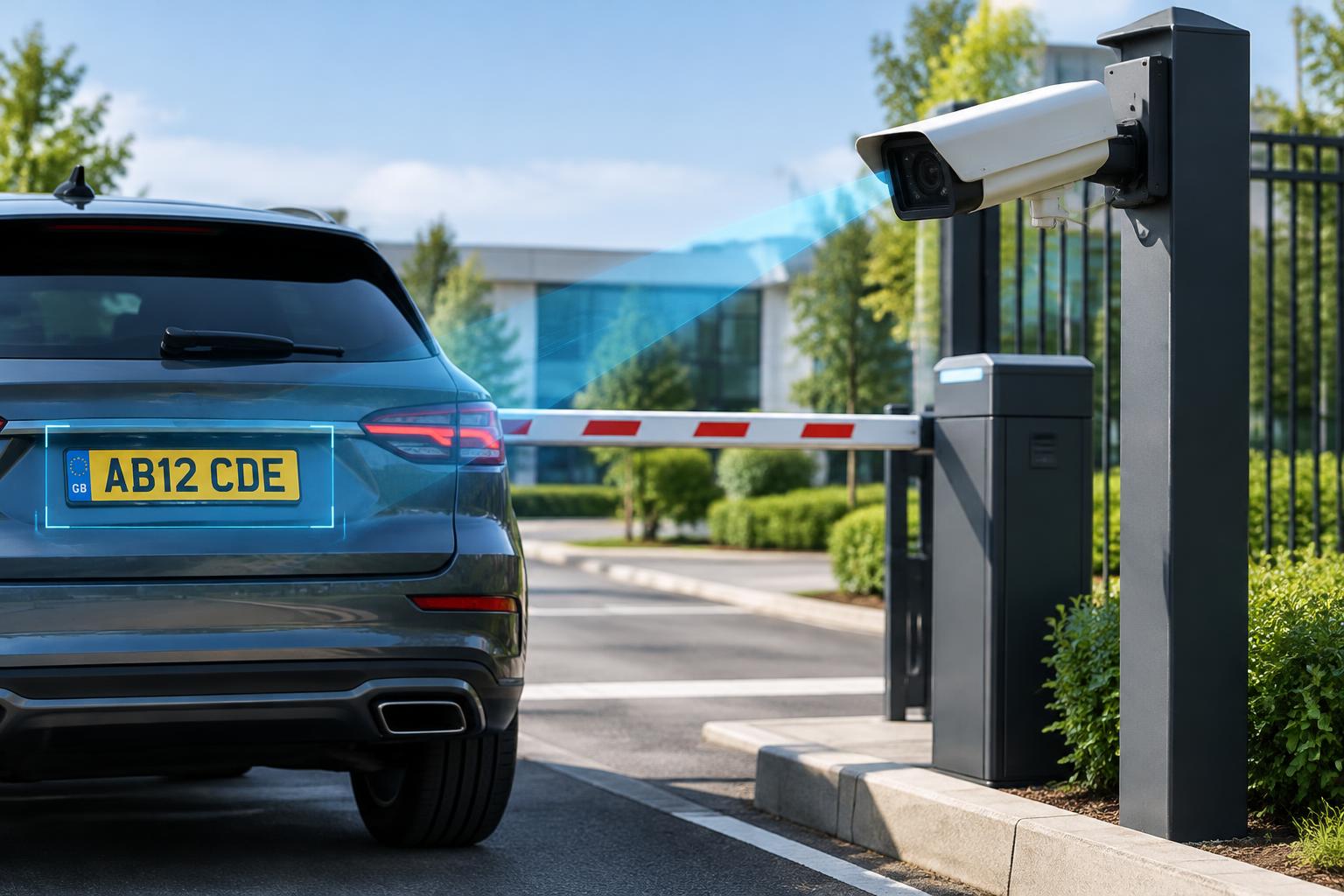
automatic number plate recognition (ANPR) is used for vehicle access control in business parks, campuses, parking garages, and logistics yards. The goal is simple: identify a vehicle fast enough to open a barrier without creating queues. Accuracy depends on lighting, camera geometry, and how decisions are integrated into your security workflow.
This article compares three common ANPR architectures and the practical details that determine recognition rate in the field.
Comparing edge, server, and cloud recognition
Edge based ANPR
Recognition runs on the camera or a nearby edge appliance.
- Good fit for low latency gate opening and limited bandwidth sites
- Often triggers a barrier via relay output or a local API
- Tradeoff is managing firmware updates across many devices
Server based ANPR
Video streams are processed on an on premises server or VM.
- Good fit for multi lane sites that need centralized policy and easier model updates
- Integrates with access control and parking management software via REST API or SDK
- Tradeoff is network dependency and added round trip latency
Cloud assisted ANPR
Frames or events are sent to a cloud service for recognition and decisioning.
- Tradeoff is connectivity, data governance, and compliance requirements
Installation details that matter more than the algorithm
Most “ANPR doesn’t work” tickets are actually imaging problems. For a single-lane entrance, there are a few things worth planning for in advance. You need an LPR-capable camera with IR illumination so it can capture plates at night, mounted on a stable bracket with as little vibration as possible. Provide a PoE network with surge protection and outdoor-rated cabling, and add a trigger that detects the presence of a vehicle, such as an induction loop, radar, or photocell. Finally, connect the barrier through a dry contact relay or a controller input.
Camera placement matters just as much, and a handful of field-proven rules apply here. Keep the plate large enough in the frame and avoid wide-angle overview shots. Reduce skew by mounting the camera as close to perpendicular to the plate plane as possible, and control motion blur with a shutter speed that suits the approach speed. Finally, avoid backlight and reflections by adjusting the angle and adding shading.
Integration patterns for access control and parking
For license plate whitelist access control and parking gate automation with ANPR, the integration should carry more than just the plate string.
A robust event payload usually includes:
- Plate string and confidence score
- Timestamp and lane identifier
- Optional snapshot for audit and dispute handling
- Decision result and reason code
Example workflow for a corporate campus:
- ANPR reads the plate at the entry lane
- The access control system checks a permit list with time windows
- The barrier opens and the event is logged for audit
Commissioning checklist and quick troubleshooting
Commissioning works best as a sequence. Start with a bench test using recorded clips from your target lane, then install and align the camera using live view before locking the mount in place. Next, configure separate exposure profiles for day and night and validate the IR performance. Once the imaging is right, validate your whitelist and blacklist logic, including any visitor permits, and finish by testing barrier timing end to end during peak throughput.
A few quick checks cover the most common issues. If the system returns the wrong characters, verify the region settings and the plate format configuration. Night failures usually point to IR power, reflections, or exposure switching, so check those first. And when recognition misses only now and then, adding or fine-tuning the presence trigger tends to solve it.
When you match the architecture to the site and commission methodically, ANPR becomes a dependable vehicle identification layer rather than a fragile demo.